This bird was photographed as it perched atop a small tree between catching insects for its mate. I captured the bird as it turned and looked into my camera lens. The perspective of the image shows the Scrub Jay as if it were giving me a stern forceful look.
Thursday, March 31, 2011
Pic of the Day
Scrub Jay – Merritt Island National Wildlife Refuge, Florida: Florida host many endangered species. One, the Scrub Jay can be found in scrub oak habitat across Florida in isolated patches. This bird was found along the Scrub Jay Trail at Merritt Island NWR on Cape Canaveral. This bird, along with its mate was not only approachable, but showed no wariness to people. While the female of the pair gathered nest material, the male gathered insects to feed her. When the male caught an insect he would fly to the female and feed her the morsel. The jays carried on their nuptial duties within a few feet of me, as if I were invisible. It is always exciting to see birds behaving naturally only a few feet away.
Nikon D300, Nikkor 500mm f4, digital capture ISO 200, 1/1000 sec. @ f9
Saturday, March 26, 2011
Pic of the Day
American Egret – Gatorland; Orlando, Florida: In January a friend, who lives in Florida told me of the egret rookery at Gatorland. Gatorland is a major tourist attraction who’s major draw is the American Alligator. Yes, Gatorland host thousands of gators. Some of the big ones live in the large natural (looking) ponds.
In nature herons and egrets naturally nest above gator holes, as gators serve to protect the nesting birds from marauding coons, opossum and other predators. The ponds at Gatorland provide the perfect nesting habitat for wading birds, and they come to nest by the hundreds.
This American Egret, in its beautiful nuptial plumes stands over its nest and eggs to preen and adjust feathers before returning to incubation duties. It was in a perfect location as the evening grew on. The sun lighted the egret from behind rendering the delicate aigrette plumes in exquisite detail. It was the delicate aigrette plumes that almost brought the American, and other egrets to near extinction a hundred years ago. The fanciful plumes were in high demand at the turn of the twentieth century as a fashion accessory for women’s hats. Fortunately the Audubon Society foresaw the consequences of the plume trade and dispatched wardens and legislation to halt the destruction of these elegant birds.
Nikon D3, Nikkor 80-200mm f2.8, Digital Capture @ ISO 200, 1/400sec. @ f5.6
For more information on Gatorland, log onto their website at: http://www.gatorland.com
Wednesday, March 23, 2011
Pic of the Day
Dancing Egret – Estero Lagoon; Fort Myers Beach, Florida: Of all the birds feeding in Estero Lagoon it was the Snowy Egrets that put on the most flamboyant show. Their only rival was a lone Reddish Egret as they dance wildly on the hunt. As schools of fish moved through the lagoon the snowy’s were the first to pounce on the evasive prey. As the fish zigzagged through the water, so did the snowy. With out stretched wings for balance this snowy raced through the lagoon striking the water with precision as it plucked its breakfast from the shallows.
Monday, March 21, 2011
Pic of the Day
Nikon D7000, Nikkor 300mm 2.8VR, Digital Capture ISO 200, 1/2,000 sec. @ f4.5
Sunday, March 20, 2011
Pic of the Day
Roseate Spoonbill – Estero Lagoon; Fort Myers Beach, Florida: Among the half dozen Roseate Spoonbills feeding in Estero Lagoon, only one was an adult in breeding plumage. The adult became my target for most of my roseate photos during the shoot. At one point during the feeding frenzy it caught a fish and walked right up to me. The spoonbill came so close I could not take a full frame photo of the bird, I had to settle for a headshot. Fortunately the spoonbill manipulated the fish in its bill as I shot, thus giving me the opportunity to shoot this detailed view of the prey and the spoonbills head. Shooting was hectic with so much activity going on around me. So many birds feeding drew my attention from one activity to another without pause. I did not realize that I had captured the sequence until I reviewed the image-files after downloading. I love surprises like this.
Saturday, March 19, 2011
Pic of the Day
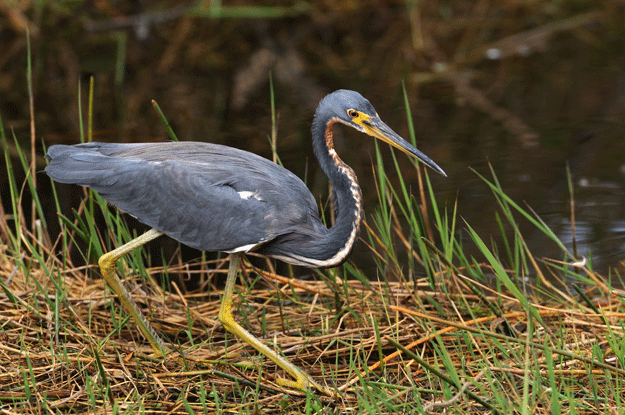
Tri-colored Heron – Estero Lagoon; Fort Myers Beach, Florida: While shooting the feeding frenzy at Estero Lagoon this Tri-colored Heron caught a sheepshead and walked straight toward me. The heron stopped less than 10 feet from me and began to manipulated the fish in many position before sending it down its gullet. This is just one of many shots I took. I shot six frames, which took about a second, then the event was over. So, there was no time to switch cameras to get a full frame shot. With that said I must confess that I do like the close-up image, as it shows much more detail in the prey, and centers on the action itself. I will eventually post more images of this sequence.
Friday, March 18, 2011
Pic of the Day
Snowy Egret – Estero Lagoon; Fort Myers Beach, Florida: After spending a week driving from Fort Desoto in Saint Petersburg south to Sanibel Island, east to Anhinga Trail in the Everglades then North (with stops along the way) to Merritt Island National Refuge, I finally had a couple of mornings of good shooting at Estero Lagoon on by second drive around the state.
Estero Lagoon begins, or ends, depending on your perspective at the Holiday Inn in Fort Myers Beach. I arrived at the lagoon just as the sun was rising and was excited to see about fifty or more waders feeding in the shallow waters of the lagoon.
The morning was perfect. The sea breeze was cool, and the birds were bathed with the warmth of sunrise light. More than a dozen species of birds filled the lagoon and each searching and catching food from the shallows. Spoonbills waded back and forth along the stretch of water in front of my camera while egrets, herons, ibises and shorebirds stalked the waters. Herons, egrets and spoonbills were catching Sheepshead, each about four to six inches in length. Ibis were busy gleaning blue crab and least sandpipers were pulling marine worms from the mud.
Great opportunities were present at Estero Lagoon and I took advantage of as many as possible. While I took many shots that I am very pleased with, so many good shots got away. I was shooting three cameras during the feeding frenzy. I used a Nikon D300 with a 500mm f4 lens mounted on a tripod. I also used a Nikon D7000 with a 300mm f2.8 VR lens hand held. Many of the close up shots were taken with this particular set-up. I also used a Nikon D3 with a Nikkor 80-200mm f2.8 for shots of birds when the came too close for the other lenses. And, the birds did come close. I sometimes moved out of their way instead of them moving out of mine. The birds seemed to pay me no attention. I am not surprised since Fort Myers Beach is a popular tourist destination and is heavily used.
I photographed this Snowy Egret using the D7000 camera and 300mm lens set-up. I saw the snowy catch the fish and then start flying. Using a fast shutter speed and panning with the bird I was able to get a focusing senor on the eye which allowed for a tack sharp image. I shot two frames of the bird as it flew by. This one was sharp, the first image was slightly out of focus. The VR (vibration reduction) feature , fast shutter speed, and ability to hand hold the lens made this image possible.
Thursday, March 17, 2011
Pic of the Day
Green-backed Heron – Ritch Grissom Memorial Wetlands; Viera, Florida: As I drove along the west side of a water impoundment at the Ritch Grissom wetlands in Viera, Florida I notice a photographer busy taking photos. As I drove past I could see that she was taking photos of a Green-backed Heron. The setting was very nice, but not wanting to disturb the photographer I drove on past about 300 feet and parked. My plan was to back-up to the site when the photographer had finished and shoot the heron my self. It was not long until I saw the photographer pack-up, get in her vehicle and leave. But before I could get back to the spot, another photographer pulled-up and began to shoot. Still I waited. After five or ten minutes the second photographer left and I was able to back-up to the spot where the heron stood. Much to my pleasant surprise the green-backed was still there, patiently waiting for a fish to swim by.
In slow motion I pulled all my gear together and slid down the road bank to the waters level and began to shoot. The heron was motionless at it perched atop lily pads that were in various stages of flowering. I shot a few photos as the bird lay in wait. Like lighting it suddenly lunged forward and came up with a minnow. Then it arose from its fishing spot, walked a few feet left, then right, and back left before settling in to a slightly different spot. I photographed the heron from about fifteen minutes as it moved across the lily pads. The heron was most patient with me, and my wait for the opportunity was well worth the time it took.
Nikon D7000, Nikor 500mm f4, Digital Capture ISO 200, 1/1000 secon @ f 9
Monday, March 14, 2011
Pic of the Day
Osprey – Ritch Grissom Memorial Wetlands; Viera, Florida: My first visit to the Viera wetlands was in January of this year. I found it to be a wonderful place to shoot. My return this March found the wetlands green and lush, but fewer birds. Most of the ducks had moved north, and most of the Limpkins and herons seen in January had dispersed to breeding grounds.
Even though there were fewer birds than my January visit, the last evening at the wetlands on this trip was quite productive. Green Heron, Glossy and White Ibis, a few herons and Limpkins were quite active. While driving around the impoundments I saw numerous osprey fishing. I saw this osprey flying into the marsh about 500 feet from where I was standing. It began hovering above the water looking for prey. I quickly jumped into my van and drove toward it. It continued to hover, then fly to a new spot and hover again as it searched for fish. Within a few seconds I was at a good shooting distance. I then jumped out of the van and began shooting while handholding a 300mm vibration reduction lens. Of three shots taken, this one was tack-sharp, and captured the Osprey as it looked down into the water for a fish. I shoot the image while standing on the running board of the van and panning with the Osprey as it flew over. The VR lens and a fast shutter speed gave me the advantage to capture this image.
Labels:
Bird Photography,
Bobby Harrison,
Nikon D7000,
Osprey,
Viera Wetlands
Who's Looking
I would like to welcome viewers from Iran and Finland. Iran and Finland becomes the 80th and 81st countries from which viewers have logged-on to Bobby's Photo Blog. Thanks for logging-on and please visit the blog often. Bobby
Saturday, March 12, 2011
Pic of the Day
It has been a week since my last post. I make my apologies to those of you who check the blog more frequently. As I mentioned in my last post, I have been in Florida shooting for more than a week. While birds have been scattered I have been able to come-up with some shots that I really like. I had two exceptional mornings at Estero Lagoon where I photographed feeding Spoonbills, Tri-colored Herons, Ibises, Snowy and American Egrets. I will post images from Estero once I’m home and have more time to write.
Boat-tailed Grackle, Quiscalus major – Wakodahathee Wetlands; Delray Beach Florida: Earlier this week I was at the Wakodahatchee Weltlands in Delray Beach. Usually this location is inundated with birds, but not this trip. There were a few nesting egrets, cormorants and anhingas, but they are not in what I consider a good shooting location. One species that was abundant is the Boat-tailed Grackle. Breeding season is on for the grackle and this bird was singing his heart out to attract a mate.
What I found most fascinating about the image was the background. I have mentioned in previous post that it is the backgrounds that often make or break the image. I found this complimentary background to be perfect. I chose to do a head shot because the bird was perched on a distracting handrail. The image was shot as the sun was only a half hour from setting. The background was yellow-green foliage. The setting sun intensified by the foliage and struck the grackle at an angle that illuminate the iridescent of its plumage.
Though the number of birds on this trip have been sparse, I have been happy with some of the results.
Nikon D300, Nikor 500mm f4, Digital Capture ISO 200
Saturday, March 5, 2011
Pic of the Day
Hello everyone. It has been some time since I have made a post. I am in Florida shooting, or should I say trying to shoot. I have come south to photograph wadding birds in breeding plumage, but waders have been few and far between. I have not seen any significant number of birds. Even the colonies that I frequent this time of year have only a third of the birds I normally see. I talked with a biologist, and was told that after doing aerial surveys if southwest Florida, no large colonies of heron or wood stork have been found this year. No one seems to know what’s going on this breeding season.
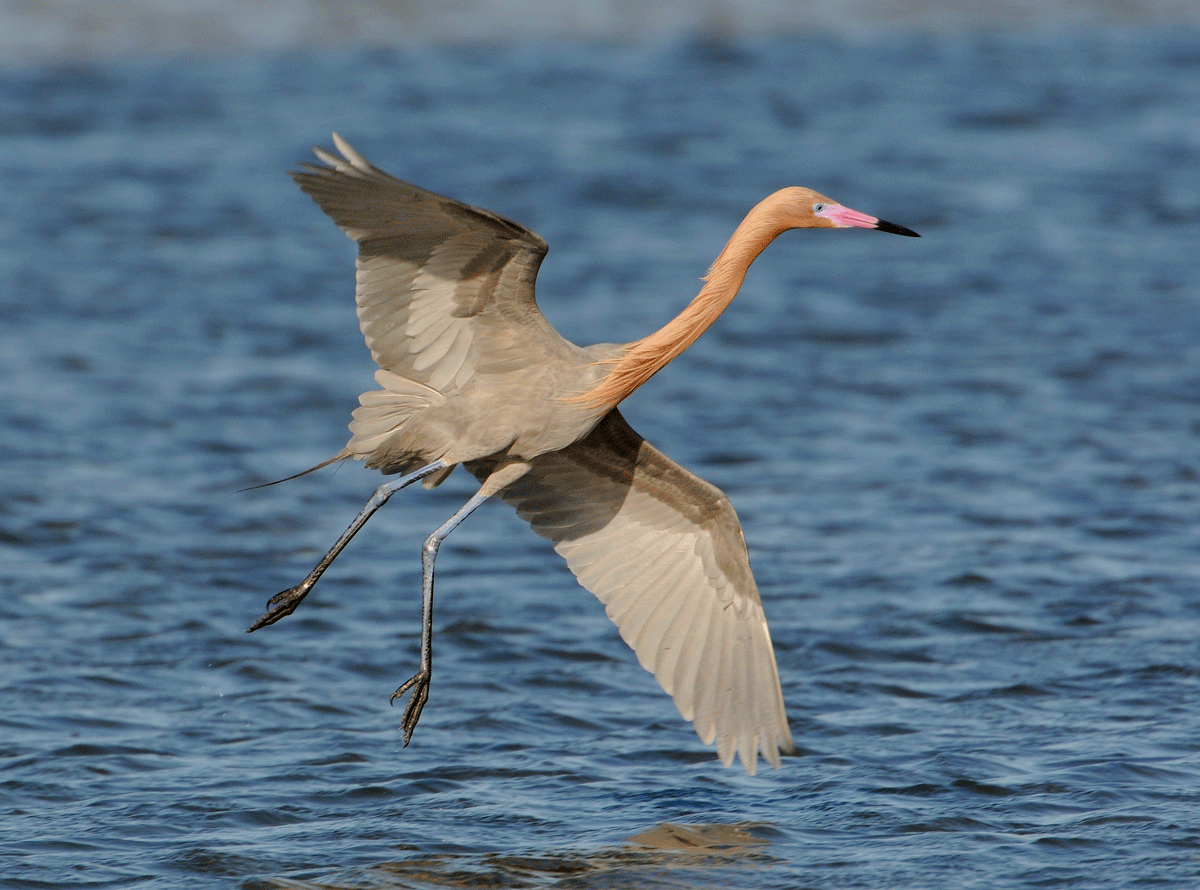
Though the birds have been far and few between I have been able to get some shots. This Reddish Egret was photographed at Fort Desoto Park in St. Petersburg, Florida. There were only a handful of (visible) birds in the area when I made this shot. Fortunately the egret was actively feeding which allowed me to get this in-flight shot.
Sunday, February 27, 2011
7th Anniversary of Ivory-billed Woodpecker Sighting
![]() |
Some Ivory-billed Woodpecker sighting location in
Bayou Deview during 2004-2005 search season.
Sighting mention below are indicated on this map
|
Over the next year I had an additional 5 sightings. The very next day, February 28th , I saw an Ivory bill flying southwest, about a half mile south of the first sighting of the previous day. My third sighting came on May 5th, the fourth on June 9th, and a 5th sighting came of September 4th. All three of these sighting were within 525 feet of each other. My 6th sighting occurred 3/4th of a mile north of Arkansas Hwy 17 on January 22, 2005. This sighting was special, for I saw two birds flying together. This was the first time that I knew there was more than one Ivory-bill in the Bayou Deview search area. Based on the number of sighting that were occurring on Bayou Deview during early 2004, I believed that at least one or more Ivory-bills were making feeding forays into Bayou Deview about once every two weeks.
My January 22nd sighting was the last time I positively identified Ivory-bills on Bayou Deview. The sighting Tim and I had on February 27th 2004 was four years after a major ice storm had hit the area. The ice storm was severe and created good feeding habitat for Ivory-bills. Perhaps that is why there were Ivory-bills in the area when Tim and I arrived in February 2004.
To read more about the February 27th 2004 sighting follow this link:
Saturday, February 26, 2011
Who's Looking
Welcome viewers from Sri Lanka and Lebanon. Sri Lanka and Lebanon are the 78th and 79th country from which viewers have logged onto Bobby's Photo Blog. I hope you have enjoyed the blog and will comeback often. BobbyL
Thursday, February 24, 2011
Who's Looking
Viewers from Argentina have logged onto Bobby's Photo Blog. Argentina becomes the 77th country from which viewers have logged on. Thank you for checking out the blog and please come back often. Bobby
Saturday, February 19, 2011
Pic of the Day
Alaska Range from Denali Highway, Alaska: The abundance of wildlife, snowcapped mountains and shoreline as always made Alaska one of my favorite shooting destinations. This photo of the Alaska Range was taken on my favorite stretch of road. The Denali Highway connects Cantwell (which is just south of Denali National Park), and Paxson Junction on the Richardson Highway. The 150+ mile road crosses tundra and taiga, follows riverbeds and crosses mountain passes revealing the stunning beauty of wild Alaska. From various points on the highway great views of Denali itself is possible. Denali, the tallest mountain in North America is the second highest peak in the world. The highway also provides great views of numerous glaciers. On my first trip across the Denali Highway I only saw two other vehicles. However the road is highly traveled today, but is still a great way to see the great Alaskan wilderness.
Labels:
Alaska,
Alaska Range,
Bird Photography,
Bobby Harrison,
Denali,
Denali Highway,
Kodachrome,
Mountains,
Nikon,
Nikon F3
Friday, February 18, 2011
Pic of the Day
Snow Geese – Bosque del Apache National Wildlife Refuge, New Mexico: Bosque is world renowned for its abundance of over wintering Snow Geese and Sandhill Cranes. More than 35,000 Snow Geese invade the refuge by early October and remain until March when they begin their journey back north. These two geese were flying to one of the many water impoundments where they will join other members of the flock to roost overnight. To make this image I used a 300mm lens mounted on a handmade gunstock. An electronic cable release mounted as a trigger operated the camera’s auto focus and shutter release. An auto focus lens and dynamic focus was essential to keep the birds in focus as I panned with them during their fly-by. A rapid 8 frames per-second provide a frame with the wings in just the right position.
Thursday, February 17, 2011
Who's Looking
Viewers from Puerto Rico have logged on to Bobby's Photo Blog. Puerto Rico is the 76th country from which viewers have logged-on. Welcome to the blog and please visit often. Bobby
Tuesday, February 15, 2011
Pic of the Day
Loggerhead Shrike – Bosque del Apache National Wildlife Refuge, New Mexico: I was at Bosque to photograph Snow Geese and Sandhill Cranes, birds that winter at the refuge by the tens of thousands and make Bosque so famous.
While making an early morning run to photograph geese and cranes I came across this Loggerhead Shrike hunting along the roadside. Shrikes, also known as “Butcher Birds,” catch insects and mice and often impale them on thorns and barbed wire before tearing them apart with their hooked bill.
I approached this bird using my van as a blind. With my window down and camera on a window mount I turned the engine off, and coasted to the shrike. It was lit from the side and facing into the sun, defiantly not flattering light. The side of the shrike facing the camera was in the shadows and virtually a silhouette. However, the background was perfect. It was clean and did not competing with the subject. But good fortune turned in my favor. Instead of leaping into flight, the bird turned its head and looked over its back. The strong side lighting illuminated the front of the shrike and ignited a catch light in its eye, creating a strong dynamic image of this “Butcher bird.” Nikon F5, Nikkor 500mm f4 with 1.4 teleconverter, Kodachrome 64
Sunday, February 13, 2011
Whintey's Blog
My Daughter, Whitney, has updated her blog. She has some wonderful photos of a Weimaraner Dog. Please take a look. I find the photos to be quite engaging. Click here to go to Whitney's blog;
whitneyrobison.blogspot.com
Labels:
Weimaraner,
Whitney Robison,
Whitney's Blog
Saturday, February 12, 2011
Recently Published Work
Friday, February 11, 2011
Pic of the day
![]() |
| Arizona Woodpecker, Photo 1 |
Arizona Woodpecker – Madera Canyon, Arizona: I photographed this Arizona Woodpecker near the Santa Rita Lodge in southeast Arizona. If you have an older field guide the bird may be identified as a Strickland’s Woodpecker. The 42nd Supplement of the American Ornithologists Union split the Strickland’s into two groups placing the Arizona Woodpecker at the northern end of the birds range and the Strickland’s at the southern end of the range. The Arizona/Stickland’s Woodpecker range is from southeast Arizona and southwest New Mexico, south through central Mexico. The bird was originally named for British scientist Hugh Edwin Strickland (1811-1853).
These two images show the woodpecker at rest (photo 1), and drumming (photo 2). The drumming photo shows the head in motion as it reverberates against the tree. To drum, woodpeckers typically strikes its target around 20 times per second. I used a slow shutter speed to take both photos. As I made the exposure for image 2 the woodpeckers head was still, but during the exposure the woodpecker started drumming, thus exposing the blurred motion over the still image of the woodpeckers head. Sometimes you just get lucky. To learn more about the mechanics of woodpecker drumming, go to: http://www.arn.org/blogs/index.php/literature/2011/02/10/woodpecker_drumming_inspires_shock_absorAlso see May 19 post of an Arizona Woodpecker.
Nikon D200, Nikkor 500mm f4 with 1.4 Teleconverter
Tuesday, February 8, 2011
Speaking in Louisville
![]() |
| Bobby speaking about birds at Louisville Adventist Academy. Photo by: Whitney Robison |
My daughter, who teaches 5th and 6th grade at Louisville Adventist Academy in Louisville, Kentucky has been studying birds with her students over the last few weeks. She invited me to the school to show bird photos and speak on birds and bird watching. I gladly excepted and made the trip last week. I had a great time and the kids were exceptionally courteous. During the presentation they were quite and seemed genuinely interested in what I was saying. When I finished the program I took questions, and the questions were quite good. I was very impressed with the students. The students also made a card for me with an ivory-billed woodpecker on the front. Each student that attended the program signed the card……WHAT A TREAT! Who knows what future ornithologist might spring from that group!
Who's Looking
Belize has just become the 75th country from which viewers have logged on to Bobby's Photo Blog. Welcome to the blog, and please log on often!
Monday, February 7, 2011
Pic of the Day
Glassware – Studio Photography: I have been a wildlife and nature photographer for more than thirty-six years, and those who know me know that I am most passionate about birds. However, my specialty in my undergraduate degree was studio photography, specifically portraits. Before I started teaching full time, 19 years ago, I operated a studio and made part of my living shooting portraits and products.
I spend so much time shooting birds these days that I do not get into the studio very often. So, when I teach a studio class it gives me the opportunity to do demonstrations that allow me explore subjects and create images. This semester I am teaching a studio photography class. The first few assignment introduce my students to lighting and its effects through photographing simple subjects. As the semester progress lighting and subject matter become more complex.
I shot this image as a demonstration on how to illuminate a simple object with a single light source. The image is a close-up of a glass vase. A single light shinning through seamless white paper illuminates the vase, creating a black line that divides the image with a graceful curve. The simple object becomes a study in texture, form, shape, and tone; the essence of studio lighting.
My students have already started shooting the assignments and are producing some very creative works. I will share some of their work on this blog in future post.
Nikon D3, Nikkor 80-200 f4, Digital Capture ISO 200, 1/200 sec. @ f22
Labels:
Bobby Harrison,
D3,
Glass,
Glassware,
lighting,
Nikon,
Nikon D3,
Studio lighting,
Studio Photography
Sunday, February 6, 2011
Pic of the Day
Mountain Bluebird – Yellowstone National Park, Wyoming: I was photographing Ruddy Duck when a fellow photographer asked if I had photographed the Mountain Bluebird nest. I said no and asked where it was. Like all wildlife photographers he was willing to share his find with fellow photographers and told me exactly where to go. After shooting the ducks I headed for the bluebird nest. Sure enough, the bluebird nest was just where it was supposed to be, and so where dozens of birder’s, photographers and curiosity seekers.
With all the people lined-up to see the activity at the nest it would have been difficult to shoot. The birds also seemed somewhat wary of all the commotion from the spectators. I waited for about half and hour or so and until the horde of people moved on. I drove up the road to a nearby picnic area and parked my van. I gathered my equipment, dawned camo clothing and covers and walked back to the nest site.
The tree that the nest was in was about 60 feet from the road. I had to use a 2X extender to obtain a reasonable size image in frame. Fortunately the sun was shinning bright and that allowed me to use a fast shutter speed. Once at the nest site I found myself to be the lone visitor. Because the nest tree was in a ravine, it was position below eye level. I quickly slide down the embankment about six feet making myself eye level with the nest, and invisible to passerby on the road above. I covered myself and the camera with camo cloth and observed and photographed the birds while all alone. With each car that passed I expected someone to stop and discover me, but it never happened. I was able to photograph the birds going about there afternoons activity without them even noticing that I was nearby. This shot was taken right after the female fed her nestling and perched on a nearby limb to preen, stretch and scratch an itch.
To see another image of this bluebird go to the “On the Road” post for June 17, 2010.
Sunday, January 30, 2011
Recently Published Work
Thursday, January 27, 2011
Who's Looking
I would like to welcomes new viewers from Georgia. Georgia is the 74th country from which readers have log-on to Bobby's Photo Blog. Welcome to the blog and please visit often.
Tuesday, January 25, 2011
Pic of the Day
Earlier this month I was at the Circle B and found the birdlife to be quite impressive. Hundreds of White Pelicans and Woodstorks crowded the trees that stand in the water impoundments. Fulvous Tree Ducks, other waterfowl and wading birds were plentiful. A specialty among the waders was the Limpkin. Limpkins were quite abundant, perhaps the most limpkins I have seen in one place outside of the Ritch Grissom Wetlands at Veria, Florida.
While I was photographing a group of Limpkins along the shoreline of one of the water impoundments this Limpkin flew by. I could not believe my good fortune. With my camera already set in autofocus mode I quickly swung the lens toward the flying bird. The autofocus sensor locked onto the head of the bird and snapped into focus as I shot a series of images. Out of the six images shot, this one captured the wings in just the right position with a body posture that is indicative of this species in flight. Of course, part of luck is being in the right place at the right time, and staying observant to what is happening around you. Nikon D300, Nikkor 500mm f4, Digital Capture ISO 200, 1/400 sec. @ f7.1
Saturday, January 22, 2011
Book Review
Who's Looking
Viewers from Algeria have logged on to Bobby's Photo Blog. Algeria is the 73rd country from which viewers have logged on. Welome to the blog, and come back Often!
Friday, January 21, 2011
Whitney's Photo Blog
![]() |
| Branden and Whitney in Canebrake taking photos. |
Over the last year my daughter (Whitney) has taken an interest in photography. On a recent trip to Cincinnati she took photos at an arboretum. Most recently, on one of her visits home she wanted to go somewhere interesting to take photos. I took her and Brandon (her husband) to the canebrake on Keel Hollow Road to shoot. She and Brandon really enjoyed walking around in the canebrake, and shooting. She also took some very nice photos.
She now has a blog to show her work. I am impressed. She has a good eye and is mastering the technical side of the art as well. She made some great images both in Cincinnati and at the canebrake. You can see her blog at, www.whitneyrobison.blogspot.com. I also have a link to her blog in “Bobby's Favorite Blogs” on this page.
As you may have already guessed, I am a proud father. She certainly has the talents to become an excellent photographer.
Thursday, January 20, 2011
Pic of the Day
Sanderling – Blind Pass; Captiva, Florida: This is another shot taken with the Frisbee/ball head combination at Blind Pass. I shot this image a few minutes after shooting the turnstone in the previous post. I do love the low shooting angle that the Frisbee/ball head combination provides. The image was shot at a wide aperture of f4, The wide aperture provides a shallow depth of field isolating the Sanderling against other birds in the flock. Shallow depth of field, or selected focus is an essential composition technique when using long lenses.
Tuesday, January 18, 2011
Pic of the Day
Ruddy Turnstone – Blind Pass; Captiva, Florida: On January 5th I posted an image of a Snowy Egret that I took using a long lens mouned on a ball head attached to a Frisbee. I mentioned in the post that I had gotten the idea from a recent book I had read, but could not remember which book at the time of the post. The book was Captured: Lessons from Behind the Lens of a Legendary Wildlife Photographer, by Moose Peterson. The book, by the way is well written and worth reading.
Using the Frisbee mounted ball head I went to Blind Pass on Captiva Island to shoot shorebirds and terns. The set-up worked well as I crawled across the beach. The Frisbee allowed me to easily slide the camera forward and backwards as I move over the sand. As I mentioned in the January 5th post, the Frisbee is very flexible and has a tendency to cause the camera and lens to awkwardly tilt left, right and forward. I have since mounted the ball head on a pie pan to see if it will work better than the Frisbee. Once I have tried the new outfit, I’ll let you know how it works.
This Ruddy Turnstone was taken with my lens mounted on the ball head/Frisbee combination. Turnstones were numerous on the beach at Blind Pass and were feeding on Pen Shells that had washed ashore during a recent storm. The lens mounted on the Frisbee/ball head combination made it easy to slide toward the turnstones as they ran up and down the beach, and backward as the bird ran toward me. I often found myself backing up rather than moving toward the birds. It appeared to me that by laying on the beach the turnstones did not see me as a threat, and pretty much ignored me.
Note: To order Captured, by Moose Peterson go to: http://www.amazon.com/gp/product/0321720598/ref=pd_lpo_k2_dp_sr_1?pf_rd_p=486539851&pf_rd_s=lpo-top-stripe-1&pf_rd_t=201&pf_rd_i=1579904823&pf_rd_m=ATVPDKIKX0DER&pf_rd_r=1VG509Z91QAZBP5HT8WY
Monday, January 17, 2011
Pic of the Day
![]() |
| Tri-colored Heron |
Nikon D300, Nikkor 500mm f4 (both images)
Sunday, January 16, 2011
Pic of the Day
Green Heron – Anhinga Trail; Everglades National Park, Florida: Anhinga Trail is one of the most reliable places on the planet to find birds to photograph. During the dry season from January to April, a plethora of birds to watch and photograph can be found on the .8 tenths mile trail.
I do not remember a time that I have been to Anhinga Trail and not seen green herons perched on a rock or low hanging branch snatching minnows from the slough. This Green Heron was photographed in the late evening light as the sun was setting. While the orange light of the setting sun barely illuminated the heron, it revealed detailed, intricate patterns in the heron’s feathers that are often overlooked by the casual observer.
Pic of the Day
![]() |
| Crescent Moon, Shadow side 1/2 second, f4 |
![]() |
| Crescent Moon 1/400th second, f4.5 |
Crescent Moon – January 6, 2011: As I drove north out of Florida a brilliant crescent moon hung above the western horizon. The sky was a deep azure blue and quickly fading to black. The shadow side of the moon, lit by light reflecting from Earth was quite bright in the cold, crisp winter air. The conditions were perfect for photography.
As I drove across the Florida/Georgia state line I pulled into the Georgia welcome station, set-up my camera and lens on a tripod and began shooting. Knowing the exposure for the sunlit side of the moon is 1/125th of a second at f8, I set an equivalent exposure of 1/400th of a second at f4.5. The faster shutter speed helped reduce blurriness caused by camera/lens vibration.
After shooting for the detail in the crescent moon, I took another image exposing for the shadow side of the moon. I did a number of exposure variations and achieved a reasonably sharp image of the shadow side at 1/2 second at f4. The sunlit crescent is highly overexposed but craters and mares are readily visible on the shadow side.
Thursday, January 13, 2011
Pic of the Day
Great Egret among Snowies –Merritt Island NWR, Florida: I was driving through what looked to be a lifeless Merritt Island NWR, then I saw this scene above. Water in the marsh was extremely low, and was restricted to small pools scattered along the wildlife drive. Such pools become havens for fish as water in the marsh shrinks. Birds quickly become aware of the concentrations and descend on the pools with a vengeance.
As soon as I saw the scene I brought my van parallel to the pond to access the little feeding frenzy that was taking place. The birds were so intent on their feeding activity they paid me little notice. I was immediately struck by the graphic nature of the scene, “S” curved necks, and all white birds. But, It was not so much the birds themselves that made the image, as it was their reflections. As I shot photos of the egrets dancing around their fishing hole I was reminded again that nature is always full of surprises, and I loved this surprise. Nikon D300, Nikkor 24-85mm Zoom, Digital Capture ISO 200, 125 Sec. @ f8
Tuesday, January 11, 2011
Pic of the Day
Ringed-necked Duck – Ritch Grissom Memorial Wetlands; Viera, Florida: Ringed-necked ducks have always been one of my favorite duck species. The male with its gray flanks set against a purple black back and breast, accented with a white flank strips and ringed bill is visually stunning. Though the female wears a dress of brown feathers, her white-eye and bill ring gives her a subtle beauty that makes her the perfect complement to the male.
In the wild it is usually difficult to get close to ducks, but at protected sanctuaries and preserves they can be very approachable. As I drove the auto trail at the Ritch Grissom wetlands I spotted these ring-necks feeding in the shallows close to the road.
I pulled the van past the ducks and parked, got out and stealthily slid down to the waters edge about a hundred feet from them. With my camera already on a tripod I sat down on the ground and hoped that the ducks would move toward me as they fed.
While waiting for the ducks to swim toward me a Limpkin landed in the reeds right in front of me and began plucking apple snails from the water. I could not believe my good fortune as the Limpkin presented me with a great photo opportunity.
While I was shooting the Limpkin, another wildlife watcher stopped to look at the Ring-necks. In doing so the ducks began to swim toward me as if I were not even there. As they came within range I began to shoot. As I began shooting the sun broke through clouds, bathing the ducks in the warm glowing light of a retiring sun. As I have said so many times in previous post, I love it when everything comes together. That evening I photographed these ring-necked ducks, it could not have been more perfect.
Nikon D300, Nikkor 500mm f4, Digital Capture ISO 200, 1/400 sec. @ f9
Monday, January 10, 2011
Pic of the Day
White Ibis –
A. Max Brewer Memorial Parkway; Titusville, Florida: This
trip was certainly the year for photographing ibis. Ibis seemed to be
everywhere and were very photographable. This ibis was photographed on
the causeway that leads from Titusville to Cape Canaveral just before entering
the Merritt Island National Wildlife Refuge. I stopped along the causeway
to photograph gulls, but the sky was overcast and the images looked very
dull. Soon, the sun began to break through the clouds and the birds on
the causeway came alive. All of a sudden, birds began to appear from all
directions to feed in the shallows of the Indian River.
As I shot images of gulls, an ibis flew onto the scene and began searching for prey. It was not long until it was pulling horseshoe crabs out of the water. The antics of the ibis were most interesting. With each catch the ibis would toss the crab into the air, catch it with its beak, then crunch down breaking the crabs shell. The tossing and crunching continued for about forty-five seconds per crab. Once broken and cracked to the ibis’ satisfaction, the crab went down its gullet. The gulls that were ever present stayed close to the ibis and continually tried to snatch its catch…..to no avail.
Subscribe to:
Posts (Atom)