Showing posts with label Wildbird. Show all posts

Monday, July 16, 2012

Pic of the Day


     Kirtland’s Warbler -- Grayling, Michigan:  When I was at Magee Marsh in May I saw and photographed a Kirtland’s Warbler.  This was not the first time I had seen the bird; back in 1979 my wife and I drove to Grayling to see the Kirkland’s on its nesting grounds.  We saw many birds, especially males singing on their territory.  The birds were easy to see, but a little too far away for good photographs. 
     Over the years I have made a number of trips to Grayling and Mio to photograph the Kirkland’s; spending many mornings on the warbler tours trying to get good images.  With each trip I saw many birds, but was never happy with the images.  Birds were always too far away for good images.
     On June 3, I was on another tour.  There were three of us, plus the guide the morning started out great.  No sooner had we hit the trail into the jack pines a male Kirtland’s pop-up on a limb and began sing.  The day was young and the sun was still behind the clouds on the horizon.  The light was dull, but I shot a few images, I wanted more….what photographer doesn’t!
     As we walked along the path Kirtland’s were singing all around us, but they are all to distance photograph.  We walked half a mile, and the sun had broken through the clouds, but no luck with any birds close enough for photography.
     As we headed back our guide stopped where we had heard a male singing earlier.  She said, “we should wait here a while, this birds territory is on both sides of the tail.”  As we stood listening to the bird, we glimpsed a female moving through the lower level of the jack pines.  A moment later the male followed in her path, then climbed to the top of a small jack pine and began singing.  Within minutes the male flew past, almost hitting me, then it landed in a leafless willow a dozen feet in front of me.  Alighting in the willow the Kirtland’s climbed upward and began singing its territorial song.  In full sunlight the bird put on quite a show as I shot frame after frame.  The turn of events was very pleasing!
    As I continued my walk out of the jack pines two more males put on a show.  I posted those images soon after they were taken.  Click here to see the previous Kirtland’s post: http://bobbyharrison.blogspot.com/search?q=Kirtland%27s+Warbler

Nikon D7000, Nikkor 500mm f4, 1/2,000sec. @ f5 

Thursday, July 5, 2012

Pic of the Day


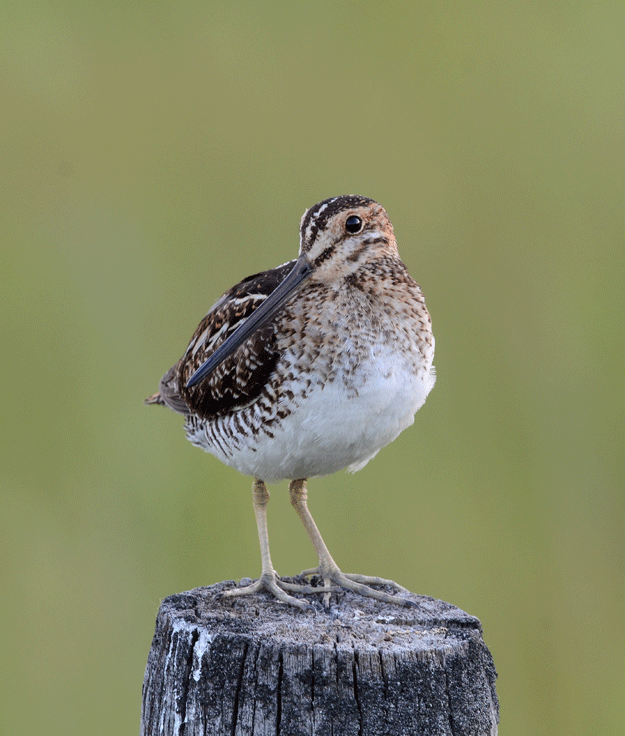
     Wilson's Snipe – Lee Metcalf National Wildlife Refuge, Montana:  When I arrived at the Lee Metcalf NWR just outside of Stevensville, Montana there was only a half hour of light before the sun would set behind the Bitterroot Mountains.  I immediately went about finding a subject to shoot with those last few minutes of light, but had little success.  During that time I scoped the area and found spots I need to be the following morning for the best light.
     As I drove out of the refuge onto a county access road I saw this Wilson's snipe perched atop a fence post.  I have often seen snipe, but usually at the edge of muddy wetland that usually provide the worst of shooting condition.  They are so well camouflaged that once found and photographed they are hard to seen in the image.  They are also very shy and easily spooked, making photography even more difficult. 
     As I passed this snipe I slowed the van and a cautiously backed up within a hundred feet of the bird.  The sun had set, and I knew I had to work from a tripod if I wanted to obtain sharp images.  With nothing to lose, thinking that the bird would fly as soon as it saw me, I got out of the van in plain view and, set-up my camera gear.  Still thinking that all was for naught, I began a slow approach toward the snipe.  To my great joy the snipe seemed unconcerned with me.  At thirty feet I began to shoot images and slowly worked to about eighteen to twenty feet.  With the sun far set, I had to shoot very slow shutter speeds, but at the same time I wanted to maintain a sharp image from the front of the fence post the snip was perched through the bird itself.  Fortunately the bird did not move, except to turn its head every now and then, which gave me the opportunity to use the slow shutter speed and maintain depth-of-field.
     As I continued to shoot, the only sound heard was the hum of my shutter snapping.  Then in the silence between the shutter snaps I heard a faint buzzing.  The buzzing osculated as if it was moving closer, then farther away.  Immediately I recognized the sound and why my snipe was so patient with me.  Her focus was not on me, but on a males buzzing nuptial flight display occurring above our heads.  After a few more shots, I backed off and let the dance continue.  I was a very happy camper!
    I had thought I had lost the chance to shoot after the sun sat that evening, but as always, the unexpected delighted me with some wonderful images.

Top Image:  Nikon D7000, Nikkor 500mm f4, 1/30 sec. @ f9, Tripod
Middle Image:  Nikon D7000, Nikkor 500mm f4, 1/30 sec. @ f9, Tripod
Bottom Image:  Nikon D7000, Nikkor 500mm f4, 1/30 sec. @ f9, Tripod

Saturday, June 30, 2012

Pic of the Day


     Western Grebe; Aechmophorus occidentalis -- Bear River Migratory Bird Refuge; Brigham, Utah:  Always expect the unexpected.  This is a lesson I have learned over my many years of photographing birds.  While I was at the Bear River Migratory Bird Refuge, I had a fantastic time photographing Western and Clarke’s Grebes.  The grebes were always in the hustle and bustle of life.  There were birds with chicks, feeding chicks and birds chasing off intruders getting too close to chicks.  Then, there were those that were fishing.  Lots of grebes were fishing, and most were catching small fry that were no more than an inch or inch and half long.   As soon as an adult would surface with a fish, it would feed it to its’ chick.  This was good and I got find photos of adults feeding chicks, but I want a grebe with a bigger fish. 
     Just when I was about to give up the idea of a grebe with a bigger fish, the unexpected happened.  When I came across this fellow fishing, he surfacing a couple of times a minute with small fish like all the others.  After watching for a few minutes he surfaced, much to my delight, with a catfish that was about 7-8 inches long. 
     Instead of catching the catfish between its beak, the grebe speared the catfish with its lower mandible.  With its sharp spiny back and side fins catfish must be tough to get down.  After about twenty minutes of thrashing the catfish against the water, diving and resurfacing with the fish the grebe eventually got his catch down. 

Nikon D7000, Nikkor 500mm f4 with 1.4 teleconvert, Exposure 1/1,600 Sec @ f6.3

Monday, May 28, 2012

Pic of the Day


     Common Yellowthroat Warbler – Magee Marsh, Ohio:  Another one of the many warblers I saw along the boardwalk at Magee Marsh.  As mentioned in a previous post, the birds at Magee are fearless, often moving so close that I had to back-up to get a shot.  Although this image is cropped, the bird was within the minimum focus distance of my lens requiring the use of extension tubes to get this close-up. 
I love shooting the warblers, and I am already looking forward to next spring!

Nikon D7000, Nikkor 300mm f2.8VR - with extension tubes, 1/80sec. @ f5.6

Sunday, May 27, 2012

Pic of the Day


     Tree Swallow – Ottawa National Wildlife Refuge, Ohio:  Right next door to Magee Marsh is Ottawa NWR, and it was there that I found this handsome tree swallow.  This bird was shot at one of my favorite spots in Ottawa, a small bush about fifteen feet in front of a tree swallow house and it provides the perfect perches for the birds (click here for May 22, 2011 post), and always a bustle of activity.
     When I arrived this year the tree swallows had not started nesting, but were looking for sites.  This fellow had picked out my favorite box, but a pair of house sparrows had picked the same box.  There was an ensuing feud between the pairs of birds, and from my observation it looked as if the swallows were ahead.  
     Between the bouts of chasing the sparrows from the box the male alighted on this branch, starred directly into the lens to provide the captivating eye contact between the bird and viewer that I love so much.  The clean background didn't hurt either.

Nikon D7000, Nikkor 500mm f4 VR with 1.4 extender, 1/200 sec. @ f7.1, lens on beanbag resting on auto door window base.

Tuesday, May 22, 2012

Pic of the Day


     Black-capped Chickadee – Magee Marsh:  One of the great things about Magee Marsh is the fearlessness of the birds.  They go about their daily activities unconcerned with human presences on and about the boardwalk. 
     This Black-capped Chickadee was nesting in a cavity of a limb that hung over the boardwalk and about six feet high.  The nest was in the perfect place for photography.  Beginning in the early morning the male would bring its mate food while she remained on the nest.  This shot was made just after a food delivery.
     Dozens of people gathered around the nest  to watch the male ferry food to the female.  On occasion she would fly-out of the nest, alight on a limb and allow the male to feed her, then she would dart back into the nest with lighting speed. 
     I used a slower shutter speed in order to balance the flash that illuminated the bird with the background.  This technique was best achieved when sunlight struck the background foliage.  Hope you enjoy the image!

Nikon D7000, Nikkor 500mm f4, 1/80sec. @ f-11, Fill Flash

Friday, May 18, 2012

Pic of the Day

     Magnolia Warbler – Magee Marsh, Ohio:  Another of the many magnolia warblers that I saw at Magee.  Though not singing his heart out as the male in the post for May 13, this little fellow struck a handsome pose before flitting off into the brush.


Nikon D7000, Nikkor 500mm f4, 1/250 @ f4, Fill Flash

Sunday, May 13, 2012

Recently Published Work

    My latest Birding Escape in Living Bird magazine (the flagship publication of the Cornell Lab of Ornithology) is out.  The article is on Audubon National Wildlife Refuge in North Dakota.  You can check out Living Bird and subscribe at:  http://www.allaboutbirds.org/page.aspx?pid=1085

Friday, August 12, 2011

Recently Published Work

     I just returned from Florida, where I spent a few days visiting some of my favorite sites and family, (see the August 8 post).  When I returned, the summer issue of Creation Illustrated was in the mail.  This issue holds my latest  "A Lens on Creation" article.  This issues article is on Machias Seal Island and its spectacular seabirds.
     If you are intrested in subscribing to Creation Illustrated follow this link: http://www.creationillustrated.com

Monday, August 8, 2011

Pic of the Day


     Thunderstorm over Fort Myers Beach from Sanibel Island Causeway -- Florida:   Summertime in Florida is a great time and place to photograph thunderstorms. I shot this image from one of the spoil islands on the causeway to Sanibel Island.  The view from the spoil island is looking northeast over San Carlos Bay.  The image was originally shot in color and converted to black & white in photoshop.

Nikon D3, Nikkor 24-85 zoom-set to 24mm, 1/500sec. @ f10, Handheld

Sunday, July 31, 2011

Pic of the Day


     Black-billed Magpie – Moraine Campground; Rocky Mountain National Park, Colorado:  I have many photos of Black-billed Magpie.  But, I was not happy with any of them.  While I was photographing wildflowers this Magpie flew to a nearby rock and landed.  I quickly gave up the flowers and began stalking the magpie.  I took photos at a distance just incase the bird flew, but it remained on the rocks and let me make a close approach.
     As I shot I became quite humored by the Magpies antics.  As I shot the Magpie would stretch its head under its body, and between its legs.  It appeared to be picking something from it feathers, perhaps parasites.  Whatever the reason, the behavior made for interesting photos.
     Oh, by the way, I am happy with these Magpie images.  Clear, unobstructed backgrounds and behavior always make the image more interesting.

Nikon D7000, Nikkor 500mm f4 VRII, 1/160 sec. @ f8, Gitzo Tripod with Arca Swiss B2 ball head 

Saturday, July 30, 2011

Pic of the Day

Razor-billed Auk, Image A
Razor-billed Auk, Image B
       Razor-billed Auk – Les Iles au Perroquets; Mingan Archipelago, Quebec:  These images are just two of the many Razorbills I photographed at Les Iles au Perrosquets on the north shore of the Gulf of Saint Lawrence.  Just before landing, Razorbills, like all alcids, move their legs from a streamline position under their body (Image B), and bring them forward as they prepare to land on the islands cliff face (Image A).  Most of the Razorbills photographs I shot were of birds with legs and feet in a streamline position.  I was fortunate to get a shot just as the Razorbill was beginning its upward swing and bring its legs forward.  Luckily, I snapped this image as the Razorbill moved into an angle that placed a highlight in the eye as well.

Nikon D300, Nikkor 300mm 2.8 VR, 1/2000 sec. @ f7.1, Handheld using custom made gunstock mount

Friday, July 29, 2011

Who's Looking

     Welcome viewers from Morocco!  You have made Morocco the 90th country from which viewers have logged on to Bobby’s Photo Blog.  I hope you enjoyed the blog and will forward the URL to your friends.  I update the blog often so please come back…..Bobby

Who's Looking

     Viewers from Macau and the Isle of Man have made these two countries the 88th and 89th countires (respectively) from which viewers have logged onto Bobby’s Photo Blog.  Welcome to the blog.  I hope you enjoyed the images and if so, please log on often. 
     For all of you who log on, please let your friends know about the blog as well.  Just copy the URL and pass it on.  Thanks for your help in getting the word out about the blog……Bobby

Wednesday, July 27, 2011

Pic of the Day


     Atlantic Puffin – Machias Seal Island, Maine:  While I was able to get flight shots of Puffins and Razorbills on Les Iles au Perroquets, in the Mingan Archipelago, I had to travel to Machias Seal Island to get close-ups. 
    I tired to get to the island out of Cutler, Maine.  However,  the one boat that travels to Machias Seal was booked for the entire month of July.  Fortunately I was able to catch a ride from Grand Manan Island, in New Brunswick.  Unfortunately, I did not get to the island until 2:30 in the afternoon.  This time would not have been too bad if the typical weather of fog and clouds prevailed, but the day was perhaps the most  beautiful I had ever seen in the Gulf of Maine.  The sun was high, bright and hot.  The hot weather kept most of the birds off the rocks and in the water.
     Once in the blind I lucked out with finding a rock perch used by the puffins that provided a clean background and also provided an angle to the sun that that reduced harsh shadows.  While shooting I was discouraged with the light and fewer number of birds.  But, after viewing the images I was quite pleased with the results. 

Nikon D7000, Nikkor 300mm f2.8, 1/800sec. @ f7.1

Monday, July 25, 2011

Pic of the Day


     Yellow-headed Blackbird – Bear River National Wildlife Refuge; Brigham, Utah:  I searched and searched Bear River NWR for a Yellow-headed Blackbird to photograph.  Now, Yellow-headed Blackbirds were everywhere.  But all were quite shy, and every time I got close enough for the shot, they flew.  I wanted that close-up image of a Yellow-head blackbird with head held back, beak agape and singing its territorial song.
     It seemed that all the males were doing what I wanted, but I just could not get close enough.  I had worked all morning and had not got the shot I really wanted. 
     As I drove out of the refuge I traveled the 12 mile road between the refuge entrance and the headquarters building, again Yellow-headed blackbirds were plentiful.  Yet, every time I got close to the birds, they flew.  In the last quarter mile I saw this blackbird perched on a fence post singing its territorial call.  As so many times earlier that day, I slowly pulled my van within shooting distance.  This time the blackbird did not fly.  Just as I had envisioned the bird continued singing with head held back and beak agape.  Now, if I could just get this shot with the blackbird on a natural perch.  Until then, I’ll enjoy this image.  Hope you do as well.

Nikon D7000, Nikkor 500mm f4 VRII,  1/320 sec. @ f6.3

Sunday, July 24, 2011

Pic of the Day


     Thunderstorm from Grand Manan; New Brunswick, Canada:  I must confess that I have not obtained the number of quality images that I had hoped over the summer.  I added many adequate bird photos and even new species, but unique images seemed to escape me.
     On my last evening at Grand Manan, I found myself on the northwest corner of the island.  Looking west across the Gulf of Maine the setting sun was shinning through a major thunderstorm. 
The light was beautiful and the scene memorable.  As I looked west the landmass to the north was Campobello Island, New Brunswick, the vacation destination of U. S. President, Franklin Roosevelt almost three quarters of a century ago; to the south, the Maine Coastline.  The golds and blues of sky and water were harmonious and exquisite. 
     Beginning my photography career at 15 years old, I shot black and white film and made my own prints from the first time I picked-up a camera.  I grew-up seeing the world in color and in my mind visualizing those color images in tonalities of black and white, a necessity for creating dynamic black and white images.  So, when I saw this scene I not only saw a beautiful color image, but a stunning black and white photograph as well. 
     In this post I am showing both the color image and the black and white conversion.  I do some manipulation on all my photos.  I have never seen a digital image that did not need some curves (contrast) and color correction manipulation, and the black and white conversion requires much more.  I also do    manipulation when printing from black and white film as well.  The idea with both mediums is to utilize the full potential of either medium to create a full tonal range image. 
     As the thunderstorm moved from Campobello Island into Maine, I continued to shoot many images as the sun set.  The scene that evening provided what I felt I had missed over my summer travels.   


Nikon D7000, Nikkor 24-85mm set to 24mm, 1/50sec @ f8 

Saturday, July 23, 2011

Pic of the Day

     Atlantic Puffin – Les Iles au PerroquetsMingan Archipelago; Gulf of Saint Larwence:  After the last post, I though I should post a close-up of a puffin in flight.  Hope you like it!


Nikon D300, Nikkor 300 f2.8 VR, 1/2,00 sec. @ f 7.1

Friday, July 22, 2011

Pic of the Day

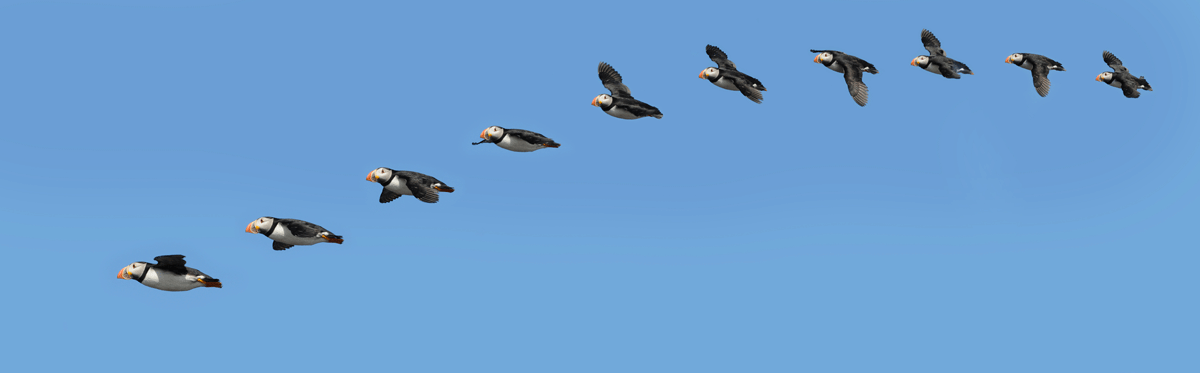
     Atlantic Puffin (composite) – Les Iles au Perroquets, Mingan Archipelago; Gulf of Saint Lawerence, Canada:  This is a composite of 10 images I made of one bird as it flew by.  Most of the images are very sharp, though about 3 are a little soft.  I included the soft images in the composition as it completes the series and at the computers resolution the soft images are not perceived as such.  The series shows the bird further away at the right and closer on the left, thus the difference in size of the puffin.  The original composite is 14” x 45”.
    I had a great time shooting flying Alcids, but it was exhausting raising the D300 and 300mm 2.8 to my shoulder for a couple of hours.  However, I do like the results……hope you do as well.

Double Click on the image and the composite will expand to 10” wide


Nikon D300, Nikkor 300mm f2.8, Digital Capture ISO 320

Thursday, July 21, 2011

Update, and Pic of the Day:

   Hello everyone, this is my first post since July 7.  Sorry for not posting sooner but I have been on (and off) the road since my last post. 
     My latest travels have taken me to Canada and Maine.  My Canadian destination was Longue Pointe de Mingan, on the north shore of the Gulf of Saint Lawrence.  From there I took a small boat to, Les Iles au Perroquets to photograph puffins and other seabirds.  After arriving at Les Iles au Perroquet I found it somewhat of a disappointment as I was under the impression that I would have the opportunity to get very close to puffins. 
     While the island host about 200 breeding puffins, there are no blinds that allow close access to the birds.  Though I could not get close-up images of the birds I quickly saw the potential of shooting flight shots as the birds flew to their burrows.  The only other location I had photographed Atlantic Puffins was Machias Seal Island, off the coast of Maine.  While standing in the blinds at Machias Seal, it is next to impossible to take flight shots, so I took advantage of the situation on Les Iles au Perroquets.  By the way, this translates to “Island of the Parrots.”  The name was given by old sailor who called puffins, “Sea Parrots,” because of their large colorful beak. 
     To shoot the flight images I used a 300mm lens mounted on a custom made gunstock mount.  The gunstock mount allowed me to follow the birds with a smooth panning motion.  A cable release in the gunstock allowed me to release the shutter as if pulling the trigger of a gun.  I would say that about 1/3 of the images I shot were sharp.  Not too bad as the puffins were extremely fast fliers.  Razorsbills, by the way, flew considerably slower.  I did not notice this until I started taking the flight shots.  Razorbills were somewhat easy to get the lens on and follow; puffins were much more difficult because of the speed they flew.
     I also used a Nikon D300 with an MBD-11 set to continuous high frame rate.  I love shooting the Nikon D7000 with its 16 mega pixel frame, but it simply does not shoot enough frames per second to get the job done in this situation.

     Razorbill Auk – Les Iles au Perroquets, Mingan Archipelago; Gulf of Saint Lawerence, Canada:  
     I have always loved photographing razorbills.  They are a real challenge being a totally black and white bird.  Well, that is not quite true.  The black is really a brown-black, but in bright sunlight, as when this shot was taken, the angle has to be just right to see the brown coloration. 
     As the auks and puffins flew past me they would often tilt at an angle that illuminated the bird at just the right angle to put a highlight in the eye.  I began shooting before the tilt, with the expectations of capturing an image with the highlight in the eye.  I like using cameras with a fast frame rate to capture the wings in just the right position.
     I had to watch for birds flying low over the water at some distance from shore.  Once finding one that appeared to be heading ashore, I pointed the lens and locked focus as it approached.  The birds move very fast and I often lost focus. This was simply caused by my inability at times to pan the camera as the birds flew passed (they move sooooo darn fast).
     I lucked out with this bird, it has two sand eels in its beak.  One of the reasons I went to “Les Iles au Perroquets” was to photograph puffins with fish.  I was happy to settle for this image.

More to come..............