Showing posts with label D300. Show all posts

Sunday, July 31, 2011

Pic of the Day


     Black-billed Magpie – Moraine Campground; Rocky Mountain National Park, Colorado:  I have many photos of Black-billed Magpie.  But, I was not happy with any of them.  While I was photographing wildflowers this Magpie flew to a nearby rock and landed.  I quickly gave up the flowers and began stalking the magpie.  I took photos at a distance just incase the bird flew, but it remained on the rocks and let me make a close approach.
     As I shot I became quite humored by the Magpies antics.  As I shot the Magpie would stretch its head under its body, and between its legs.  It appeared to be picking something from it feathers, perhaps parasites.  Whatever the reason, the behavior made for interesting photos.
     Oh, by the way, I am happy with these Magpie images.  Clear, unobstructed backgrounds and behavior always make the image more interesting.

Nikon D7000, Nikkor 500mm f4 VRII, 1/160 sec. @ f8, Gitzo Tripod with Arca Swiss B2 ball head 

Friday, July 29, 2011

Who's Looking

     Welcome viewers from Morocco!  You have made Morocco the 90th country from which viewers have logged on to Bobby’s Photo Blog.  I hope you enjoyed the blog and will forward the URL to your friends.  I update the blog often so please come back…..Bobby

Who's Looking

     Viewers from Macau and the Isle of Man have made these two countries the 88th and 89th countires (respectively) from which viewers have logged onto Bobby’s Photo Blog.  Welcome to the blog.  I hope you enjoyed the images and if so, please log on often. 
     For all of you who log on, please let your friends know about the blog as well.  Just copy the URL and pass it on.  Thanks for your help in getting the word out about the blog……Bobby

Sunday, April 24, 2011

Recently Published Work

   The spring issue of Creation Illustrated is out!  My column, A Lens on Creation covers the Tall Grass Prairie Preserve near Pawhuska, Oklahoma.  If you are interested in subscribing to Creation Illustrated follow this link: http://www.creationillustrated.com

Saturday, April 2, 2011

Pic of the Day

   American Oystercatcher – Fort Desoto Park; Saint Petersburg, Florida:  There were very few birds at Fort Desoto Park when I arrived, but those that were feeding in the estuary made good subjects for my camera.  While I was photographing a winter plumed Black-bellied Plover a pair of American Oystercatchers flew-in and landed on the mudflats very close to me.  The female ran to quickly to the grassy edge of the estuary while the male stood his ground on the mud flats.  As I shot a few frames the male took off in a quick sprint toward the female, allowing me to shoot this image as the Oystercatcher ran at full gallop.  My favorite part of the image is the movement, and the water kicked up as the bird runs across the flats.

Nikon D300, Nikkor 500mm f4, Digital Capture ISO 200,  Exposure 1/1,250@ f6.3

Thursday, March 31, 2011

Pic of the Day

   Scrub Jay – Merritt Island National Wildlife Refuge, Florida:  Florida host many endangered species.   One, the Scrub Jay can be found in scrub oak habitat across Florida in isolated patches. This bird was found along the Scrub Jay Trail at Merritt Island NWR on Cape Canaveral.  This bird, along with its mate was not only approachable, but showed no wariness to people.  While the female of the pair gathered nest material, the male gathered insects to feed her.  When the male caught an insect he would fly to the female and feed her the morsel.  The jays carried on their nuptial duties within a few feet of me, as if I were invisible.  It is always exciting to see birds behaving naturally only a few feet away.
   This bird was photographed as it perched atop a small tree between catching insects for its mate.  I captured the bird as it turned and looked into my camera lens.  The perspective of the image shows the Scrub Jay as if it were giving me a stern forceful look.

Nikon D300, Nikkor 500mm f4, digital capture ISO 200, 1/1000 sec. @ f9

Wednesday, March 23, 2011

Pic of the Day

   Dancing Egret – Estero Lagoon; Fort Myers Beach, Florida:  Of all the birds feeding in Estero Lagoon it was the Snowy Egrets that put on the most flamboyant show.  Their only rival was a lone Reddish Egret as they dance wildly on the hunt.  As schools of fish moved through the lagoon the snowy’s were the first to pounce on the evasive prey.  As the fish zigzagged through the water, so did the snowy.  With out stretched wings for balance this snowy raced through the lagoon striking the water with precision as it plucked its breakfast from the shallows.

Nikon D300, Nikkor 500mm f4, Digital Capture ISO 200, 1/1,250 @ f8

Saturday, February 12, 2011

Recently Published Work

     The winter, 2011 issue of Creation Illustrated is out!  The issue contains my second column with this magazine.  The article is about Everglades National Park’s, Anhinga Trail and it’s amazing birds.  To subscribe, or learn more about Creation Illustrated go to: http://www.creationillustrated.com

Sunday, February 6, 2011

Pic of the Day

   Mountain Bluebird – Yellowstone National Park, Wyoming:  I was photographing Ruddy Duck when a fellow photographer asked if I had photographed the Mountain Bluebird nest.  I said no and asked where it was.  Like all wildlife photographers he was willing to share his find with fellow photographers and told me exactly where to go.  After shooting the ducks I headed for the bluebird nest.   Sure enough, the bluebird nest was just where it was supposed to be, and so where dozens of birder’s, photographers and curiosity seekers.
   With all the people lined-up to see the activity at the nest it would have been difficult to shoot.  The birds also seemed somewhat wary of all the commotion from the spectators.  I waited for about half and hour or so and until the horde of people moved on.  I drove up the road to a nearby picnic area and parked my van.  I gathered my equipment, dawned camo clothing and covers and walked back to the nest site.
The tree that the nest was in was about 60 feet from the road.  I had to use a 2X extender to obtain a reasonable size image in frame.  Fortunately the sun was shinning bright and that allowed me to use a fast shutter speed.  Once at the nest site I found myself to be the lone visitor.  Because the nest tree was in a ravine, it was position below eye level.  I quickly slide down the embankment about six feet making myself eye level with the nest, and invisible to passerby on the road above.  I covered myself and the camera with camo cloth and observed and photographed the birds while all alone.   With each car that passed I expected someone to stop and discover me, but it never happened.  I was able to photograph the birds going about there afternoons activity without them even noticing that I was nearby.   This shot was taken right after the female fed her nestling and perched on a nearby limb to preen, stretch and scratch an itch.

To see another image of this bluebird go to the “On the Road” post  for June 17, 2010.

Nikon D300, Nikkor 500mm f4 with 2X Extender (teleconverter), Digital Capture ISO200

Tuesday, January 25, 2011

Pic of the Day

   Limpkin – Circle B Bar Reserve; Lakeland, Florida:  About a year ago friends that live in Florida brought my attention to the Circle B Bar Reserve and the rich photo opportunities it presents.   Once an active cattle ranch, the Circle B was purchased by Polk county and the Southwest Florida Water Management Destrict Lands Program as part of the Upper Peace River restoration.  The Reserve is combination of oak  hammocks, freshwater marshes, hardwood swamp and lakeshore.   During late January through mid March the reserve is a haven for wading birds, waterfowl, eagles and osprey.
   Earlier this month I was at the Circle B and found the birdlife to be quite impressive.  Hundreds of White Pelicans and Woodstorks crowded the trees that stand in the water impoundments.  Fulvous Tree Ducks, other waterfowl and wading birds were plentiful.  A specialty among the waders was the Limpkin.  Limpkins were quite abundant, perhaps the most limpkins I have seen in one place outside of the Ritch Grissom Wetlands at Veria, Florida.
   While I was photographing a group of Limpkins along the shoreline of one of the water impoundments this Limpkin flew by.  I could not believe my good fortune.  With my camera already set in autofocus mode I quickly swung the lens toward the flying bird.  The autofocus sensor locked onto the head of the bird and snapped into focus as I shot a series of images.  Out of the six images shot, this one captured the wings in just the right position with a body posture that is indicative of this species in flight.  Of course, part of luck is being in the right place at the right time, and staying observant to what is happening around you.   


Nikon D300, Nikkor 500mm f4, Digital Capture ISO 200, 1/400 sec. @ f7.1

Monday, January 17, 2011

Pic of the Day

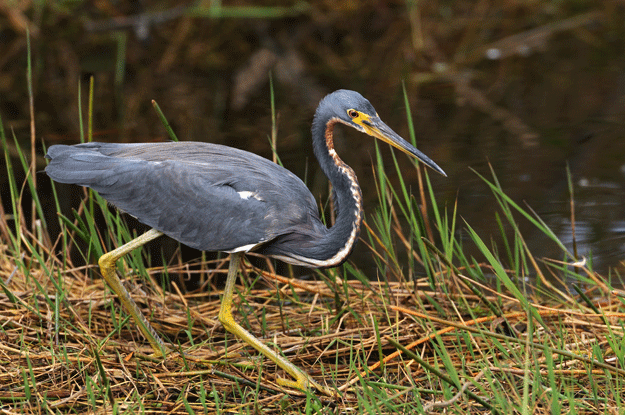
Tri-colored Heron

Little Blue Heron      
     Anhinga Trail; Everglades National Park, Florida: Continuing the theme of the last post, here are a couple of more photos of common birds found on Anhinga Trail.  Both of these birds were shot in the same spot.  The Tri-colored heron was stalking and catching fish when the Little Blue Heron flew-in and frightened the Tri-colored away.  After feeding in the same location the little blue stretched and preened before resuming feeding activity. I must say that I do love the pose of the Tri-colored Heron.  It is a classic heron pose with its potential energy and "S" curved neck.
Nikon D300, Nikkor 500mm f4  (both images)

Sunday, January 16, 2011

Pic of the Day

    Green Heron – Anhinga Trail; Everglades National Park, Florida:  Anhinga Trail is one of the most reliable places on the planet to find birds to photograph.   During the dry season from January to April, a plethora of birds to watch and photograph can be found on the .8 tenths mile trail.
   I do not remember a time that I have been to Anhinga Trail and not seen green herons perched on a rock or low hanging branch snatching minnows from the slough.  This Green Heron was photographed in the late evening light as the sun was setting.  While the orange light of the setting sun barely illuminated the heron, it revealed detailed, intricate patterns in the heron’s feathers that are often overlooked by the casual observer.  

Nikon D300, Nikkor 500mm f4, Digital Capture ISO 400, 1/125th Second, f6.3

Thursday, January 13, 2011

Pic of the Day

   Great Egret among Snowies –Merritt Island NWR, Florida:  I was driving through what looked to be a lifeless Merritt Island NWR, then I saw this scene above.  Water in the marsh was extremely low, and was restricted to small pools scattered along the wildlife drive.  Such pools become havens for fish as water in the marsh shrinks. Birds quickly become aware of the concentrations and descend on the pools with a vengeance.
   As soon as I saw the scene I brought my van parallel to the pond to access the little feeding frenzy that was taking place.  The birds were so intent on their feeding activity they paid me little notice.  I was immediately struck by the graphic nature of the scene, “S” curved necks, and all white birds.  But, It was not so much the birds themselves that made the image, as it was their reflections.  As I shot photos of the egrets dancing around their fishing hole I was reminded again that nature is always full of surprises, and I loved this surprise.


Nikon D300, Nikkor 24-85mm Zoom, Digital Capture ISO 200, 125 Sec. @ f8

Tuesday, January 11, 2011

Pic of the Day


   Ringed-necked Duck – Ritch Grissom Memorial Wetlands; Viera, Florida:  Ringed-necked ducks have always been one of my favorite duck species.  The male with its gray flanks set against a purple black back and breast, accented with a white flank strips and ringed bill is visually stunning.  Though the female wears a dress of brown feathers, her white-eye and bill ring gives her a subtle beauty that makes her the perfect complement to the male.
   In the wild it is usually difficult to get close to ducks, but at protected sanctuaries and preserves they can be very approachable.  As I drove the auto trail at the Ritch Grissom wetlands I spotted these ring-necks feeding in the shallows close to the road.
   I pulled the van past the ducks and parked, got out and stealthily slid down to the waters edge about a hundred feet from them. With my camera already on a tripod I sat down on the ground and hoped that the ducks would move toward me as they fed.
While waiting for the ducks to swim toward me a Limpkin landed in the reeds right in front of me and began plucking apple snails from the water.  I could not believe my good fortune as the Limpkin presented me with a great photo opportunity. 
   While I was shooting the Limpkin, another wildlife watcher stopped to look at the Ring-necks.  In doing so the ducks began to swim toward me as if I were not even there.  As they came within range I began to shoot.  As I began shooting the sun broke through clouds, bathing the ducks in the warm glowing light of a retiring sun.  As I have said so many times in previous post, I love it when everything comes together.  That evening I photographed these ring-necked ducks, it could not have been more perfect.

Nikon D300, Nikkor 500mm f4, Digital Capture ISO 200, 1/400 sec. @ f9

Monday, January 10, 2011

Pic of the Day

 White Ibis – A. Max Brewer Memorial Parkway; Titusville, Florida:  This trip was certainly the year for photographing ibis.  Ibis seemed to be everywhere and were very photographable.  This ibis was photographed on the causeway that leads from Titusville to Cape Canaveral just before entering the Merritt Island National Wildlife Refuge.  I stopped along the causeway to photograph gulls, but the sky was overcast and the images looked very dull.  Soon, the sun began to break through the clouds and the birds on the causeway came alive.  All of a sudden, birds began to appear from all directions to feed in the shallows of the Indian River. 
   As I shot images of gulls, an ibis flew onto the scene and began searching for prey.  It was not long until it was pulling horseshoe crabs out of the water.  The antics of the ibis were most interesting. With each catch the ibis would toss the crab into the air, catch it with its beak, then crunch down breaking the crabs shell.   The tossing and crunching continued for about forty-five seconds per crab.  Once broken and cracked to the ibis’ satisfaction, the crab went down its gullet. The gulls that were ever present stayed close to the ibis and continually tried to snatch its catch…..to no avail.

Nikon D300, 500mm f4, Digital Capture ISO 200, 1/2500 sec. @ f6.3