Showing posts with label Pribilof Islands. Show all posts

Sunday, January 18, 2015

Pic of the Day

Tufted Puffin, Fratercula cirrhata; Saint Paul Island, Pribilof, Alaska
     Discovered in 1788 by Russian navigator, Gavrill Pribilof.  The “Pribilof Islands”, Saint Paul and Saint George lay 770 miles west of Anchorage, Alaska. 
Roger Tory Peterson once called them the Galapagos of the North, for they harbor almost half a million fur seals and millions of sea birds.  I have traveled to the Pribilofs five times and spent a total of 50 days on Saint Paul Island.  It is an incredible place with wonderful photo opportunities.  Weather on the islands is unpredictable.  I have witnessed heavy overcast, dense fog, 40 mile and hour wind, rain falling horizontally, and sunshine all in the same day.  Rain gear is essential for both the photographer and camera equipment. 


This Tufted Puffin was photographed perched on a rocky projection at Reef Point on the south side of the island.  The Tufted Puffins is one of two species of puffins found in the Bering Sea and the only puffin with blonde tuffs of feathers above the eye.  Like the Atlantic Puffin the colorful beak is ornamental and looses it bright color after the breeding season.

Nikon F5, Nikkor 500 f4, Provia 100

Sunday, December 11, 2011

Pic of the Day


     Horned Puffin – Saint Paul Island; Pribilof Islands, Alaska:  With millions of seabirds nesting on the cliffs of Saint Paul Island, finding an interesting and unconventional pose can be difficult as most species of seabirds typically perch the sameway.  After days of shooting the standard seabird photos, I spent many hours walking the cliffs looking for something unique.
     While shooting along Ridge Wall, on the southwest shore of the island, I found this horned puffin tucked away in a hidden nook.  To access the puffin I had to slide down a wet and slippery grassy slope, then climb a few feet down to a narrow ledge.  In after thought, it was a risky move just for a photograph.  I not only got myself to the ledge, but a camera backpack and tripod as well.   Had I slipped, or the ledge given way I would a fallen eighty feet or more to a boulder strewn shoreline.  Since I was on my own, it would have been days before anyone would have noticed I was missing. 
     The ledge on which I stood was only thirteen or fourteen inches wide, barley enough room for me to stand.  Once on the ledge I barely had room for the tripod.  I actually placed two legs of the tripod on the ledge about ten inches apart, while the third extended to rest on a rock protruding from the wall of the cliff.
     Puffins, auklets and murres were all about me.  As I stood shooting the puffin, parakeet auklets landed on shallow ledges only inches below my feet, they seemed to have no fear of me.  After I was home and had the developed slides in my hand I was very happy I had made the effort.  This image was unique among my seabird photographs; the puffin seemed to be in meditative repose.  I did find that unconventional pose after all.  I spent more than an hour on the ledge that day, and returned three more times during my two-week stay.  The little niche I had found provided one of my favorite images from the pribilofs, and most definitely, one of my most unique experiences.

Nikon F5, Nikkor 500mm f4, Fujichrome Provia 100

Saturday, October 23, 2010

Recently Published Work

   I have written an article on the Pribilof Islands that has been published in the most recent issue of "Creation Illustrated," (Vol 17, No.3).
     The article is a two-page spread with four photos.  I also have a photo of Sandhill Cranes in the same issue on page 48 (below), which accompanies an article by Gayle Irwin entitled, Running the Race.  
    To learn more about, or subscripbe to "Creation Illustrated," follow this link: http://www.creationillustrated.com

Thursday, October 21, 2010

Pic of the Day

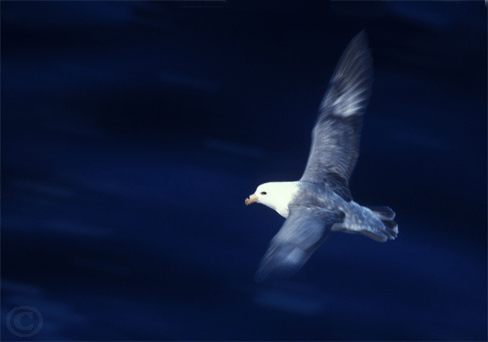
    Northern Fulmar, Fulmarus glacialis  – Saint Paul Island; Pribilof Islands, Alaska:  The Zapadni Cliffs rise out of the Bering Sea, jutting upward for two hundred feet or more.  The height and location of the cliffs provides a splendid view of Saint Paul on a clear day. 
     On a blustery June morning I stood atop the Zapadni Cliffs bundled in a down parka and mittens searching for just the right spot to photograph seabirds.  Walking along the cliffs I found numerous outcrops of rocks that allowed views of birds lined along the narrow ledges.  As I was shooting auklets and murres I noticed a few Northern Fulmars soaring just off the cliff face.  The fulmars soared in long, wide, sweeping figure eight pattern. 
     As I sat and observed, I saw that the fulmars moved in a rhythmic, predictable pattern; a pattern that brought them close to the cliffs edge, which would allow me to get a good shot of these wind masters.  Moving to a position that allowed me to shoot over the cliffs edge I had full command of the scene before me, being able to follow the birds as they road the winds in their long sweeping arcs.    
     The fulmars moved so fast it was hard keeping up with them as I looked through the cameras viewfinder.  If not for the auto focus and tracking feature of the lens and camera a sharp image would have been impossible.  The overcast of the mornings sky required me to shoot using a slow shutter speed and panning technique.  Panning combined with the slow shutter speed causes the background of an image (in this case the moving waves of the Bering Sea) to render as streaks of tone and color.  The technique worked exceedingly well as the slow shutter speed combined with the panning action blurred the background and wing movement to produced an ethereal quality of movement and action that defined the moment and the essence of a fulmar.  
Nikon F5, Nikkor 300mm f4, Ektachorme 100s

Saturday, October 9, 2010

Pic of the Day

    Arctic Fox – Saint Paul Island; Pribilof Islands, Alaska:  The Pribilof Islands are one of my favorite shooting locations.   The four islands that make-up the Pribilof  Archipelago are remote and wild and harbor millions of breeding fur seals and seabirds during the Arctic summer.  I have made five trips to the Pribs, and each one has garnered a lifetime of memories and wonderful shooting opportunities. 
    On one occasion while photographing a least auklet colony near the city of Saint Paul I found myself in the mist of abandoned utility pipes.  The pipes provided excellent cover as I shot the colony.  This particular colony was one of many on Saint Paul and from the numbers I saw must have held many thousands of birds.  The small stretch of rocky seawall where I was shooting was inundated with auklets while flocks of a hundred or more birds were constantly winging in from the sea.
     As I shot frame after frame of the auklets I noticed flashes of movement in my peripheral vision.  Aware that the Arctic Fox on the island love to steal, or worse, urinate on unattended  items  I quickly gathered all my equipment close to my side.  Paying closer attention to the phantom movement I soon saw that the fleeting shadows were indeed a family of Artctic Fox.  The fox were living among the jumble of abandoned utility pipes and I must have been close to the den.
     As I continued to shoot the auklets, the fox kits ran back and forth, over and under, and through the long pipes as they chased and tackled each other.  They were most rambunctious , barley allowing me to get  a shot of their play.  With the kits so close I knew the vixen must me nearby; so I began looking for her.  Sure enough,  I spotted her about thirty feet away peeking out of one of the utility pipes as she kept a watchful eye on me.  With little though I swung the camera around, shot a few frames and then went back to shooting the auklet colony.
    When I arrived home I had a ton of green boxes awaiting my perusal.  Coming home from a long trip and having the film waiting for inspection was like coming home to Christmas, reliving the trip all over again.  I quickly began to sort through the slides, recounting to myself where I had shot each one.  When I opened the box with the fox slides I was happily surprised when I saw the vixen in the utility pipe.  I had remembered shooting the image, but had not thought much about it.  I immediately recognized the image as somewhat special - cute in its on way as the fox was looking directly into the lens.  She was making sure I was no threat to her kits.  
     The next year I entered the image in the Nature’s Best / Cemex International Nature Photography Contest, where it was selected as the winner in the backyard habitat category .  This image was my third win in the Nature’s Best contest, which just goes to prove that good images can just pop-up out of nowhere.  It certainly did for me, while shooting auklets amists a jumble of old abandonded utility pipes.
Nikon F5, Nikkor 500mm  f/4, Fuji Provia
Note:  Also see the “Pic of the Day” post for April 14, 2010

Wednesday, April 14, 2010

Pic of the Day


     Tufted Puffin – Saint Paul Island, Pribilof, Alaska: Discovered in 1788 by Russian navigator, Gavrill Pribilof. The “Pribilof Islands”, Saint Paul and Saint George lay 770 miles west of Anchorage, Alaska. 
Roger Tory Peterson once called them the Galapagos of the North, for they harbor almost half a million fur seals and millions of sea birds. I have traveled to the Pribilofs five times and spent a total of 50 days on Saint Paul Island. It is an incredible place with wonderful photo opportunities. Weather on the islands is unpredictable. I have witnessed heavy overcast, dense fog, 40 mile per-hour wind, rain falling horizontally, and sunshine, all in the same day. Rain gear is essential for both the photographer and camera equipment.
This Tufted Puffin was photographed perched on a rocky projection at Reef Point on the south side of the island. The Tufted Puffins is one of two species of puffins found in the Bering Sea and the only puffin with blonde tuffs of feathers above the eye. Like the Atlantic Puffin the colorful beak is ornamental and looses it bright color after the breeding season.
Nikon F5, Nikkor 500mm f4, Provia 100