Showing posts with label Nikon D300. Show all posts

Saturday, August 9, 2014

Pic of the Day

Upland Sandpiper, Bartramia longicauda:
Tallgrass Prairie Preserve; Pawhuska, Oklahoma

Nikon D300, Nikkor 500mm f4 with 1.4 teleconverter, 1/200 second @ f6.3

Sunday, September 8, 2013

Pic of the Day


Acorn Woodpecker, Melanerpes formicivorus
Madera Canyon, Arizona

Nikon D300, Nikkor 500mm f4, 1/125 second @ f7.1

Friday, August 16, 2013

Pic of the Day


Least Tern, Sternula antillarum;  Biloxi, Mississippi
    One of the great spectacles of the bird world is the Least Tern colony at Biloxi, Mississippi.  Thousands of terns and hundreds of black skimmers arrive in May to nest on the public beaches along a dozen miles of the Mississippi gulf coast.
    The birds nest right up to the sidewalks and give bird watchers and photographers fantastic viewing opportunities.  I took this photo from a sidewalk that runs along side one of the colonies.  I just happened to be in the right place when one of the terns arrived with a fish.

Nikon D300, Nikkor 500mm f4, 1/640 second @ f8

Wednesday, March 27, 2013

Sandhill Crane, Grus canadensis - Viera Wetlands, Florida

    On one of my rounds atop a berm at the Viera Wetlands I came across this sandhill crane probing the ground for roots.  The crane was standing on a neatly mowed grasses area, and it was quite a domestic scene.  So, instead of shooting a long shot, I slowly made my way toward the crane and shot a close-up.   The background was just perfect and it allowed me to isolate the bird against a clean background.
Nikon D300, Nikkor 500 f4, 1/2000 sec. @ f4.5, Camera mounted on tripod

Friday, July 20, 2012

Moon Landing Anniversary


     I can't believe that I almost missed this anniversary.  Today is the 43rd anniversary of Neil Armstrong's and Buzz Aldrin's landing on the Moon.  I remember well, being glued to the television as the Eagle landed and then Neil Armstrong stepping off the LEM's ladder onto the moons surface.  WHAT A THRILL FOR ALL OF US WATCHING!  I hope we return someday.

Nikon D300, Nikkor 500mm with 1.4 tele-converter, 1/250 sec. @ f8, Tripod

Thursday, July 12, 2012

Trip Update & Who's Looking:

     After 42 days and 11,000 miles we have arrived home.  What a GREAT TRIP!  We had a fantastic time.  I added 23 new birds to my life list, and got some shots that I am really happy with.  I will begin posting in a couple of days.  I need a little time to get things squared away here at the house before I start posting.  The yard is a mess! 
   In the mean time, I would like to welcome viewers from the Netherlands Antilles and Laos to the blog.  These two nations have become the 112th and 113th countries from which viewers have logged onto Bobby's Photo Blog.  Welcome to the Blog and please come back often.   Bobby

Friday, December 30, 2011

Happy New Year to All


    Roseate Spoonbill (audlt in its most splendid breeding plumage) – Estero Lagoon: Fort Myers Beach, Florida:  As the year draws to a close and the North Alabama winter days wax colder, My thoughts turn to the warmth of Southern Florida and its birds.  January is the month that begins the best time to shoot in Florida, with February to mid March being my favorite (I’m already planning my trips).
     This will most likely be my last post for 2011.  I will post again on the 1st of January, or so.  I leave this year with a portrait of one of Florida’s most colorful birds, and a memory for myself of one of the best times I’ve ever had photographing our beautiful wild birds.
     With less than 24 hours until 2012, I wish all of you a Happy New Year.  I look forward  to the next year of images and posts.  Bobby

Nikon D300, Nikkor 500mm f4, 1/640 @ f 9

Monday, December 26, 2011

Pic of the Day


     Roseate Spoonbill – Estero Lagoon; Fort Myers, Florida:  This image is from my shoot at Estero Lagoon, I mentioned in my last post.  As sunlight broke the horizon and hit the tide pool the spoonbills stopped their predawn feeding and began preening.  Consumed in their preening duties the spoonbills ignored my presence and I took full advantage of the warm light that bathed the birds.

Nikon D300, Nikkor 500mm f4, 1/200 sec @ f13

Sunday, December 25, 2011

Pic of the Day


     Common Egret -- Estero Lagoon, Fort Myers Beach Sandbar:  I posted a number of images from this shoot back in March.  While looking for some images to post, I came across this Common Egret. 
     The morning I shot this was incredible.  The image was taken at a huge tide pool that had been cutoff from the Gulf waters because of the low tide.  The tide pool was filled with fish and I photographed bird feeding for two mornings.  This is just one of the many birds I shot.  Many species were feeding before the sun rose, but after the sun breeched the horizon many birds began to fly to the tide pool.    
     I particularly liked how the wing provides a background and frames the bird’s head.  Also, as this image demonstrates, the birds paid little attention to me, giving me great photo opportunities. 


Nikon D300, Nikkor 500mm f4, 1/1,600 @ f8

Friday, October 28, 2011

Pic of the Day


     Everglades Kite – Loxahatchee National Wildlife Refuge, Florida:  Loxahatchee NWR is located just west of Palm Beach in what was once the eastern expanse of the wild everglades.  Today the former everglades north of highway US41 is a series sugar cane fields and huge water impoundments with controlled water levels.  They are also home to the endangered Everglades Kite, also know as the Snail Kite.  The Everglades Kite is a specialist, feeding primarily on Ampullariidae, or Apple Snails as they are commonly known.  This kite was photographed as it soared over the sawgrass glades searching for Apple Snails.  Clearly seen is the kites deeply curved beak, which it uses to open the snails Operculum and reach inside the shell to extract the meat of the snail.

Nikon D300, Nikkor 500mm f4

Friday, October 7, 2011

Pic of the Day

Before
After
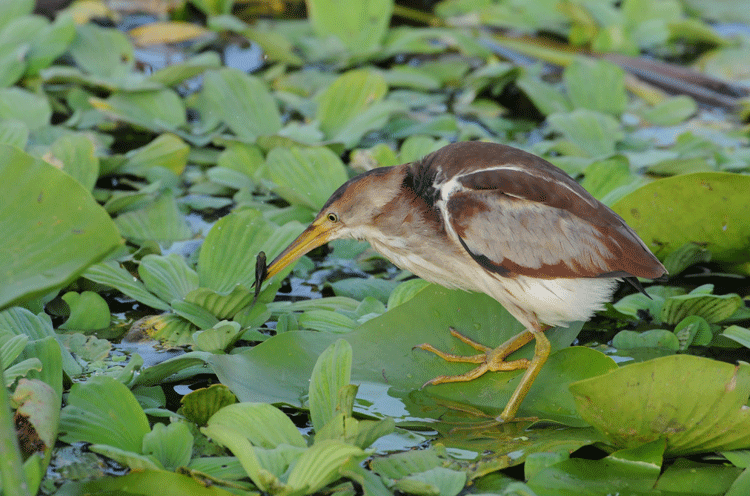
     Least Bittern – Wakodahatchee Wetlands; Palm Beach, Florida:  If I had to make a list of  birds that are the most challenging to photograph, the least bittern would be near the top.  Bitterns are secretive birds and are most often seen in the breeding season when they are busy chasing each other through their weedy habitat.   I have spent hours looking for bitterns; slowly driving along drainage canals and pond edges looking for the slightest movement that might give up this master of disguise.  Their delicately streaked feathers provide the perfect camouflage among their golden marsh reed habitat.  On occasion I do find them; and when I do, I savor the opportunity to shoot.
     Finding bitterns is one thing; finding them in a good location for shooting is another.  I found this least bittern while walking the boardwalks of the Wakodahatchee Wetlands in Palm Beach. Florida.  The day was late and the sun was inching toward the horizon.  As the sun dropped this bittern came out of hiding to hunt among the lily pads that sheltered small fry.   I immediately took advantage of the situation and began shooting.  As the bittern slowly tread across the lily pads it would pluck a small fry from the water.  With each stab I shot a burst of frames.  These two images captures the essence of the hunt.  As the bird stalked it would stretch its head forward, slowly turning it left and then right to gauge the distance of the prey.  Then, with lighting speed the bitters thrust forward. Before the eye can realize what has happened, the head springs back to the body with a fish in its beak.  In less than a second the small fry is gone and the routine begins again as I continue to shoot beyond what the light will allow.  I savor each moment with each frame shot and  look forward to the next hunt for the least bittern.

Nikon D300, Nikkor 500mm f4,  1/320 second @ f7.1, Arca Swiss Ball Head on Gitzo Tripod

Friday, September 23, 2011

Pic of the Day


     Little Blue Heron – Tamiami Trail, Florida:  As the Tamiami Trail turns east and crosses southern Florida on its route to Miami, it traverses a great wilderness that is composed of Fackahatchee Strand State Park, Big Cypress Swamp and the Everglades National.  The trail crosses habitat that include cypress swamps, cypress hammocks and sawgrass prairies.  The varied habitat and canal that parallels the highway provides great opportunities for shooting.  When I travel to southern Florida, I always make it a point to spend a few days along the two-lane highway to photograph its abundant birds.
     When I cross the trail from west to east I typically start around mid to late afternoon.  Traveling east along the trail at that time place the sun to my back, which provides perfect illumination for my subjects. This Little Blue Heron was photographed along the stretch of highway that crosses Big Cypress Swamp.  The day was waning quickly and the sun was low on the horizon.  The scene was overall very dark; only the heron was lit with sunlight.  The lighting made the use of auto metering useless.  To obtain a correct exposure I used my cameras spotmeter to meter the heron feathers.  Once I had an exposure reading I underexposed the feather by 2/3 of a stop, which placed the feather a little darker than a middle tone.   By placing the bird’s feathers at the correct tonality the dark water and foliage was properly exposed.
     With all said, I never really think too much about the technical aspect of photography when I’m shooting.  I have been taking photographs so long that the technical aspects are second nature to me.  What I am constantly thinking of is the aesthetics, always looking for a scene, a group of elements that will make a good image.  When I see it, I usually only have time to set-up the gear and shoot.  If I had to think about the technical, I most likely would miss the shot.  I’m glad I didn’t miss this one. 

Nikon D300, Nikkor 500mm f4, 1/125 sec. @ f7.1

Tuesday, September 20, 2011

Pic of the Day

     Ring-necked Duck (hen) – Ritch Grissom Wetlands, Viera, Florida:  When I am shooting, I always target the male birds of the species.  With few exceptions males are the most colorful, therefore making them an ideal subject.  Females on the other hand are mostly dull and drab.   Dull and drab are necessary traits for individuals that will set on a nest for hours on end.  However, they are beautiful birds in there on right.  The hen ring-necked, with its variations of browns and grays also sports a white facial ring at the base of the bill and the white ring on the tip of the bill as does the male.  The mottled browns and white patches breaks-up the body shape thus providing the perfect camouflage, and a stunning portrait.

Nikon D300, Nikkor 500mm f4 w/1.4 teleconverter, 1/400 @ f10

Monday, September 12, 2011

Pic of the Day

     Anhinga – Anhinga Trail: Everglades National Park, Florida:  Strolling along Anhinga Trail in the Florida Everglades I came upon this Anhinga perched on the wooden rail along the trails path.  As you can imagine the red eyes caught my attention immediately.  As I readied my tripod and lens the Anhinga latched onto every move I made, and would not take its eyes off me.  This was just what I wanted, the bird looking directly into the camera lens. 
The red eyes are certainly the center of interest and the gaze into the lens makes them even more poignant.

Nikon D300, Nikkor 500mm f4,  Arca Swiss ball head on Gitzo Tripod, 1/200 sec. @ f8
ISO 200

Thursday, August 25, 2011

Who's Looking

     Welcome viewers from VietnamVietnam is the 91st country from which people have logged onto Bobby’s Photo Blog.  I hope you enjoy the blog and will Log on often.  Bobby

Monday, August 8, 2011

Pic of the Day


     Thunderstorm over Fort Myers Beach from Sanibel Island Causeway -- Florida:   Summertime in Florida is a great time and place to photograph thunderstorms. I shot this image from one of the spoil islands on the causeway to Sanibel Island.  The view from the spoil island is looking northeast over San Carlos Bay.  The image was originally shot in color and converted to black & white in photoshop.

Nikon D3, Nikkor 24-85 zoom-set to 24mm, 1/500sec. @ f10, Handheld

Saturday, July 23, 2011

Pic of the Day

     Atlantic Puffin – Les Iles au PerroquetsMingan Archipelago; Gulf of Saint Larwence:  After the last post, I though I should post a close-up of a puffin in flight.  Hope you like it!


Nikon D300, Nikkor 300 f2.8 VR, 1/2,00 sec. @ f 7.1

Friday, July 22, 2011

Pic of the Day

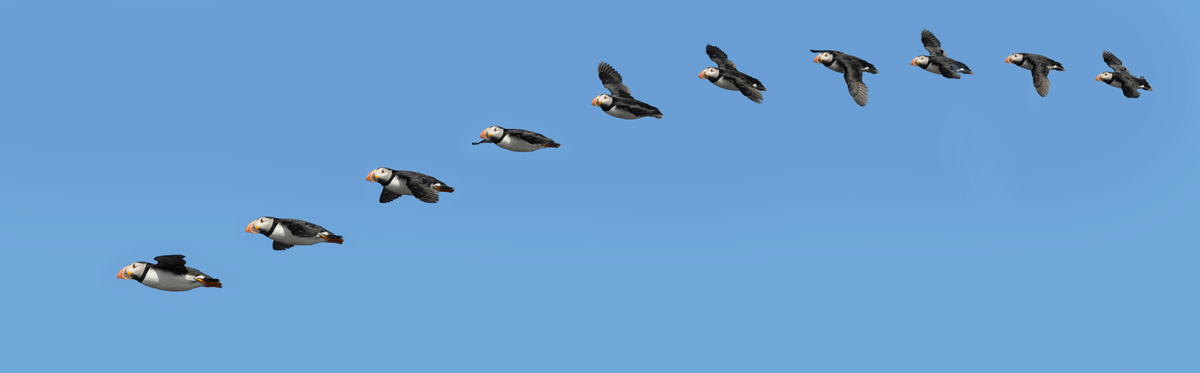
     Atlantic Puffin (composite) – Les Iles au Perroquets, Mingan Archipelago; Gulf of Saint Lawerence, Canada:  This is a composite of 10 images I made of one bird as it flew by.  Most of the images are very sharp, though about 3 are a little soft.  I included the soft images in the composition as it completes the series and at the computers resolution the soft images are not perceived as such.  The series shows the bird further away at the right and closer on the left, thus the difference in size of the puffin.  The original composite is 14” x 45”.
    I had a great time shooting flying Alcids, but it was exhausting raising the D300 and 300mm 2.8 to my shoulder for a couple of hours.  However, I do like the results……hope you do as well.

Double Click on the image and the composite will expand to 10” wide


Nikon D300, Nikkor 300mm f2.8, Digital Capture ISO 320

Thursday, July 21, 2011

Update, and Pic of the Day:

   Hello everyone, this is my first post since July 7.  Sorry for not posting sooner but I have been on (and off) the road since my last post. 
     My latest travels have taken me to Canada and Maine.  My Canadian destination was Longue Pointe de Mingan, on the north shore of the Gulf of Saint Lawrence.  From there I took a small boat to, Les Iles au Perroquets to photograph puffins and other seabirds.  After arriving at Les Iles au Perroquet I found it somewhat of a disappointment as I was under the impression that I would have the opportunity to get very close to puffins. 
     While the island host about 200 breeding puffins, there are no blinds that allow close access to the birds.  Though I could not get close-up images of the birds I quickly saw the potential of shooting flight shots as the birds flew to their burrows.  The only other location I had photographed Atlantic Puffins was Machias Seal Island, off the coast of Maine.  While standing in the blinds at Machias Seal, it is next to impossible to take flight shots, so I took advantage of the situation on Les Iles au Perroquets.  By the way, this translates to “Island of the Parrots.”  The name was given by old sailor who called puffins, “Sea Parrots,” because of their large colorful beak. 
     To shoot the flight images I used a 300mm lens mounted on a custom made gunstock mount.  The gunstock mount allowed me to follow the birds with a smooth panning motion.  A cable release in the gunstock allowed me to release the shutter as if pulling the trigger of a gun.  I would say that about 1/3 of the images I shot were sharp.  Not too bad as the puffins were extremely fast fliers.  Razorsbills, by the way, flew considerably slower.  I did not notice this until I started taking the flight shots.  Razorbills were somewhat easy to get the lens on and follow; puffins were much more difficult because of the speed they flew.
     I also used a Nikon D300 with an MBD-11 set to continuous high frame rate.  I love shooting the Nikon D7000 with its 16 mega pixel frame, but it simply does not shoot enough frames per second to get the job done in this situation.

     Razorbill Auk – Les Iles au Perroquets, Mingan Archipelago; Gulf of Saint Lawerence, Canada:  
     I have always loved photographing razorbills.  They are a real challenge being a totally black and white bird.  Well, that is not quite true.  The black is really a brown-black, but in bright sunlight, as when this shot was taken, the angle has to be just right to see the brown coloration. 
     As the auks and puffins flew past me they would often tilt at an angle that illuminated the bird at just the right angle to put a highlight in the eye.  I began shooting before the tilt, with the expectations of capturing an image with the highlight in the eye.  I like using cameras with a fast frame rate to capture the wings in just the right position.
     I had to watch for birds flying low over the water at some distance from shore.  Once finding one that appeared to be heading ashore, I pointed the lens and locked focus as it approached.  The birds move very fast and I often lost focus. This was simply caused by my inability at times to pan the camera as the birds flew passed (they move sooooo darn fast).
     I lucked out with this bird, it has two sand eels in its beak.  One of the reasons I went to “Les Iles au Perroquets” was to photograph puffins with fish.  I was happy to settle for this image.

More to come..............

Sunday, June 26, 2011

Who's Looking

     I would like to thank the viewers from the Dominican Republic for logging onto Bobby's Photo Blog.  The Dominican Republic becomes the 86th country from which viewer have logged on.  Welcome to the Blog and please log on often.  Bobby