 |
| Boat-tailed Grackle, Quiscalus major; Wakotahatchee Preserve, Florida |

Showing posts with label Bird Photogarphy. Show all posts
Showing posts with label Bird Photogarphy. Show all posts
Sunday, December 29, 2013
Pic of the Day

Saturday, August 18, 2012
Pic of the Day
 |
| Gila Woodpecker at nest; Catalina State Park, Arizona |
Gila Woodpecker;
Melanerpes uropygialis and Brown-crested Flycatcher; Myiarchus tyrannulus– Catalina State Park; Tucson, Arizona:
When I arrived at Catalina State Park
this summer the first thing I saw was the open fruit on the gigantic saguaro
cactus at the parks entrance. A
number of the cacti were covered with open fruit and a plethora of birds were
visiting the cacti to feed on the fruit. I had
arrived at just the right time of the year, many of the species that nest in
southeast Arizona were breeding and feeding their nestling saguaro fruit.
This Gila Woodpecker
was found forty feet from the park entrance nesting in a saguaro cactus. Saguaros live from 150 to 200 years and can
reach heights of 70 feet. Judging
from the size of the arms that was on this particular saguaro its age must
excide 150 to 175 years.
 |
| Saguaro Cacti, Organ Pipe National Monument |
Saguaros
are the trees of the forest and home to many desert species from mammals and
reptiles to birds. Woodpeckers
like this Gila, drills holes into the cactus just like it would a tree. In fact, the internal structure of the saguaro is an
intricate intertwined woody ribbed structure, necessary to support a cactus
that weighs 10 to 15 tons. Yes, 10
to 15 tons……seems unbelievable.
Once the
cavity is excavated the cactus begins to secrete a mucus (for a better word)
that coats the damage. The coating
stops the loss of precious water stored in the cactus. The harden cavity becomes a perfect
home for the birds and other wildlife that inherit the cavity over time. Even after a saguaro dies and falls to
the ground, the cavity, called a boot serves as a dwelling for ground
creatures.
Other
birds that use the excavated cavities of the woodpeckers are Elf Owls,
Ash-throated and pictured here, the Brown-crested Flycatchers. In spring and summer and fall the
saguaro provides much need insulation from the head and in winter, insulation
from the cold.
Saguaro Cactus are found only in Arizona,
with a few spilling over into extreme southeastern California and in western
Sonara, Mexico. I will post more
birds photographed in Catalina State Park and the desert southwest in future
updates.
Gila Woodpecker: Nikon D7000, Nikkor 500mm f4, 1/500 second @ f8, Tripod
Saguaro Cacti: Nikon F4, Kodachorme 64, exposure unknown, Tripod
Brown-crested Flycatcher: Nikon D7000, Nikkor 500mm f4, 1/160 second @ f7.1, Tripod
 |
| Brown-crested Flycatcher at nest: Catalina State Park, Arizona |
Thursday, July 19, 2012
Pic of the Day

Lincoln’s Sparrow (Melospiza lincolnii) – Magee Marsh, Ohio: Over the spring and summer I have seen 23 lifer’s. Twenty-three birds I have never seen
before. You would think, as
common as Lincoln’s sparrows are, I would have seen the bird years ago. But, that’s the nature of
birding. The Lincoln’s is the
first of my 23 lifer’s this spring.
The Lincoln’s sparrow was named by John James Audubon to
honor his friend, Thomas Lincoln of Dennysville, Maine. Lincoln took a specimen of his sparrow
in 1834 while traveling with
Audubon on his Nova Scotia expedition.
Audubon originally named the bird “Tom’s Finch”, but the name was later changed to
Lincoln’s Sparrow.
Lincoln’s are ground nesters. The female weave a cup of dried sedges
and line the nest with soft vegetation.
It nests in areas of wet thickets and shrubby bogs, under
vegetation across Canada, Alaska and the northeaster and western United States.
They spend most of their time on or near the ground where
they run, walk and hop as they search on food. During the nesting season they typically eat beetles, larvae
and spiders. In winter seeds and
invertebrates become their mainstay.
This Lincoln’s Sparrow was photographed in a wet shrubby bog
from the boardwalk of Magee Marsh, Ohio; on its Northward migration. I was
photographing a yellow-rumped warbler when this fellow came out of the lower
vegetation and perched on a snag.
It was Richard Crossley who brought the bird to my attention. Little did Richard know at the time, that the
Lincoln’s was a lifer for me!
Monday, July 16, 2012
Pic of the Day

Kirtland’s Warbler -- Grayling, Michigan: When I was at Magee Marsh in May I saw
and photographed a Kirtland’s Warbler.
This was not the first time I had seen the bird; back in 1979 my wife
and I drove to Grayling to see the Kirkland’s on its nesting grounds. We saw many birds, especially males
singing on their territory. The
birds were easy to see, but a little too far away for good photographs.
Over the years I have made a number of trips to Grayling and Mio to photograph the Kirkland’s; spending many mornings on the warbler tours trying to get good images. With each trip I saw many birds, but was never happy with the images. Birds were always too far away for good images.
Over the years I have made a number of trips to Grayling and Mio to photograph the Kirkland’s; spending many mornings on the warbler tours trying to get good images. With each trip I saw many birds, but was never happy with the images. Birds were always too far away for good images.
On June 3, I was on another tour. There were three of us, plus the guide the morning started
out great. No sooner had we hit
the trail into the jack pines a male Kirtland’s pop-up on a limb and began
sing. The day was young and the
sun was still behind the clouds on the horizon. The light was dull, but I shot a few images, I wanted
more….what photographer doesn’t!
As we walked along the path Kirtland’s were singing all
around us, but they are all to distance photograph. We walked half a mile, and the sun had broken through the
clouds, but no luck with any birds close enough for photography.
As we headed back our guide stopped where we had heard a male
singing earlier. She said, “we
should wait here a while, this birds territory is on both sides of the
tail.” As we stood listening to
the bird, we glimpsed a female moving through the lower level of the jack
pines. A moment later the male
followed in her path, then climbed to the top of a small jack pine and began
singing. Within minutes the male
flew past, almost hitting me, then it landed in a leafless willow a dozen feet in
front of me. Alighting in the
willow the Kirtland’s climbed upward and began singing its territorial
song. In full sunlight the bird
put on quite a show as I shot frame after frame. The turn of events was very pleasing!
As I continued my walk out of the jack pines two more males
put on a show. I posted those
images soon after they were taken.
Click here to see the previous Kirtland’s post: http://bobbyharrison.blogspot.com/search?q=Kirtland%27s+Warbler
Thursday, July 5, 2012
Pic of the Day

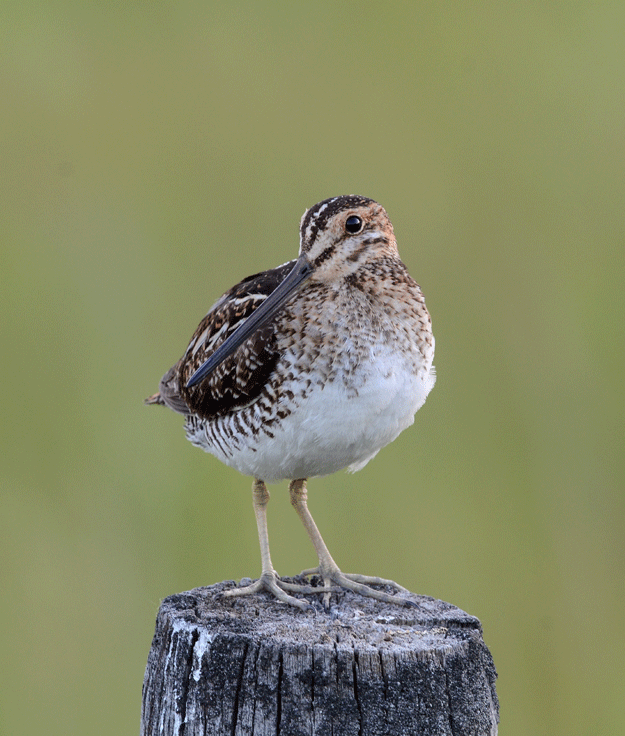

Wilson's Snipe – Lee Metcalf National Wildlife Refuge, Montana: When I arrived at the Lee Metcalf NWR just outside of Stevensville, Montana there was only a half hour of light before the sun would set behind the Bitterroot Mountains. I immediately went about finding a subject to shoot with those last few minutes of light, but had little success. During that time I scoped the area and found spots I need to be the following morning for the best light.
As I drove out of the refuge onto a county access road I saw this Wilson's snipe perched atop a fence post. I have often seen snipe, but usually at the edge of muddy wetland that usually provide the worst of shooting condition. They are so well camouflaged that once found and photographed they are hard to seen in the image. They are also very shy and easily spooked, making photography even more difficult.
As I passed this snipe I slowed the van and a cautiously backed up within a hundred feet of the bird. The sun had set, and I knew I had to work from a tripod if I wanted to obtain sharp images. With nothing to lose, thinking that the bird would fly as soon as it saw me, I got out of the van in plain view and, set-up my camera gear. Still thinking that all was for naught, I began a slow approach toward the snipe. To my great joy the snipe seemed unconcerned with me. At thirty feet I began to shoot images and slowly worked to about eighteen to twenty feet. With the sun far set, I had to shoot very slow shutter speeds, but at the same time I wanted to maintain a sharp image from the front of the fence post the snip was perched through the bird itself. Fortunately the bird did not move, except to turn its head every now and then, which gave me the opportunity to use the slow shutter speed and maintain depth-of-field.
As I continued to shoot, the only sound heard was the hum of my shutter snapping. Then in the silence between the shutter snaps I heard a faint buzzing. The buzzing osculated as if it was moving closer, then farther away. Immediately I recognized the sound and why my snipe was so patient with me. Her focus was not on me, but on a males buzzing nuptial flight display occurring above our heads. After a few more shots, I backed off and let the dance continue. I was a very happy camper!
I had thought I had lost the chance to shoot after the sun sat that evening, but as always, the unexpected delighted me with some wonderful images.
Top Image: Nikon D7000, Nikkor 500mm f4, 1/30 sec. @ f9, Tripod
Middle Image: Nikon D7000, Nikkor 500mm f4, 1/30 sec. @ f9, Tripod
Bottom Image: Nikon D7000, Nikkor 500mm f4, 1/30 sec. @ f9, Tripod
Saturday, June 30, 2012
Pic of the Day

Western Grebe; Aechmophorus occidentalis -- Bear River Migratory Bird Refuge; Brigham, Utah: Always expect the unexpected. This is a lesson I have learned over my many years of photographing birds. While I was at the Bear River Migratory Bird Refuge, I had a fantastic time photographing Western and Clarke’s Grebes. The grebes were always in the hustle and bustle of life. There were birds with chicks, feeding chicks and birds chasing off intruders getting too close to chicks. Then, there were those that were fishing. Lots of grebes were fishing, and most were catching small fry that were no more than an inch or inch and half long. As soon as an adult would surface with a fish, it would feed it to its’ chick. This was good and I got find photos of adults feeding chicks, but I want a grebe with a bigger fish.
Just when I was about to give up the idea of a grebe with a bigger fish, the unexpected happened. When I came across this fellow fishing, he surfacing a couple of times a minute with small fish like all the others. After watching for a few minutes he surfaced, much to my delight, with a catfish that was about 7-8 inches long.
Instead of catching the catfish between its beak, the grebe speared the catfish with its lower mandible. With its sharp spiny back and side fins catfish must be tough to get down. After about twenty minutes of thrashing the catfish against the water, diving and resurfacing with the fish the grebe eventually got his catch down.
Nikon D7000, Nikkor 500mm f4 with 1.4 teleconvert, Exposure 1/1,600 Sec @ f6.3
Monday, June 25, 2012


Lewis’s Woodpecker – Stevensville, Montana: For three days I drove Glacier National Park, The National Bison Range, and Metcalf NWR looking for Lewis’s Woodpecker. Lewis’s Woodpecker is an uncommon bird in its range, and I was told by park rangers and other birder’s that, “you don’t find Lewis’s, they just happen. They move around a lot.”
The Lewis’s Woodpecker was first collect by Meriwether Lewis on the 1805 expedition into the recently acquired Louisiana Purchase territory. The bird was named for its discoverer.
The Lewis’s Woodpecker was first collect by Meriwether Lewis on the 1805 expedition into the recently acquired Louisiana Purchase territory. The bird was named for its discoverer.
Unlike other woodpeckers the Lewis’s does not usually dig into a tree for insects, but fly catches. I have observed the bird perched in typical woodpecker posture, then, leap into the air to hawk insects. It is most unusual behavior for a woodpecker.
After chasing the bird for three days I did not think I would find one, then I stopped and talked with another photographer while shooting at Lee Metcalf NWR. I asked him if he had seen a Lewis’s. He told me he had seen one that morning on a road west and north of Stevensville. With his directions I took off looking, and to my great surprise I found not one, but three birds just a half a mile north of where he told me to look. As I watched the birds I was incredibly excited. The Lewis’s is a “Lifer” for me. Seeing the bird itself was enough, but I had not only seen the bird, I saw one fly to nearby cavity. I had found nesting birds, and an opportunity to shoot photos.
The nest was situated in a cottonwood stump about twelve feet off the ground. There was also a drive into pasture about 20-25 feet from the nest that I would pull into. The nest was perfectly situated for me to use my van as a blind. I have enjoyed two good mornings shooting this wonderful, and some what rare bird. I was just hoping to see this beautiful bird, but I have been fortunate to photograph it as well. What more could I ask for!
Top Photo: Nikon D7000, Nikkor 500mm f4, with 1.4 teleconverter, 1/1000 sec @ f8
Bottom Photo: Nikon D 7000, Nikkor 500mm f4, 1/000 sec, @ f7.1
Top Photo: Nikon D7000, Nikkor 500mm f4, with 1.4 teleconverter, 1/1000 sec @ f8
Bottom Photo: Nikon D 7000, Nikkor 500mm f4, 1/000 sec, @ f7.1
Saturday, June 23, 2012
Pic of the Day
 |
Marsh Wren: Marsh Wrens were nesting about 20 feet apart it seemed.
This guy was very loud as it moved through its territory. I used my van
as ablind to get this and manty other shots.
|
 |
Water Impoundment at sunset. The reeds in the foreground is where
the the top image was taken.
|
Thursday, June 14, 2012
Pic of the Day

Western Grebe with chick – Bear River Migratory Bird Refuge; Brigham, Utah: When I arrived at Bear River Migratory Bird Refuge I was quite shocked. I had called the week before and was informed that the water levels were not as high as last year at this same time. I was expecting low water, but not what I found. Last year held extremely high water, and the birds were everywhere, nesting right-up to the road. This year the water is extremely low. Areas that held nesting stilts and avocets last year are dried and cracked. However, Impoundment 2 holds lots of water and lots of birds, so shooting is very good. Also, birds are more advanced in nesting and age of young this year. Last year I saw no fledgling grebes, but this year they are everywhere.
I shot this image of a western grebe chick hitching a ride on mom’s back this morning. Birds are not as quite as close as I like, but with a little patience the birds will eventually come quite close. I will work here another day or two and then head toward Nevada.
Nikon D7000, Nikkor 500mm f4, 1/1,600 second @ f6.3, ISO 400
Saturday, June 9, 2012
Pic of the Day

Kirtland’s Warbler – Grayling, Michigan: This is another image of the same warbler in the last post. Here are a few facts about the Kirtland’s Warbler:
• First identified in 1851 from a specimen collected near Cleveland, Ohio and collected on Dr. Jared Kirtland’s farm. (obviously a migratory bird on)
• Nesting ground was not discovered until 1903.
• Kirtland’s nest on the ground under jack pines that are 5-20 feet tall which range from 6 to 22 years old.
• A pair of Kirtland’s require at least eight acres of dense young jack pine forest.
• Females lay 4 to 5 eggs, and the chicks remain in the nest for 9 to 10 days.
• Kirtland's winter in the Bahamas.
• Wintering grounds were not discovered until the early 1990's
• Kirtland's winter in the Bahamas.
• Wintering grounds were not discovered until the early 1990's
• Cowbirds are a threat to the Kirtland’s, as cowbirds parasitize Kirtland’s nest.
• A cowbird removal program was instituted in 1972. Prior to the removal program cowbird parasitized 70% of the Kirtland’s nest. After the first year of the program cowbird parasitizing dropped to 7%.
• The ongoing battle to save the Kirtland’s Warbler from extinction is waged by the U.S. Fish and Wildlife Service, The U.S. Forest Service, Michigan Department of Natural Resources, and the U.S. Geological Survey.
Most fact posted here are from the following website:
Thursday, June 7, 2012
Pic of the Day

Kirtland’s Warbler on Jack Pine – Grayling, Michigan: After flying from the Bahamas this fellow went right to work establishing a nesting territory among the Jack Pines in the upper part of lower Michigan.
Jack Pine Warbler, is another name for the Kirtland’s, as the Jack Pine ecosystem is the only habitat this bird uses to nest. The bird is a ground nester and prefers trees that are about 4 to 20 feet in height to nest under. This bird was in perfect Kirtland’s habitat with trees 8 to 12 years old and 4 to 10 feet tall.
The nesting grounds of the Kirtland’s is closed to the public so I had to take the tour to have any hope of getting shots of the bird on it’s nesting ground. This is the fourth time I have driven to Graying to see the bird and this time was the first encounter that left me with some nice photos of the bird. After shooting a male singing in a deciduous tree I came across this bird singing while perched in a Jack Pine. This bird put on quite a show and gave me the opportunity to shoot a lot of images. I went on the tour 3 more mornings, but none gave me better shots. I’ll post a few more Kirtland’s over the next few days. Nikon D7000, Nikkor 500mm f4, 1/1,600 sec. @ f5
Monday, May 28, 2012
Pic of the Day

Common Yellowthroat Warbler – Magee Marsh, Ohio: Another one of the many warblers I saw along the boardwalk at Magee Marsh. As mentioned in a previous post, the birds at Magee are fearless, often moving so close that I had to back-up to get a shot. Although this image is cropped, the bird was within the minimum focus distance of my lens requiring the use of extension tubes to get this close-up.
I love shooting the warblers, and I am already looking forward to next spring!
Sunday, April 22, 2012
Pic of the Day

Angry Birds,
now they haunt me in real life as well!
Nikon D7000, Nikkor 500mm f4, 1/500 sec. @ f4
Saturday, April 21, 2012
Pic of the Day

Least Bittern – Viera Wetlands; Viera, Florida:
Friday, April 20, 2012
Pic of the Day

Least Bittern – Viera Wetlands; Viera, Florida: While at the alligator farm at Saint
Augustine I made a quick trip to Viera to check for least bitterns. I searched all afternoon with no
success. It was not until about
thirty minutes before sunset that I saw a least bittern flying across the top
of a patch of reeds. Watching
where the bittern disappeared I set out to search for the bird. Within a few minutes this bittern came
to the edge of the reed bed and presented itself to be photographed.
Friday, March 30, 2012
Pic of the Day

Dogwood Blossom – Horse Cove, Alabama: On the day I shot the Azaleas (see post for March 24), I also shot a few dogwood blooms. Some years the dogwoods around my home do not bloom, but this year it seems that every dogwood in the forest is in bloom. They're just beautiful!
Nikon D7000, Nikkor 500mm f4, 1/80th second @ f7.1
Friday, March 18, 2011
Pic of the Day

Snowy Egret – Estero Lagoon; Fort Myers Beach, Florida: After spending a week driving from Fort Desoto in Saint Petersburg south to Sanibel Island, east to Anhinga Trail in the Everglades then North (with stops along the way) to Merritt Island National Refuge, I finally had a couple of mornings of good shooting at Estero Lagoon on by second drive around the state.
Estero Lagoon begins, or ends, depending on your perspective at the Holiday Inn in Fort Myers Beach. I arrived at the lagoon just as the sun was rising and was excited to see about fifty or more waders feeding in the shallow waters of the lagoon.
Estero Lagoon begins, or ends, depending on your perspective at the Holiday Inn in Fort Myers Beach. I arrived at the lagoon just as the sun was rising and was excited to see about fifty or more waders feeding in the shallow waters of the lagoon.
The morning was perfect. The sea breeze was cool, and the birds were bathed with the warmth of sunrise light. More than a dozen species of birds filled the lagoon and each searching and catching food from the shallows. Spoonbills waded back and forth along the stretch of water in front of my camera while egrets, herons, ibises and shorebirds stalked the waters. Herons, egrets and spoonbills were catching Sheepshead, each about four to six inches in length. Ibis were busy gleaning blue crab and least sandpipers were pulling marine worms from the mud.
Great opportunities were present at Estero Lagoon and I took advantage of as many as possible. While I took many shots that I am very pleased with, so many good shots got away. I was shooting three cameras during the feeding frenzy. I used a Nikon D300 with a 500mm f4 lens mounted on a tripod. I also used a Nikon D7000 with a 300mm f2.8 VR lens hand held. Many of the close up shots were taken with this particular set-up. I also used a Nikon D3 with a Nikkor 80-200mm f2.8 for shots of birds when the came too close for the other lenses. And, the birds did come close. I sometimes moved out of their way instead of them moving out of mine. The birds seemed to pay me no attention. I am not surprised since Fort Myers Beach is a popular tourist destination and is heavily used.
I photographed this Snowy Egret using the D7000 camera and 300mm lens set-up. I saw the snowy catch the fish and then start flying. Using a fast shutter speed and panning with the bird I was able to get a focusing senor on the eye which allowed for a tack sharp image. I shot two frames of the bird as it flew by. This one was sharp, the first image was slightly out of focus. The VR (vibration reduction) feature , fast shutter speed, and ability to hand hold the lens made this image possible.
Subscribe to:
Posts (Atom)