
Thursday, August 25, 2011
Who's Looking
Welcome viewers from Vietnam, Vietnam is the 91st country from which people have logged onto Bobby’s Photo Blog. I hope you enjoy the blog and will Log on often. Bobby

Sunday, August 21, 2011
Pic of the Day

Mountain Bluebird – Moraine Valley; Rocky Mountain National Park: Moraine Valley is perhaps one of the best places that I have ever visited for Mountain Bluebirds. The birds are very approachable and provide great opportunities for shooting. This bird and its mate allowed me to stalk and take photos for an hour and half while conducting its normal daily activity. The birds at Moraine are well adjusted to the park visitors.
I shot this image while the bird perched on a branch against a bright backgrounds of clouds. To expose the bluebird with detail, instead of a silhouette I over exposed the CCD by more than 2 stops. Over exposing the background produced a near white backdrop for the bird, while rendering the bluebird with detail and accurate color.
Thursday, August 18, 2011
Pic of the Day
Sorry for not posting sooner. School has resumed and I have been very busy preparing for classes. First day was Wednesday. I currently have 102 students in one of my classes, and 15-20 in each of my other three (full classes). I'm looking forward to a great semester. Now that things are underway I should be able to post more often. Bobby

Pronghorn Antelope – Colorado: Driving north out of Craig, Colorado to Interstate 80 in Wyoming, I crossed a hundred miles of the beautiful and desolate country. The rolling hills were green and inundated with pronghorn. Along the road it seemed that I was encountering Pronghorn around every curve.
I saw plenty of lone Pronghorn and groups of males, but when I saw this buck with his harem I had to stop and shoot. My first thought was that I would never get close to this animal. But, much to my surprise the buck did not move his harem off in a gallop when I stopped.
Fortunately the buck was just off the road, and very close to a cattle gate that gave me access off the main highway. As I dove off the highway on to the side road the buck stood his ground, while watching me intently. The females continued to feed, apparently relying on the buck to tell them when to run.
After shooting for about five minutes the male turned toward me, curled his upper lip and snorted. After taking the shot, the buck turned and walked away. At the males signal the females turned and trotted off in the same direction just in front of the buck. I was surprised that I had the opportunity to shoot and happy to have captured the behavior on file.
Interesting facts about Pronghorns:
Pronghorns are the only living member of its family in the world. It is the fastest land mammal in the world and can sprint as fast as 60 mph and can sustain a speed of 30 mph for miles. The African Cheetah is often credited with being the fastest animal, but it is a sprinter and can not sustain its speed over long distances. Pronghorns usually have twins and weight 5-7 pounds at birth. Adults can reach 75-130 pounds. Males have forked antlers consisting of Keratin growing on a bony core. Only 40% of females have horns, and the female's horns never split and never get longer than their ears. For more interesting facts about Pronghorns, click on this link: http://webcache.googleusercontent.com/search?q=cache:N3CSQ40DitsJ:www.gpnc.org/pronghor.htm+Do+female+Pronghorn+Antelope+have+horns&cd=1&hl=en&ct=clnk&gl=us&source=www.google.com
Interesting facts about Pronghorns:
Pronghorns are the only living member of its family in the world. It is the fastest land mammal in the world and can sprint as fast as 60 mph and can sustain a speed of 30 mph for miles. The African Cheetah is often credited with being the fastest animal, but it is a sprinter and can not sustain its speed over long distances. Pronghorns usually have twins and weight 5-7 pounds at birth. Adults can reach 75-130 pounds. Males have forked antlers consisting of Keratin growing on a bony core. Only 40% of females have horns, and the female's horns never split and never get longer than their ears. For more interesting facts about Pronghorns, click on this link: http://webcache.googleusercontent.com/search?q=cache:N3CSQ40DitsJ:www.gpnc.org/pronghor.htm+Do+female+Pronghorn+Antelope+have+horns&cd=1&hl=en&ct=clnk&gl=us&source=www.google.com
Friday, August 12, 2011
Recently Published Work

If you are intrested in subscribing to Creation Illustrated follow this link: http://www.creationillustrated.com
Monday, August 8, 2011
Pic of the Day

Thunderstorm over Fort Myers Beach from Sanibel Island Causeway -- Florida: Summertime in Florida is a great time and place to photograph thunderstorms. I shot this image from one of the spoil islands on the causeway to Sanibel Island. The view from the spoil island is looking northeast over San Carlos Bay. The image was originally shot in color and converted to black & white in photoshop.
Nikon D3, Nikkor 24-85 zoom-set to 24mm, 1/500sec. @ f10, Handheld
Sunday, July 31, 2011
Pic of the Day


Black-billed Magpie – Moraine Campground; Rocky Mountain National Park, Colorado: I have many photos of Black-billed Magpie. But, I was not happy with any of them. While I was photographing wildflowers this Magpie flew to a nearby rock and landed. I quickly gave up the flowers and began stalking the magpie. I took photos at a distance just incase the bird flew, but it remained on the rocks and let me make a close approach.
As I shot I became quite humored by the Magpies antics. As I shot the Magpie would stretch its head under its body, and between its legs. It appeared to be picking something from it feathers, perhaps parasites. Whatever the reason, the behavior made for interesting photos.
Oh, by the way, I am happy with these Magpie images. Clear, unobstructed backgrounds and behavior always make the image more interesting.
Saturday, July 30, 2011
Pic of the Day
 |
| Razor-billed Auk, Image A |
 |
| Razor-billed Auk, Image B
Razor-billed Auk – Les Iles au Perroquets; Mingan Archipelago, Quebec: These images are just two of the many Razorbills I photographed at Les Iles au Perrosquets on the north shore of the Gulf of Saint Lawrence. Just before landing, Razorbills, like all alcids, move their legs from a streamline position under their body (Image B), and bring them forward as they prepare to land on the islands cliff face (Image A). Most of the Razorbills photographs I shot were of birds with legs and feet in a streamline position. I was fortunate to get a shot just as the Razorbill was beginning its upward swing and bring its legs forward. Luckily, I snapped this image as the Razorbill moved into an angle that placed a highlight in the eye as well.
|
Friday, July 29, 2011
Who's Looking
Welcome viewers from Morocco! You have made Morocco the 90th country from which viewers have logged on to Bobby’s Photo Blog. I hope you enjoyed the blog and will forward the URL to your friends. I update the blog often so please come back…..Bobby
Who's Looking
Viewers from Macau and the Isle of Man have made these two countries the 88th and 89th countires (respectively) from which viewers have logged onto Bobby’s Photo Blog. Welcome to the blog. I hope you enjoyed the images and if so, please log on often.
For all of you who log on, please let your friends know about the blog as well. Just copy the URL and pass it on. Thanks for your help in getting the word out about the blog……Bobby
Wednesday, July 27, 2011
Pic of the Day

Atlantic Puffin – Machias Seal Island, Maine: While I was able to get flight shots of Puffins and Razorbills on Les Iles au Perroquets, in the Mingan Archipelago, I had to travel to Machias Seal Island to get close-ups.
I tired to get to the island out of Cutler, Maine. However, the one boat that travels to Machias Seal was booked for the entire month of July. Fortunately I was able to catch a ride from Grand Manan Island, in New Brunswick. Unfortunately, I did not get to the island until 2:30 in the afternoon. This time would not have been too bad if the typical weather of fog and clouds prevailed, but the day was perhaps the most beautiful I had ever seen in the Gulf of Maine. The sun was high, bright and hot. The hot weather kept most of the birds off the rocks and in the water.
Once in the blind I lucked out with finding a rock perch used by the puffins that provided a clean background and also provided an angle to the sun that that reduced harsh shadows. While shooting I was discouraged with the light and fewer number of birds. But, after viewing the images I was quite pleased with the results.
Monday, July 25, 2011
Pic of the Day

Yellow-headed Blackbird – Bear River National Wildlife Refuge; Brigham, Utah: I searched and searched Bear River NWR for a Yellow-headed Blackbird to photograph. Now, Yellow-headed Blackbirds were everywhere. But all were quite shy, and every time I got close enough for the shot, they flew. I wanted that close-up image of a Yellow-head blackbird with head held back, beak agape and singing its territorial song.
It seemed that all the males were doing what I wanted, but I just could not get close enough. I had worked all morning and had not got the shot I really wanted.
As I drove out of the refuge I traveled the 12 mile road between the refuge entrance and the headquarters building, again Yellow-headed blackbirds were plentiful. Yet, every time I got close to the birds, they flew. In the last quarter mile I saw this blackbird perched on a fence post singing its territorial call. As so many times earlier that day, I slowly pulled my van within shooting distance. This time the blackbird did not fly. Just as I had envisioned the bird continued singing with head held back and beak agape. Now, if I could just get this shot with the blackbird on a natural perch. Until then, I’ll enjoy this image. Hope you do as well.
Sunday, July 24, 2011
Pic of the Day


Thunderstorm from Grand Manan; New Brunswick, Canada: I must confess that I have not obtained the number of quality images that I had hoped over the summer. I added many adequate bird photos and even new species, but unique images seemed to escape me.
On my last evening at Grand Manan, I found myself on the northwest corner of the island. Looking west across the Gulf of Maine the setting sun was shinning through a major thunderstorm.
The light was beautiful and the scene memorable. As I looked west the landmass to the north was Campobello Island, New Brunswick, the vacation destination of U. S. President, Franklin Roosevelt almost three quarters of a century ago; to the south, the Maine Coastline. The golds and blues of sky and water were harmonious and exquisite.
Beginning my photography career at 15 years old, I shot black and white film and made my own prints from the first time I picked-up a camera. I grew-up seeing the world in color and in my mind visualizing those color images in tonalities of black and white, a necessity for creating dynamic black and white images. So, when I saw this scene I not only saw a beautiful color image, but a stunning black and white photograph as well.
In this post I am showing both the color image and the black and white conversion. I do some manipulation on all my photos. I have never seen a digital image that did not need some curves (contrast) and color correction manipulation, and the black and white conversion requires much more. I also do manipulation when printing from black and white film as well. The idea with both mediums is to utilize the full potential of either medium to create a full tonal range image.
As the thunderstorm moved from Campobello Island into Maine, I continued to shoot many images as the sun set. The scene that evening provided what I felt I had missed over my summer travels.
Nikon D7000, Nikkor 24-85mm set to 24mm, 1/50sec @ f8
Nikon D7000, Nikkor 24-85mm set to 24mm, 1/50sec @ f8
Saturday, July 23, 2011
Pic of the Day

Nikon D300, Nikkor 300 f2.8 VR, 1/2,00 sec. @ f 7.1
Friday, July 22, 2011
Pic of the Day
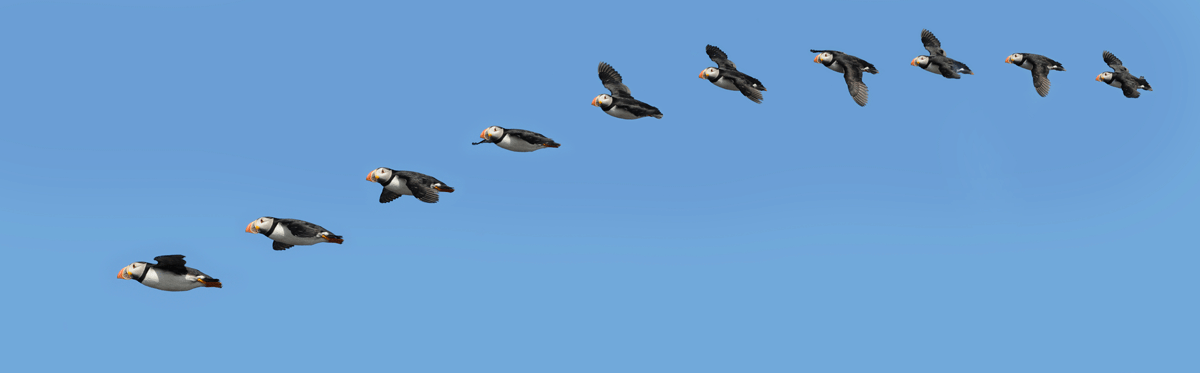
Atlantic Puffin (composite) – Les Iles au Perroquets, Mingan Archipelago; Gulf of Saint Lawerence, Canada: This is a composite of 10 images I made of one bird as it flew by. Most of the images are very sharp, though about 3 are a little soft. I included the soft images in the composition as it completes the series and at the computers resolution the soft images are not perceived as such. The series shows the bird further away at the right and closer on the left, thus the difference in size of the puffin. The original composite is 14” x 45”.
I had a great time shooting flying Alcids, but it was exhausting raising the D300 and 300mm 2.8 to my shoulder for a couple of hours. However, I do like the results……hope you do as well.
Nikon D300, Nikkor 300mm f2.8, Digital Capture ISO 320
Thursday, July 21, 2011
Update, and Pic of the Day:
Hello everyone, this is my first post since July 7. Sorry for not posting sooner but I have been on (and off) the road since my last post.
My latest travels have taken me to Canada and Maine. My Canadian destination was Longue Pointe de Mingan, on the north shore of the Gulf of Saint Lawrence. From there I took a small boat to, Les Iles au Perroquets to photograph puffins and other seabirds. After arriving at Les Iles au Perroquet I found it somewhat of a disappointment as I was under the impression that I would have the opportunity to get very close to puffins.
While the island host about 200 breeding puffins, there are no blinds that allow close access to the birds. Though I could not get close-up images of the birds I quickly saw the potential of shooting flight shots as the birds flew to their burrows. The only other location I had photographed Atlantic Puffins was Machias Seal Island, off the coast of Maine. While standing in the blinds at Machias Seal, it is next to impossible to take flight shots, so I took advantage of the situation on Les Iles au Perroquets. By the way, this translates to “Island of the Parrots.” The name was given by old sailor who called puffins, “Sea Parrots,” because of their large colorful beak.
To shoot the flight images I used a 300mm lens mounted on a custom made gunstock mount. The gunstock mount allowed me to follow the birds with a smooth panning motion. A cable release in the gunstock allowed me to release the shutter as if pulling the trigger of a gun. I would say that about 1/3 of the images I shot were sharp. Not too bad as the puffins were extremely fast fliers. Razorsbills, by the way, flew considerably slower. I did not notice this until I started taking the flight shots. Razorbills were somewhat easy to get the lens on and follow; puffins were much more difficult because of the speed they flew.
I also used a Nikon D300 with an MBD-11 set to continuous high frame rate. I love shooting the Nikon D7000 with its 16 mega pixel frame, but it simply does not shoot enough frames per second to get the job done in this situation.

I have always loved photographing razorbills. They are a real challenge being a totally black and white bird. Well, that is not quite true. The black is really a brown-black, but in bright sunlight, as when this shot was taken, the angle has to be just right to see the brown coloration.
As the auks and puffins flew past me they would often tilt at an angle that illuminated the bird at just the right angle to put a highlight in the eye. I began shooting before the tilt, with the expectations of capturing an image with the highlight in the eye. I like using cameras with a fast frame rate to capture the wings in just the right position.
I had to watch for birds flying low over the water at some distance from shore. Once finding one that appeared to be heading ashore, I pointed the lens and locked focus as it approached. The birds move very fast and I often lost focus. This was simply caused by my inability at times to pan the camera as the birds flew passed (they move sooooo darn fast).
I lucked out with this bird, it has two sand eels in its beak. One of the reasons I went to “Les Iles au Perroquets” was to photograph puffins with fish. I was happy to settle for this image.
More to come..............
More to come..............
Thursday, July 7, 2011
Whitney enters National Wildlife Federation's 41st Annual Photo Contest
Hello everyone. My daughter Whitney, has entered the National Wildlife Federations 41st annual photo competition. This is her first contest and she has entered some very good images. The contest has a peoples choice award. The following link will take you to Whitney’s images. Please take the time to go to this site and vote for her images. All you have to do once you are on the page is -- click on the green, checked box, by the vote count. You can log on every day and vote for your favorite image. Please vote as often as you can. Here is the link:
Thank you for voting for Whitney’s images. --- Bobby
Sunday, July 3, 2011
Pic of the Day

Mountain Bluebird – Rocky Mountain National Park, Colorado: I was at the Moraine Campground looking for Mountain Bluebirds to photograph, but was having no luck at all. A Black-billed Magpie flew in looking for a handout so I decided to photograph it, as I had no good photos of magpies in my files. After shooting for a quarter hour I resumed my search for Mountain Bluebirds.
After what seemed to be forever of scanning the hillsides for bluebirds I finally found a female fly-catching from a low hanging branch of a pine tree. Once I saw the female I gathered my equipment and began the stalk. I moved slowly and was able to approach within 20 feet before shooting. Then, I spotted this male hawking insects from a nearby pine branch. Both birds were very approachable and I followed them for over an hour. This is just one of the many bluebird images I shot that day, and I will post a few more in the near future. Nikon D7000, Nikkor 500mm f4 VRII, 1/60 second @ f6.3
National Wildlife Federation photography contest

I recently received an email from John Nuhn, photo editor of National Wildlife Magazine. If you are not familiar with National Wildlife Magazine it is one of the premier nature magazines in the world. Each year the magazine sponsors a Nature/wildlife photography contest for amateur and professional photographers. For all you photographers, there is still time to enter. Just follow the link to enter the contest, Good Luck!
Friday, July 1, 2011
Who's Looking
Jersey becomes the 87th country from which viewers have logged onto Bobby’s Photo Blog. Welcome to the blog and log on often. Bobby
Monday, June 27, 2011
Pic of the Day

American Avocet – Bear River National Wildlife Refuge; Brigham, Utah: This is another image of an America Avocet I shot at the Bear River NWR. Bear River is such an amazing place to shoot. The early morning and evening light is exquisite, in addition to the light the reflections of the mountains in the water, (as in this photo) makes for uniquely colored backgrounds of soft pastels. In this image, the late evening clam provided water with little movement giving an almost perfect reflection.
Sunday, June 26, 2011
Who's Looking
I would like to thank the viewers from the Dominican Republic for logging onto Bobby's Photo Blog. The Dominican Republic becomes the 86th country from which viewer have logged on. Welcome to the Blog and please log on often. Bobby
Pic of the Day

Marsh Wren – Bear River NWR, Utah: Driving along one of the many cattail marshes in Bear River NWR, I found this Marsh Wren atop a reed singing its territorial song. As I watched the wren it moved among its favorite perches within its territory. I positioned my van by one of its favorite perches near the road and used the van as a blind. Not long after parking and zeroing in on the perch, the wren soon made its appearance. Climbing to the top of the reed the Marsh Wren raised it head, opened it beak, and broadcast its call across the marsh, which was promptly answered by another wren nearby. It territorial proclamation gave me the opportunity to shoot this image, and many more.
Nikon D7000, Nikkor 500mm f4 VRII, 1/1000 Second @ f7.1, ISO 200
Saturday, June 25, 2011
Pic of the Day
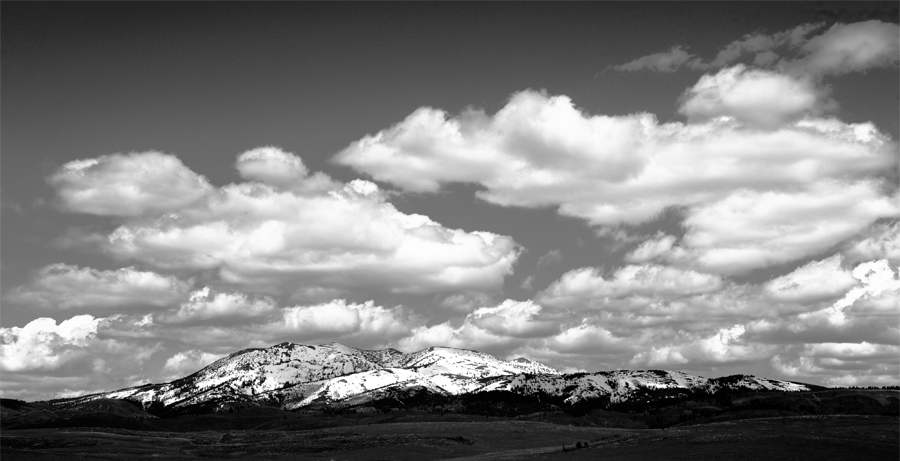
Caribou Mountain, Idaho: As I drove north to Yellowstone after leaving the Bear River Refuge I took a route that led through the high valley of Gray’s Lake National Wildlife Refuge. The Refuge is the nesting grounds of about 1,200 Sandhill Cranes and the rare Trumpeter Swan. Unfortunately I did not have time to visit the refuge, but I did take the time to shoot this scenic of Caribou Mountain which is just one of the majestic views from Gray’s Lake.
Caribou Mountain is a massive chunk of granite that rises 9,803 feet above sea level and is famous for its placer gold deposits that were discovered in 1874. Though gold is no longer mined at Caribou Mountain,individuals can still pan for gold in the mountains streams. But, that is not the reason I want to return to Gray’s Lake. For me it is the cranes and swans, they are much more valuable.Nikon D3, Nikkor 24-85mm zoom set to 48mm, 1/1,250 second @ f10, ISO 200
Whitney's Photo Blog
My daughter and her husband recently made a trip to Maine. They climbed Mt Katahdin and then they were off to Machias Seal Island where they photographed Atlantic Puffins and other seabirds. They had a great time on Machias Seal. Whitney has updated her blog and has some great puffin photos posted. You can checkout her blog at: www.whitneyrobison.blogspot.com, she will soon be adding more puffins and other shot from the trip.
Thursday, June 23, 2011
Pic of the Day

Grand Tetons and Field of Dandelions – Teton National Park, Wyoming: Driving along Antelope Flats Drive in Grand Teton National Park, I found this field of flowering dandelions. The yellow flowers provided the perfect foreground for an image of the Grand Tetons and blue sky. Walking among the flowers I found a spot with the greatest density of blooms and chose it as my foreground for the photograph. I attached my camera to a tripod and lowered the camera until it was about 18 inches off the ground allowing the expanse of flowers to fill the foreground space. I used a small aperture to create an extended depth-of-field which provided a sharpness from the flowers in the foreground to the mountains in the distance background. The yellow flowers, stretching to the foothills is the perfect complement to the blue sky that frames the mountains. Some days you just get lucky!
Wednesday, June 22, 2011
Pic of the Day

Eastern Kingbird – Camas National Wildlife Refuge; Hamer, Idaho: I arrived at Bear River NWR on a Sunday evening. The shooting was great and there were lots of birds. I was in the refuge before sunrise on Monday morning, and again I had a great morning of shooting. By 11:00 AM officials closed the refuge due to rising water. With the refuge closed I headed to Grand Teton National Park, and then to Yellowstone.
Spring was still a few weeks away in Yellowstone so I headed to Camas NWR in Idaho.
Camas is an exceptional location. The refuge has an auto drive that took me deep into the preserve. Because of the late spring many of the birds were just beginning to nest. After photographing Tundra Swan, Yellow-headed Blackbirds and Eared Grebe I came across this Eastern Kingbird.
I have photographed kingbirds before, but in my previous shots the kingbirds have been perched on man-made objects (fence post, barbed wire, road signs, etc.) This time I had a kingbird on a natural perch, I could not believe it. When I saw the bird on the natural perch I rolled my van window down, rested the camera and lens through the open window and slowly drove toward the bird.
As I approached the kingbird it flew from the perch caught an insect on the wing and returned to the same perch, What good fortune! As the bird alighted on its perch I started shooting and kept shooting. I shot numerous images as the bird twisted and turned. Finally, I had a kingbird on a natural perch. I was very happy, maybe next year I can get a Western Kingbird to do the same thing!Nikon D7000, Nikkor 500mm f4 VRII, 1/200 sec. @ f8
Pic of the Day

Around 3:00 PM the cloud cover at Farmington began to break-up and I though I would check-out Antelope Island. Antelope Island is a state park and refuge known for its birdlife, especially along the 7 mile causeway to the island. As I drove along the causeway I found it to be particularly void of life. When I arrived at the island itself little had changed. Where the causeway connected to the island there was an abundance of Yellow-headed Blackbirds, but that was about it.
As I drove around the island I could see massive thunderstorms that had formed over the Great Salt Lake. Using my I-pad, I opened the “Weather Bug” apt and saw that the storms stretched 130 degrees from the southwest to the northeast. Bear River Refuge, which lay north of Antelope Island was under a torrential downpour. This shot is of the southern tip of the storm as seen from White Rock Bay. This photo is a color digital image, which I converted to black-and-white in Photoshop.
Tuesday, June 21, 2011
Pic of the Day

Black-necked Stilt – Farmington Bird Sanctuary; Farmington, Utah: Driving through the Farmington Bird Sanctuary I saw this Black-necked Stilt aimlessly wandering in a circle. I stopped, used my van as a blind and began shooting. I took numerous images, but with each image I shot I was perplexed over the behavior. There seem to be no reason for the aimless wandering.
After about five minutes of shooting another stilt that I had notice feeding about a hundred feet away suddenly took flight and flew directly to the bird I was photographing. As soon as the new stilt alighted the bird I had been photographing flew off and the new arrival walked about three feed into the nearby grasses and settled onto a nest. The behavior of the bird I had been photographing now made sense.
The male had been protecting the nest from potential predators while the female was away feeding. Nikon D7000, Nikkor 500mm f4 VRII, 1/250 @ f8
Friday, June 17, 2011
Pic of the Day


This morning I shot these two image of the Clark's and Western grebes. Both of the birds are lifer's for me. The first lifer I've had since the Ivory-billed Woodpecker in February 2004.
I love the Bear River NWR, the shooting is great! If you have never been to this refuge, you should. Plan to be here in early to mid June. The birds are nesting and the refuge is hopping! Check back soon for more updates.
Look at the images closely. Can you tell which is the Clarks and which is the Western?
Nikon D7000, Nikkor 500mm f4
Thursday, June 16, 2011
Video of the Day
Nikon D7000, Nikkor 500mm f4
Wednesday, June 15, 2011
Pic of the Day

Monday, June 13, 2011
Pic of the Day

Tabletop formation – Kremmling, Colorado: I took the scenic route to Bear River Migratory Bird Refuge after leaving Rocky Mountain National Park. The route took me through Kremmling, Colorado. Just outside the north end of town I saw this fascinating mountain. Its formations were captivating and I just had to shoot some images. This is one of my favorites. More images to come!
Sunday, June 12, 2011
2nd Times a Charm!
As I posted previosuly, I was at Oklahoma's Tallgrass Prairie Preserve when I had to return home for a family medical issue. Now, all is well and I have arrived at the Bear River NWR near Brigham, Utah. I shot some nice photos today and hope to upload by tomarrow or Tuesday.
I also got a life bird today, a "Clark's Grebe," I'll post an image ASAP. Bobby
I also got a life bird today, a "Clark's Grebe," I'll post an image ASAP. Bobby
Sunday, June 5, 2011
Pic of the Day

Greater Roadrunner – Catalina State Park; Tucson, Arizona: Well, since I have had to return home due to family medical issues I thought I would post some images from my files. Hopefully I’ll be back on the road around Thursday and shooting soon after that.
This image of a Greater Roadrunner was photographed at Catalina State Park in Tucson, Arizona. Roadrunners are fascinating birds. When I see one, I think this is how a small Jurassic dinosaur might have looked. They are members of the family Cuculidae, which include the cuckoos, roadrunners and anis. The roadrunner is a large ground dwelling cuckoo that races around the desert and scrub seeking lizards, snakes and insects to devour.
Using my van as a blind I followed the roadrunner as it searched for prey in the parks desert scrub. After 30 minutes or so of hunting among the branchy willow the roadrunner walked into a grassy field and then into an open area allowing me to take a few unobstructed shots that showed off its blue and red feathered supercillium, long legs and thick, heavy bill. The roadrunner really does look prehistoric!
Trip Update:
Unfortunately I had to return home due to family medical issues. I left the Tallgrass Prairie arond 1:30PM on Friday and arrived home about 2:30PM Saturday. I should be back on the road by Thursday if all goes well. Bobby
Thursday, June 2, 2011
Pic of the Day
 |
| TARANTULAREX |
Taken with an iphone
Tuesday, May 31, 2011
On the road
I am heading to the Tallgrass Prairie, then further west. I will post updates after i do some shooting. Bobby
Sunday, May 29, 2011
Pic of the Day

Nikon D7000, Nikkor 500mm f4, 1/125 sec. @ f8
Saturday, May 28, 2011
Pic of the Day

The slow shutter speeds captured the movements of the body while the head, which remained almost motionless remained sharp. When I saw the image I could not help but think of those famous lyrics of Elivis!
Nikon D7000, Nikkor 300mm 2.8 with 1.4 tele-converter and 30mm of extension tubes
Sunday, May 22, 2011
Pic of the Day
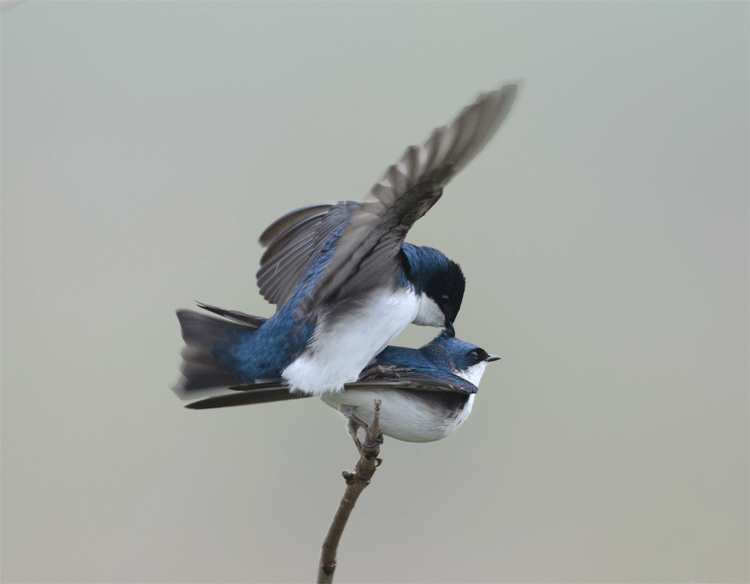
My first stop was the Ottawa NWR, which lays adjacent to Magee Marsh. The road to the visitor’s center was lined with bluebird boxes that were spaced about 300 feet apart. Instead of Bluebirds, each of the boxes were occupied by a pair of Tree Swallows. In front of one nest box was a small tree that provided a perfect perch for the attending swallows.
Using my van as a blind I parked about twenty feet away from the perch and began shooting photos of the female. Within a few minutes of shooting the male flew-in and began copulating with the female while on the wing. Shutter speeds were slow, but the slow speed added motion blur, which in turn added movement and action to the image.
When I left Magee Marsh that evening I had thought the days shooting was over. I had no idea that another great opportunity would present itself to me. Even though the light was quickly diminishing, shutter speeds were slow, and a light rain fell, the final images of the day were the highlights. Shooting seldom seen behavior is exciting, especially when unexpected.
Nikon D7000, Nikkor 500mm f4, 1/160sec. @ f7.1
Saturday, May 21, 2011
Who's Looking
Aruba marks the 85th country from which viewers have logged onto Bobby’s Photo Blog. Welcome to the blog and please log-on often as I update the bolg with new images every day or so. I hope you enjoy the blog and will return. Bobby
Friday, May 20, 2011
Pic of the Day

Blackpoll Warbler – Magee Marsh, Ohio: During my first day at Magee Marsh I saw numerous Blackpoll Warblers. In fact, the most I had ever seen in one day. This Blackpoll was one of three males and two females I saw at one time while on the Magee Marsh boardwalk. I was following this male Blackpoll with my 500mm lens as it bounded from limb to limb. Eventually it moved to a limb and paused for a fraction of a second. The view was unobstructed, and the auto-focus snapped the image into focus. I got this one and only shot before the Blackpoll slipped back in the leaf cover.
The Blackpoll is a overland spring migrant along the eastern and central flyways, but during fall migration the Blackpoll strikes out over the open ocean as it heads south to its South American wintering ground.
This was the first time I had the opportunity to photograph this beautifully patterned warbler.
This was the first time I had the opportunity to photograph this beautifully patterned warbler.
Thursday, May 19, 2011
Pic of the Day

Chestnut-sided Warbler – Magee Marsh, Ohio: On my third day at Magee Marsh the clouds had not lifted and the rain was steady most of the day. Though light, the rain required that I make a rain cover for my camera and lens to continue shooting. Thanks to dental floss and a plastic window shade from my van I was able to put together the make shift rain cover and hit the marsh a shooting.
The northerly winds and rain kept the birds low but they were still difficult to shoot. Slow shutter speeds and narrow depth-of-field made sharp images few and far between. Only when the birds paused while foraging was it possible to get a sharp image. This Chestnut-sided Warbler paused while searching for insects under the leaf cover. During the pause I shot the image.
To obtain an acceptable image size, I used a 300mm lens with a 1.4 extender with 30mm of extension tubes. Extension tubes allow a lens to focus within its minimum focus distance, thus producing a larger image size. This bird was less than 10 feet from me when I shot the photo.
Wednesday, May 18, 2011
Pic of the Day

This female, Yellow-rumped Warbler was found in a mixed flock of warblers that was moving within a low row of willows. Occasionally the birds within the willow would find an open space that allowed me to shoot an image or two before disappearing into the jumble of branches.
Shooting was difficult as the light was low, a slight drizzle fell most of the day, and the wind was ferocious. But, braving the elements did pay off with a few good shots. This is just one.
Sunday, May 15, 2011
Pic of the Day
  |
| Red-eyed Vireo -- Magee Marsh, Ohio |
In addition to the birds, I ran into Matt Mendenhall, associate editor of Bird Watching magazine. After a morning of shooting birds Matt and I met for a late lunch and had a great conversation about birds, birdwatching and kids, not necessarily in that order. I also ran into Richard Crossley of Crossley Bird Guide fame. Richard is a very nice fellow, we had a great time talking birds, photoshop and photography. He was also at the Ottawa National Wildlife Refuge today autographing his new, earth shaking, field guide.
This Red-eyed Vireo and Magnolia Warbler were photographed on the boardwalk at Magee Marsh. The vireo was captured as it looked under leaves for insects and the Magnolia was captured as it bounced from tree limb to tree limb searching for food. This might be the peak of warbler migration here at Magee Marsh. The day was very, very good. I’m here for another day to photograph the birds and then I'm off to Canada where I hope to meet them at Point Pelee on the north shore of the lake.
Sunday, May 8, 2011
Pic of the Day

Nikon D7000, Nikkor 500mm f4, 1/250sec @f11, ISO 200
Saturday, May 7, 2011
Pic of the Day

This dragonfly was perched at just the right angle, and, of out-of-focus water and foliage provided the perfect background. Within forty-five minutes after the sun rose the winds began to blow quite hard causing the foliage to violently sway, thus ending the dragonfly shooting. However, it was fun while it lasted and there were birds to shoot!
Who's Looking
Kenya is the 84th, and latest country from which viewers have logged on to Bobby's Photo Blog. Welcome to the blog. I hope you enjoy the images and will return to view my updates often. It is soooo exciting to log-on and see not only returning viewers, but new viewers from new countries. Thank you all for checking out the blog. Bobby
Friday, May 6, 2011
Pic of the day
 |
| Least Bittern, Image 1 |

Least Bittern, Image 2
Least Bittern – Ritch Grissom Memorial Wetlands; Viera, Florida: Least bitterns are one of the least (no pun intended) seen birds among birdwatchers. I went years without ever seeing one, that is until I learned the real secret to finding them. That secret is not just where, but when.
The where, is among wetland reeds and cattails where they feed, sleep and breed. The when, is early April in South Florida and late April in Northern Florida. I happened to be at the Ritch Grissom Memorial Wetlands in Viera, Florida in late April, and Least bitterns seemed to be everywhere, it was the time of bittern breeding. I saw bitterns fly from reed patch to reed patch, stalking prey and copulating. The breeding season seems to make the bitterns less wary, less reclusive and less inhibited.
The first image is of a bird I stalked for about forty-five minutes before it stepped into a semi open area among the reeds. The shooting opportunity was short, just a few seconds. As I began shooting, the bittern plucked a frog from the water and paused for just a moment. I took the image as the frog dangled from its beak, its eye visible between the reeds, and its body partially obscured with vegetation, typical of the secretive bittern.
I found the bird in the second image as I drove along the dike roads of the water impoundments. The bird was at the edge of a reed bed about fifteen feet off the road. The bittern was in a classic pose, feet stretched between two reeds, neck and head pointed upward, and an eye turned toward the camera, the kind of image I have wanted to shoot for years.
Bitterns are a challenge to photograph, as they stay hidden among reads most of the year. Breeding seasons brings them out of the depths of the reed beds, providing opportunities to photograph them, even though those opportunities are brief. Knowing when Least Bitterns begin breeding in your area will increases your shooting opportunities as well.
Image 1. Nikon D7000, Nikkor 500mm f4, 1/640sec. @ f6.3, ISO 200
Image 2. Nikon D7000, Nikkor 500mm f4, 1/500sec. @ f6.3, ISO 200
Image 1. Nikon D7000, Nikkor 500mm f4, 1/640sec. @ f6.3, ISO 200
Image 2. Nikon D7000, Nikkor 500mm f4, 1/500sec. @ f6.3, ISO 200
Thursday, May 5, 2011
Who's Looking
Welcome viewers from Haiti! Haiti becomes the 83rd country from which viewers have logged on to Bobby's Photo Blog. Welcome to the site and please log-on often. Bobby
Subscribe to:
Posts (Atom)