Saturday, March 5, 2011

Pic of the Day


     Hello everyone.  It has been some time since I have made a post.  I am in Florida shooting, or should I say trying to shoot.  I have come south to photograph wadding birds in breeding plumage, but waders have been few and far between.  I have not seen any significant number of birds.  Even the colonies that I frequent this time of year have only a third of the birds I normally see.  I talked with a biologist, and was told that after doing aerial surveys if southwest Florida, no large colonies of heron or wood stork have been found this year.  No one seems to know what’s going on this breeding season. 
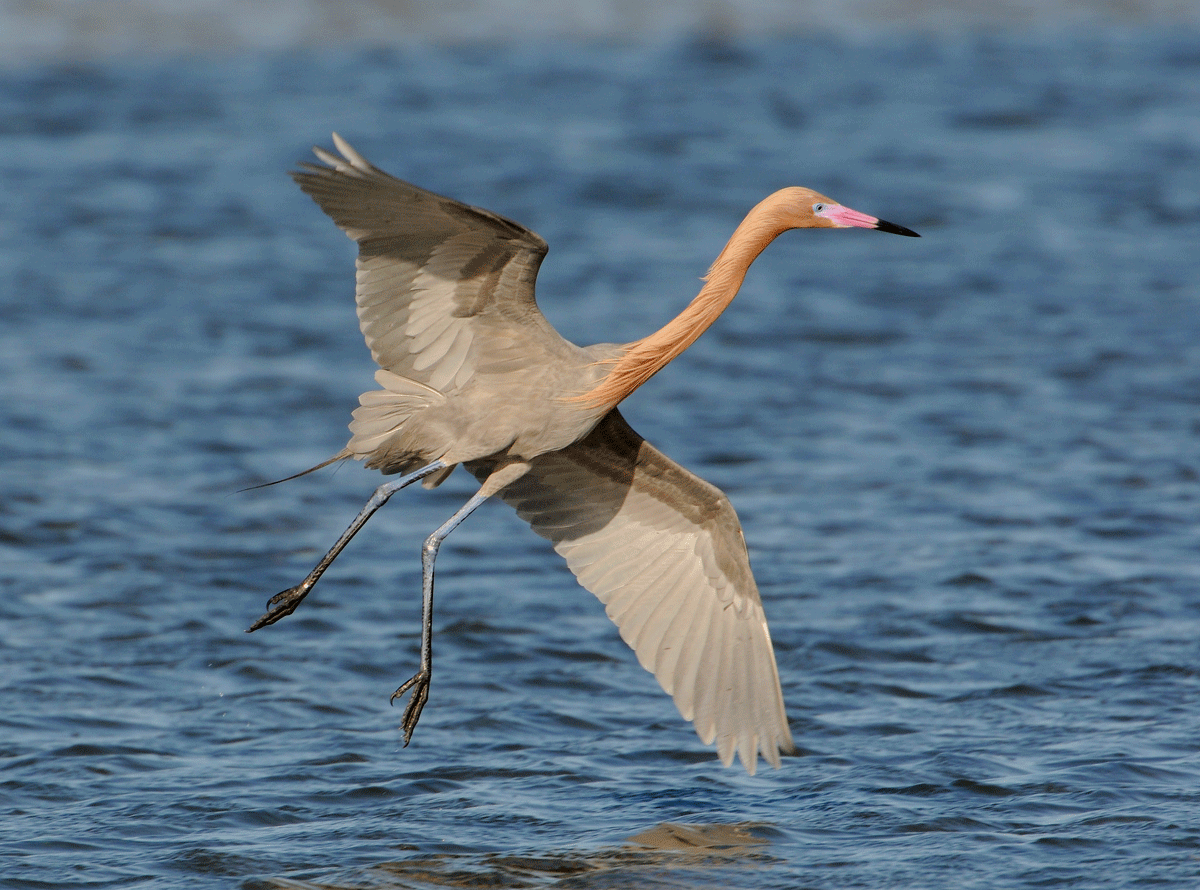
   Though the birds have been far and few between I have been able to get some shots.  This Reddish Egret was photographed at Fort Desoto Park in St. Petersburg, Florida.  There were only a handful of (visible) birds in the area when I made this shot.  Fortunately the egret was actively feeding which allowed me to get this in-flight shot.

Nikon D300, Nikkor 500mm f4, Digital Capture ISO 200,  1/640 sec. @ f9

Sunday, February 27, 2011

7th Anniversary of Ivory-billed Woodpecker Sighting

Some Ivory-billed Woodpecker sighting location in
Bayou Deview during 2004-2005 search season.
Sighting mention below are indicated on this map
   It was Seven years ago today that Tim Gallagher and I saw an Ivory-billed Woodpecker on Bayou Deview in the Cache River National Wildlife Refuge.   It is a day I will never forget.  I had researched and searched for the Ivory-bill for thirty-three years prior to the 2004 sighting.  Reports of Ivory-bills had been made almost every year of every decade since 1944, and research told me that they could still be extant.  On February 27th, 2004 I knew that they were.  Well, at least one.

   Over the next year I had an additional 5 sightings.  The very next day, February 28th , I saw an Ivory bill flying southwest, about a half mile south of the first sighting of the previous day.  My third sighting came on May 5th, the fourth on June 9th, and a 5th  sighting came of September 4th.  All three of these sighting were within 525 feet of each other.  My 6th sighting occurred 3/4th of a mile north of Arkansas Hwy 17 on January 22, 2005.  This sighting was special, for I saw two birds flying together.  This was the first time that I knew there was more than one Ivory-bill in the Bayou Deview search area.  Based on the number of sighting that were occurring on Bayou Deview during early 2004, I believed that at least one or more Ivory-bills were making feeding forays into Bayou Deview about once every two weeks.  

   My January 22nd sighting was the last time I positively identified Ivory-bills on Bayou Deview.   The sighting Tim and I had on February 27th 2004 was four years after a major ice storm had hit the area.   The ice storm was severe and created good feeding habitat for Ivory-bills.  Perhaps that is why there were Ivory-bills in the area when Tim and I arrived in February 2004.


To read more about the February 27th 2004 sighting follow this link:

Saturday, February 26, 2011

Who's Looking

   Welcome viewers from Sri Lanka and Lebanon.  Sri Lanka and Lebanon are the 78th and 79th country from which viewers have logged onto Bobby's Photo Blog.  I hope you have enjoyed the blog and will comeback often.  BobbyL

Thursday, February 24, 2011

Who's Looking

   Viewers from Argentina have logged onto Bobby's Photo Blog.  Argentina becomes the 77th country from which viewers have logged on.  Thank you for checking out the blog and please come back often.  Bobby

Saturday, February 19, 2011

Pic of the Day

     Alaska Range from Denali Highway, Alaska:  The abundance of wildlife, snowcapped mountains and shoreline as always made Alaska one of my favorite shooting destinations.  This photo of the Alaska Range was taken on my favorite stretch of road.  The Denali Highway connects Cantwell (which is just south of Denali National Park), and Paxson Junction on the Richardson Highway.  The 150+ mile road crosses tundra and taiga, follows riverbeds and crosses mountain passes revealing the stunning beauty of wild Alaska.  From various points on the highway great views of Denali itself is possible.  Denali, the tallest mountain in North America is the second highest peak in the world.  The highway also provides great views of numerous glaciers.  On my first trip across the Denali Highway I only saw two other vehicles.  However the road is highly traveled today, but is still a great way to see the great Alaskan wilderness. 

Nikon F3,  Lens Unknown, Approx. 80mm, Kodachrome 64

Friday, February 18, 2011

Pic of the Day

   Snow Geese – Bosque del Apache National Wildlife Refuge, New Mexico:  Bosque is world renowned for its abundance of over wintering Snow Geese and Sandhill Cranes.  More than 35,000 Snow Geese invade the refuge by early October and remain until March when they begin their journey back north.  These two geese were flying to one of the many water impoundments where they will join other members of the flock to roost overnight.   To make this image I used a 300mm lens mounted on a handmade gunstock.  An electronic cable release mounted as a trigger operated the camera’s auto focus and shutter release.  An auto focus lens and dynamic focus was essential to keep the birds in focus as I panned with them during their fly-by.  A rapid 8 frames per-second provide a frame with the wings in just the right position.

Nikon F5, Nikkor 300mm 2.8, on gunstock mount, Fujichrome 100

Thursday, February 17, 2011

Who's Looking

   Viewers from Puerto Rico have logged on to Bobby's Photo Blog.  Puerto Rico is the 76th country from which viewers have logged-on.  Welcome to the blog and please visit often.  Bobby

Tuesday, February 15, 2011

Pic of the Day

   Loggerhead Shrike – Bosque del Apache National Wildlife Refuge, New Mexico:  I was at Bosque to photograph Snow Geese and Sandhill Cranes, birds that winter at the refuge by the tens of thousands and make Bosque so famous. 
   While making an early morning run to photograph geese and cranes I came across this Loggerhead Shrike hunting along the roadside.   Shrikes, also known as “Butcher Birds,” catch insects and mice and often impale them on thorns and barbed wire before tearing them apart with their hooked bill.  
   I approached this bird using my van as a blind.   With my window down and camera on a window mount I turned the engine off, and coasted to the shrike.  It was lit from the side and facing into the sun, defiantly not flattering light. The side of the shrike facing the camera was in the shadows and virtually a silhouette.  However, the background was perfect.  It was clean and did not competing with the subject.    But good fortune turned in my favor.  Instead of leaping into flight, the bird turned its head and looked over its back.   The strong side lighting illuminated the front of the shrike and ignited a catch light in its eye, creating a strong dynamic image of this “Butcher bird.”


Nikon F5, Nikkor 500mm f4 with 1.4 teleconverter, Kodachrome 64

Sunday, February 13, 2011

Whintey's Blog

   My Daughter, Whitney, has updated her blog.  She has some wonderful photos of a Weimaraner Dog.   Please take a look.  I find the photos to be quite engaging.  Click here to go to Whitney's blog; 
whitneyrobison.blogspot.com

Saturday, February 12, 2011

Recently Published Work

     The winter, 2011 issue of Creation Illustrated is out!  The issue contains my second column with this magazine.  The article is about Everglades National Park’s, Anhinga Trail and it’s amazing birds.  To subscribe, or learn more about Creation Illustrated go to: http://www.creationillustrated.com

Friday, February 11, 2011

Pic of the day

                                                                                  Arizona Woodpecker, Photo 2

Arizona Woodpecker, Photo 1
   Arizona Woodpecker – Madera Canyon, Arizona:  I photographed this Arizona Woodpecker near the Santa Rita Lodge in southeast Arizona.  If you have an older field guide the bird may be identified as a Strickland’s Woodpecker.  The 42nd Supplement of the American Ornithologists Union split the Strickland’s into two groups placing the Arizona Woodpecker at the northern end of the birds range and the Strickland’s at the southern end of the range.   The Arizona/Stickland’s Woodpecker range is from southeast Arizona and southwest New Mexico, south through central Mexico.  The bird was originally named for British scientist Hugh Edwin Strickland (1811-1853).
   These two images show the woodpecker at rest (photo 1), and drumming (photo 2).  The drumming photo shows the head in motion as it reverberates against the tree.  To drum, woodpeckers typically strikes its target around 20 times per second.  I used a slow shutter speed to take both photos. As I made the exposure for image 2 the woodpeckers head was still, but during the exposure the woodpecker started drumming, thus exposing the blurred motion over the still image of the woodpeckers head.  Sometimes you just get lucky.  To learn more about the mechanics of woodpecker drumming, go to: http://www.arn.org/blogs/index.php/literature/2011/02/10/woodpecker_drumming_inspires_shock_absor
Also see May 19 post of an Arizona Woodpecker.

Nikon D200, Nikkor 500mm f4 with 1.4 Teleconverter

Tuesday, February 8, 2011

Speaking in Louisville

Bobby speaking about birds at Louisville Adventist Academy.
Photo by: Whitney Robison
   My daughter, who teaches 5th and 6th grade at Louisville Adventist Academy in Louisville, Kentucky has been studying birds with her students over the last few weeks.  She invited me to the school to show bird photos and speak on birds and bird watching.  I gladly excepted and made the trip last week.   I had a great time and the kids were exceptionally courteous.   During the presentation they were quite and seemed genuinely interested in what I was saying.  When I finished the program I took questions, and the questions were quite good.  I was very impressed with the students.  The students also made a card for me with an ivory-billed woodpecker on the front.  Each student that attended the program signed the card……WHAT A TREAT!  Who knows what future ornithologist might spring from that group!

   For all of you at Louisville Adventist Academy, thank you for the opportunity to speak on my favorite subject, and thank you for being such a great group.  I love the card……Bobby

Who's Looking

   Belize has just become the 75th country from which viewers have logged on to Bobby's Photo Blog.  Welcome to the blog, and please log on often!

Monday, February 7, 2011

Pic of the Day

   Glassware – Studio Photography: I have been a wildlife and nature photographer for more than thirty-six years, and those who know me know that I am most passionate about birds.   However, my specialty in my undergraduate degree was studio photography, specifically portraits.  Before I started teaching full time, 19 years ago, I operated a studio and made part of my living shooting portraits and products.
   I spend so much time shooting birds these days that I do not get into the studio very often.  So, when I teach a studio class it gives me the opportunity to do demonstrations that allow me explore subjects and create images.  This semester I am teaching a studio photography class.  The first few assignment introduce my students to lighting and its effects through photographing simple subjects.  As the semester progress lighting and subject matter become more complex. 
   I shot this image as a demonstration on how to illuminate a simple object with a single light source.  The image is a close-up of a glass vase.  A single light shinning through seamless white paper illuminates the vase, creating a black line that divides the image with a graceful curve.  The simple object becomes a study in texture, form, shape, and tone; the essence of studio lighting.
   My students have already started shooting the assignments and are producing some very creative works. I will share some of their work on this blog in future post.

Nikon D3, Nikkor 80-200 f4, Digital Capture ISO 200,  1/200 sec. @ f22

Sunday, February 6, 2011

Pic of the Day

   Mountain Bluebird – Yellowstone National Park, Wyoming:  I was photographing Ruddy Duck when a fellow photographer asked if I had photographed the Mountain Bluebird nest.  I said no and asked where it was.  Like all wildlife photographers he was willing to share his find with fellow photographers and told me exactly where to go.  After shooting the ducks I headed for the bluebird nest.   Sure enough, the bluebird nest was just where it was supposed to be, and so where dozens of birder’s, photographers and curiosity seekers.
   With all the people lined-up to see the activity at the nest it would have been difficult to shoot.  The birds also seemed somewhat wary of all the commotion from the spectators.  I waited for about half and hour or so and until the horde of people moved on.  I drove up the road to a nearby picnic area and parked my van.  I gathered my equipment, dawned camo clothing and covers and walked back to the nest site.
The tree that the nest was in was about 60 feet from the road.  I had to use a 2X extender to obtain a reasonable size image in frame.  Fortunately the sun was shinning bright and that allowed me to use a fast shutter speed.  Once at the nest site I found myself to be the lone visitor.  Because the nest tree was in a ravine, it was position below eye level.  I quickly slide down the embankment about six feet making myself eye level with the nest, and invisible to passerby on the road above.  I covered myself and the camera with camo cloth and observed and photographed the birds while all alone.   With each car that passed I expected someone to stop and discover me, but it never happened.  I was able to photograph the birds going about there afternoons activity without them even noticing that I was nearby.   This shot was taken right after the female fed her nestling and perched on a nearby limb to preen, stretch and scratch an itch.

To see another image of this bluebird go to the “On the Road” post  for June 17, 2010.

Nikon D300, Nikkor 500mm f4 with 2X Extender (teleconverter), Digital Capture ISO200

Sunday, January 30, 2011

Recently Published Work

    My latest Great Birding Escape column has been published in the Winter, 2011 Issue of Living Bird Magazine.  The GBE is on Shawnee Statel Forest in southern Ohio.  When the issue is made available on line, I will post a link so you may access it through the Living Bird website.  If you would like to subscribe to Living Bird go to: http://www.allaboutbirds.org/NetCommunity/Page.aspx?pid=1173

Thursday, January 27, 2011

Who's Looking

  I would like to welcomes new viewers from Georgia.  Georgia is the 74th country from which readers have log-on to Bobby's Photo Blog.  Welcome to the blog and please visit often.

Tuesday, January 25, 2011

Pic of the Day

   Limpkin – Circle B Bar Reserve; Lakeland, Florida:  About a year ago friends that live in Florida brought my attention to the Circle B Bar Reserve and the rich photo opportunities it presents.   Once an active cattle ranch, the Circle B was purchased by Polk county and the Southwest Florida Water Management Destrict Lands Program as part of the Upper Peace River restoration.  The Reserve is combination of oak  hammocks, freshwater marshes, hardwood swamp and lakeshore.   During late January through mid March the reserve is a haven for wading birds, waterfowl, eagles and osprey.
   Earlier this month I was at the Circle B and found the birdlife to be quite impressive.  Hundreds of White Pelicans and Woodstorks crowded the trees that stand in the water impoundments.  Fulvous Tree Ducks, other waterfowl and wading birds were plentiful.  A specialty among the waders was the Limpkin.  Limpkins were quite abundant, perhaps the most limpkins I have seen in one place outside of the Ritch Grissom Wetlands at Veria, Florida.
   While I was photographing a group of Limpkins along the shoreline of one of the water impoundments this Limpkin flew by.  I could not believe my good fortune.  With my camera already set in autofocus mode I quickly swung the lens toward the flying bird.  The autofocus sensor locked onto the head of the bird and snapped into focus as I shot a series of images.  Out of the six images shot, this one captured the wings in just the right position with a body posture that is indicative of this species in flight.  Of course, part of luck is being in the right place at the right time, and staying observant to what is happening around you.   


Nikon D300, Nikkor 500mm f4, Digital Capture ISO 200, 1/400 sec. @ f7.1

Saturday, January 22, 2011

Book Review

   I recently purchased the book, 100 Ways to Take Better Nature & Wildlife Photographs, by Guy Edwardes.  The book is illustrated with extraordinary photos and filled with excellent tips for beginner and experienced wildlife and nature photographers.  The book covers topics such as: Technical information, fieldcraft, composition, lighting, as well as close-up, bird, animal, flower photography and more.  It is well written and would make a fine addition to your library.   For more information about the book,  and how to order, go to:  http://www.amazon.com/Ways-better-Nature-Wildlife-Photographs/dp/0715331493/ref=sr_1_1?ie=UTF8&s=books&qid=1295753214&sr=1-1

Who's Looking

   Viewers from Algeria have logged on to Bobby's Photo Blog.   Algeria is the 73rd country from which viewers have logged on.  Welome to the blog, and come back Often!

Friday, January 21, 2011

Whitney's Photo Blog

Branden and Whitney in Canebrake taking photos.

   Over the last year my daughter (Whitney) has taken an interest in photography.   On a recent trip to Cincinnati she took photos at an arboretum.  Most recently, on one of her visits home she wanted to go somewhere interesting to take photos.  I took her and Brandon (her husband) to the canebrake on Keel Hollow Road to shoot.  She and Brandon really enjoyed walking around in the canebrake, and shooting.  She also took some very nice photos.
   She now has a blog to show her work.  I am impressed.  She has a good eye and is mastering the technical side of the art as well.  She made some great images both in Cincinnati and at the canebrake.  You can see her blog at,  www.whitneyrobison.blogspot.com.   I also have a link to her blog in “Bobby's Favorite Blogs” on this page.
   As you may have already guessed, I am a proud father.  She certainly has the talents to become an excellent photographer.

Thursday, January 20, 2011

Pic of the Day

   Sanderling – Blind Pass; Captiva, Florida:  This is another shot taken with the Frisbee/ball head combination at Blind Pass.  I shot this image a few minutes after shooting the turnstone in the previous post.  I do love the low shooting angle that the Frisbee/ball head combination provides.  The image was shot at a wide aperture of f4, The wide aperture provides a shallow depth of field isolating the Sanderling against other birds in the flock.  Shallow depth of field, or selected focus is an essential composition technique when using long lenses.

Nikon D300, Nikkor 500 f4, Digital Capture ISO 200, 1/4000 second @ f4

Tuesday, January 18, 2011

Pic of the Day

   Ruddy Turnstone – Blind Pass; Captiva, Florida: On January 5th I posted an image of a Snowy Egret that I took using a long lens mouned on a ball head attached to a Frisbee.  I mentioned in the post that I had gotten the idea from a recent book I had read, but could not remember which book at the time of the post.  The book was Captured:  Lessons from Behind the Lens of a Legendary Wildlife Photographer, by Moose Peterson.  The book, by the way is well written and worth reading.
   Using the Frisbee mounted ball head I went to Blind Pass on Captiva Island to shoot shorebirds and terns.  The set-up worked well as I crawled across the beach.  The Frisbee allowed me to easily slide the camera forward and backwards as I move over the sand.  As I mentioned in the January 5th post, the Frisbee is very flexible and has a tendency to cause the camera and lens to awkwardly tilt left, right and forward.  I have since mounted the ball head on a pie pan to see if it will work better than the Frisbee.  Once I have tried the new outfit, I’ll let you know how it works.
   This Ruddy Turnstone was taken with my lens mounted on the ball head/Frisbee combination.  Turnstones were numerous on the beach at Blind Pass and were feeding on Pen Shells that had washed ashore during a recent storm.  The lens mounted on the Frisbee/ball head combination made it easy to slide toward the turnstones as they ran up and down the beach, and backward as the bird ran toward me.  I often found myself backing up rather than moving toward the birds.  It appeared to me that by laying on the beach the turnstones did not see me as a threat, and pretty much ignored me.

Nikon D7000, Nikkor 500mm f4, Digital Capture ISO 200, 1/1250th second @ f10


Note:  To order Captured, by Moose Peterson go to:  http://www.amazon.com/gp/product/0321720598/ref=pd_lpo_k2_dp_sr_1?pf_rd_p=486539851&pf_rd_s=lpo-top-stripe-1&pf_rd_t=201&pf_rd_i=1579904823&pf_rd_m=ATVPDKIKX0DER&pf_rd_r=1VG509Z91QAZBP5HT8WY

Monday, January 17, 2011

Pic of the Day

Tri-colored Heron

Little Blue Heron      
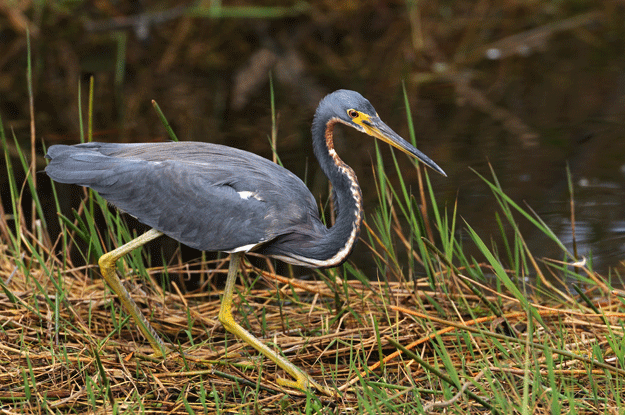
     Anhinga Trail; Everglades National Park, Florida: Continuing the theme of the last post, here are a couple of more photos of common birds found on Anhinga Trail.  Both of these birds were shot in the same spot.  The Tri-colored heron was stalking and catching fish when the Little Blue Heron flew-in and frightened the Tri-colored away.  After feeding in the same location the little blue stretched and preened before resuming feeding activity. I must say that I do love the pose of the Tri-colored Heron.  It is a classic heron pose with its potential energy and "S" curved neck.
Nikon D300, Nikkor 500mm f4  (both images)

Sunday, January 16, 2011

Pic of the Day

    Green Heron – Anhinga Trail; Everglades National Park, Florida:  Anhinga Trail is one of the most reliable places on the planet to find birds to photograph.   During the dry season from January to April, a plethora of birds to watch and photograph can be found on the .8 tenths mile trail.
   I do not remember a time that I have been to Anhinga Trail and not seen green herons perched on a rock or low hanging branch snatching minnows from the slough.  This Green Heron was photographed in the late evening light as the sun was setting.  While the orange light of the setting sun barely illuminated the heron, it revealed detailed, intricate patterns in the heron’s feathers that are often overlooked by the casual observer.  

Nikon D300, Nikkor 500mm f4, Digital Capture ISO 400, 1/125th Second, f6.3

Pic of the Day

Crescent Moon, Shadow side 1/2 second,  f4
Crescent Moon 1/400th second,  f4.5
   Crescent Moon – January 6, 2011:  As I drove north out of Florida a brilliant crescent moon hung above the western horizon.  The sky was a deep azure blue and quickly fading to black.  The shadow side of the moon, lit by light reflecting from Earth was quite bright in the cold, crisp winter air.  The conditions were perfect for photography. 
   As I drove across the Florida/Georgia state line I pulled into the Georgia welcome station, set-up my camera and lens on a tripod and began shooting.  Knowing the exposure for the sunlit side of the moon is 1/125th of a second at f8, I set an equivalent exposure of 1/400th of a second at f4.5. The faster shutter speed helped reduce blurriness caused by camera/lens vibration. 
   After shooting for the detail in the crescent moon, I took another image exposing for the shadow side of the moon.   I did a number of exposure variations and achieved a reasonably sharp image of the shadow side at 1/2 second at f4.  The sunlit crescent is highly overexposed but craters and mares are readily visible on the shadow side.

Nikon D300, Nikkor 500mm f4

Thursday, January 13, 2011

Pic of the Day

   Great Egret among Snowies –Merritt Island NWR, Florida:  I was driving through what looked to be a lifeless Merritt Island NWR, then I saw this scene above.  Water in the marsh was extremely low, and was restricted to small pools scattered along the wildlife drive.  Such pools become havens for fish as water in the marsh shrinks. Birds quickly become aware of the concentrations and descend on the pools with a vengeance.
   As soon as I saw the scene I brought my van parallel to the pond to access the little feeding frenzy that was taking place.  The birds were so intent on their feeding activity they paid me little notice.  I was immediately struck by the graphic nature of the scene, “S” curved necks, and all white birds.  But, It was not so much the birds themselves that made the image, as it was their reflections.  As I shot photos of the egrets dancing around their fishing hole I was reminded again that nature is always full of surprises, and I loved this surprise.


Nikon D300, Nikkor 24-85mm Zoom, Digital Capture ISO 200, 125 Sec. @ f8

Tuesday, January 11, 2011

Pic of the Day


   Ringed-necked Duck – Ritch Grissom Memorial Wetlands; Viera, Florida:  Ringed-necked ducks have always been one of my favorite duck species.  The male with its gray flanks set against a purple black back and breast, accented with a white flank strips and ringed bill is visually stunning.  Though the female wears a dress of brown feathers, her white-eye and bill ring gives her a subtle beauty that makes her the perfect complement to the male.
   In the wild it is usually difficult to get close to ducks, but at protected sanctuaries and preserves they can be very approachable.  As I drove the auto trail at the Ritch Grissom wetlands I spotted these ring-necks feeding in the shallows close to the road.
   I pulled the van past the ducks and parked, got out and stealthily slid down to the waters edge about a hundred feet from them. With my camera already on a tripod I sat down on the ground and hoped that the ducks would move toward me as they fed.
While waiting for the ducks to swim toward me a Limpkin landed in the reeds right in front of me and began plucking apple snails from the water.  I could not believe my good fortune as the Limpkin presented me with a great photo opportunity. 
   While I was shooting the Limpkin, another wildlife watcher stopped to look at the Ring-necks.  In doing so the ducks began to swim toward me as if I were not even there.  As they came within range I began to shoot.  As I began shooting the sun broke through clouds, bathing the ducks in the warm glowing light of a retiring sun.  As I have said so many times in previous post, I love it when everything comes together.  That evening I photographed these ring-necked ducks, it could not have been more perfect.

Nikon D300, Nikkor 500mm f4, Digital Capture ISO 200, 1/400 sec. @ f9

Monday, January 10, 2011

Pic of the Day

 White Ibis – A. Max Brewer Memorial Parkway; Titusville, Florida:  This trip was certainly the year for photographing ibis.  Ibis seemed to be everywhere and were very photographable.  This ibis was photographed on the causeway that leads from Titusville to Cape Canaveral just before entering the Merritt Island National Wildlife Refuge.  I stopped along the causeway to photograph gulls, but the sky was overcast and the images looked very dull.  Soon, the sun began to break through the clouds and the birds on the causeway came alive.  All of a sudden, birds began to appear from all directions to feed in the shallows of the Indian River. 
   As I shot images of gulls, an ibis flew onto the scene and began searching for prey.  It was not long until it was pulling horseshoe crabs out of the water.  The antics of the ibis were most interesting. With each catch the ibis would toss the crab into the air, catch it with its beak, then crunch down breaking the crabs shell.   The tossing and crunching continued for about forty-five seconds per crab.  Once broken and cracked to the ibis’ satisfaction, the crab went down its gullet. The gulls that were ever present stayed close to the ibis and continually tried to snatch its catch…..to no avail.

Nikon D300, 500mm f4, Digital Capture ISO 200, 1/2500 sec. @ f6.3

Sunday, January 9, 2011

Pic of the Day


   Limpkin – Ritch Grissom Memorial Wetlands; Viera, Florida:  The Limpkin is an interesting bird.  It appears to be a large rail, but its skeletal structure is more crane like.  Taxonomist place the Limpkin in its own genus, Aramus and family, Aramidae; and is the only extant species of the genus and family.
   This limpkin was photographed at the western most impoundment of the wetlands as it searched for Apple Snails (Ampullariidae), which is a primary food source.  Limpkins at the Ritch Grissom Wetlands are very approachable and are very numerous.  The wetlands is open to both foot traffic and auto traffic making access to the various water impoundments very accessible.

Nikon D300, Nikkor 500mm f4, Digital Capture ISO 200, 1/400 sec. @ f9

Saturday, January 8, 2011

Pic of the Day

    White Ibis – Ding Darling National Wildlife Refuge; Sanibel Island, Florida:  After leaving Fort De Soto State Park we headed for Fort Myers and Sanibel Island.  On January 2nd we were up early and on the wildlife drive.  There were few birds on the auto trail but when we arrived at the water impoundment at observation deck 3, there were two lone White Ibis feeding in the shallows.  The early morning light provided a nice reflection of the birds and a great photo opportunity as they moved along the shoreline probing the muddy bottom for crabs.  This ibis was photographed with its prey suspended in mid air just before gulping the crab down its gullet.

Nikon D7000, Nikkor 500mm f4, Digital Capture ISO 200, 1/1600 sec. @ f8

Pic of the Day


  White Ibis—Fort De Soto State Park, Saint Petersburg, Florida:  We arrived at Fort De Soto Park around 3:00 O’clock in the morning on New Years Day.  Having driven all night I was exhausted.  So, having a full size bed in the back of the van I retired for the morning and got a few hours sleep before sunrise.
     The sun rose around 7:00 O’clock and I was soon on the beaches looking for shorebird to photograph.  The morning was chilly, with temps somewhere in the mid 50’s (F).  In a small lagoon I found a flock of White Ibis huddled together with each going about its early morning preening duties.  The ibis were standing in the shade and the sunlight was falling on the water behind them.  I particularly liked the way the shadows softened the bird’s feathers and how the feathers edges seem to blend into the overexposed water in the background. 
     I made my exposure using the spot meter in manual exposure mode.   I took a meter reading from the birds whitest feathers and exposed that area one stop lighter than a middle value.  This exposure, along with the direct sunlight caused the watery background to overexpose and turn white that provides a light, ethereal quality to the image.

Nikon D7000, Nikkor 500mm f4, Digital Capture ISO 200,  1/200 sec. @ f6.3

Friday, January 7, 2011

Who's Looking

   Viewers from Armenia and Hungary have logged onto the blog over the last week.  Welcome to Bobby's Photo Blog, and please come back.  I will be posting quite regularly with images from my most recent trip.  Armenia anb Hungary bring the country count from which readers have logged-on, to seventy-two.  

Pic of the Day


   Willet – Captiva Island, Florida:  January 2nd was another beautiful day in Southern Florida, but the birds in Ding Darling National Wildlife Refuge were few and far between.  After a drive through the refuge we headed to Tween-waters, the slough that separates Sanibel Island from Captiva.  The beach on the Captiva side of the slough always has some kind of shorebirds to photograph, and this day there were terns, turnstones, sanderlings and willets. 
This Willet was one of more than a dozen in a small flock that raced up and down the beach as tourist walked along the shore line.  I took the photo as the bird paused for a moment between its movement up and down the beach.   My low level Frisbee mounted camera worked great and so did the angle of view.  The Frisbee allow me to keep the camera about 7 inches off the ground, and gives me the ability to slide the camera forward or backward across the ground as I crawl forward and backward.

Nikon D7000, Nikkor 500mm f4, Digital Capture ISO 200, 1/1000 sec. @ f9

Wednesday, January 5, 2011

Pic of the Day

   First let me wish each of you a “Happy New Year”!  On December 30th, I decided to drive south where the temperature is warmer.  So, on Friday, New Years Eve, at 2:00 PM, my wife and I headed south for Fort De Soto State Park in Saint Petersburg, Florida. 
     I took a few photos (which I will post) and then headed to Sanibel Island to visit the Ding Darling Wildlife Refuge.   While the first couple of weeks of January are not the best time to visit Florida for bird photography I had a great time.  Once I get the images squared away I will try to post one every day or two for a while.  The first image comes from the causeway to Sanibel Island.  The causeway is one of my favorite places to shoot shorebirds, but the first image I will show is a Snowy Egret.


   Snowy Egret – Sanibel Island Causeway, Florida:  This image was shot just minutes before the sun dipped below the horizon.  The light conditions were low and of the dozen shots I took only about half were sharp.  For this image I used two new pieces of equipment.  I really wanted to go to Florida to try out the new Nikon D7000.  I really like the camera, especially the video feature.  I also wanted to try out my ground level camera mount.  To take images from ground level I attached a ball head to a Frisbee.  I got the idea from a recent book I read.  I will have to give the name in a later post as I do not remember the book or author.  This photo was taken using the Frisbee mount.  After some experimentation I think a pie pan might work better.  The Frisbee is a bit flexible.  I will try the pie pan to see which works best.  However, even with the Frisbee/ball head mount I was able to get a sharp image.  I have numerous images shot with this setup and I will post over the next week or so.

Nikon D7000, Nikkor 500mm, f4, Digital Capture ISO 200, Frisbee/ballhead mount

Thursday, December 30, 2010

Pic of the Day

  Denali from Reflection Pond – Denali National Park Alaska:  Denali, “The High One”, is one of the most photographed mountains in the world, and I was in Denali National Park just for that purpose.  Denali is the second tallest mountain on the planet.  At a towering height of 20,320 feet  the mountain creates its on weather, keeping it totally obscured in clouds most of the time.  
    I made my first trip to Alaska in 1981.  After driving some 6000 miles across the United States, Canada and half of Alaska I arrived at Denali National Park eager to see and photograph the iconic landmark.  The day my wife and I arrived at the park the sky was overcast, and my dreams of seeing "The High One" seemed problematic.  After picking-up my photographers permit we drove west to wonder lake which was an arduous ten hour drive.  Heavy cloud cover and a drizzling rain dominated the day, and when we arrived at Wonder Lake no end seemed in sight.
    That night my wife and I camped at wonder lake, and around 2:00A.M.,  the clouds that hid the Alaska range began to break up revealing snippets of the mountains.  As the tops of the mountain range began to peak through the clouds we kept asking each other, “is that Denali?  No that one is higher, that must be it.”  Then the clouds began to dissipate and the entire range was visible.  Only then did we see Denali, it must have been three or four times taller than the surrounding mountains of the Alaska range.  We both stood in awe of "The High One.”
   I have returned to Denali National Park many times since that first trip and have photographed Denali over and over.  Every time I see the mountain it is different and always exciting to photograph.  This image was taken from reflection pond just East of Wonder Lake.  Surprisingly, Reflection Pond is only thirty to forty feet across, but in the early morning calm it provides a mirrored image reflection of North America’s tallest mountain.

Nikon F-5, Lens Unknown, Fujichrome 100

Sunday, December 26, 2010

Pic of the Day


       Horned Lark, Eremophila alpestris  – Pawnee National Grasslands, Colorado:  Driving the county roads in Pawnee National Grasslands is a great way to see birds.  Though birds of the open short grass prairies are easily spooked by curious photographers stumbling over the landscape, they seem to be oblivious to auto traffic roaring up and down the roads.  So, using my van as a blind to photograph grassland birds was a no brainier.
   I spotted this horned lark hundreds of feet ahead of me as I was driving one of the numerous dirt road that crisscross the grasslands.  Anticipating that the birds might fly to fence posts as I approached, I rolled my window down, attached a window mount tripod head and camera.  As I approached the birds I turned the engine off, put the van in neutral and coasted to a stop right beside this bird.  The stealth approach allowed me to get a half dozen shots before the lark flew off. 
   Fortunately this bird lifted the two feathers on each side of its brow as I shot, revealing the “horns” from whence it name is derived.

Nikon D300, Nikkor 500mm f4, Digital Capture ISO 200

Friday, December 24, 2010

Who's Looking and Happy Holidays

   I would like to wish all of you who have taken the time to sign on and read the blog a very HAPPY HOLIDAY SEASON.  I would also like to welcome the new viewers from Malaysia, Nepal and Panama.  The total number of countries from which viewers have logged on, now stands at seventy.  I hope you each have a wonderful holiday season filled with peace and joy.        Bobby

Tuesday, December 21, 2010

Update:

   North Alabama, at least my little piece of North Alabama was covered in clouds hiding the total lunar eclipse this morning.  Hope those of you in other parts of the country and planet had an opportunity to see and photograph the eclipse.

Sunday, December 19, 2010

Pic of the Day


    Full Moon – September, 2009 from Horsecove, Alabama:  On December 21, 2010, that’s only two days away, a total lunar eclipse will be visible from Alaska to Scandinavia and Greenland to Panama..  The eclipse begins with first penumbral contact at 05:27:43 UT.  Mid totality is 08:16:56 UT and ends with last penumbral contact at 11:06:04 UT.  For those living in the Easter Time Zone subtract 5 hours from UT for local time.  For Central Time Zone subtract 6 hours from UT. 
     If you would like to photograph the eclipse use a 300mm or longer focal length lens.  A 500mm will produce an image similar to the image size in the above photo on a DX format.  I have found that a good base exposure for the full moon is 1/500 second at f5.6.  As the eclipse progresses longer exposure will be necessary, and a sturdy tripod will be essential to maintain a sharp image. If weather permits I plan on photographing the eclipse and will post the results.  I hope you have fair skies as well, and have the opportunity to see and photograph the event.  For more information go to http://en.wikipedia.org/wiki/December_2010_lunar_eclipse, The site has good information.  Good luck!

Nikon D300, 500mm f4 Digital Capture ISO 200, Shot at 1/250 sec. @ f8

Saturday, December 18, 2010

Who's Looking

   I would like to take this opportunity to recognize a new viewer from Lithuania.  Welcome to the blog, and please log on often.