Monday, January 17, 2011

Pic of the Day

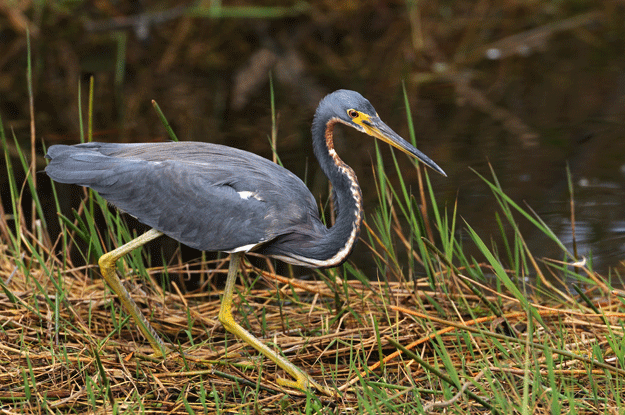
Tri-colored Heron

Little Blue Heron      
     Anhinga Trail; Everglades National Park, Florida: Continuing the theme of the last post, here are a couple of more photos of common birds found on Anhinga Trail.  Both of these birds were shot in the same spot.  The Tri-colored heron was stalking and catching fish when the Little Blue Heron flew-in and frightened the Tri-colored away.  After feeding in the same location the little blue stretched and preened before resuming feeding activity. I must say that I do love the pose of the Tri-colored Heron.  It is a classic heron pose with its potential energy and "S" curved neck.
Nikon D300, Nikkor 500mm f4  (both images)

Sunday, January 16, 2011

Pic of the Day

    Green Heron – Anhinga Trail; Everglades National Park, Florida:  Anhinga Trail is one of the most reliable places on the planet to find birds to photograph.   During the dry season from January to April, a plethora of birds to watch and photograph can be found on the .8 tenths mile trail.
   I do not remember a time that I have been to Anhinga Trail and not seen green herons perched on a rock or low hanging branch snatching minnows from the slough.  This Green Heron was photographed in the late evening light as the sun was setting.  While the orange light of the setting sun barely illuminated the heron, it revealed detailed, intricate patterns in the heron’s feathers that are often overlooked by the casual observer.  

Nikon D300, Nikkor 500mm f4, Digital Capture ISO 400, 1/125th Second, f6.3

Pic of the Day

Crescent Moon, Shadow side 1/2 second,  f4
Crescent Moon 1/400th second,  f4.5
   Crescent Moon – January 6, 2011:  As I drove north out of Florida a brilliant crescent moon hung above the western horizon.  The sky was a deep azure blue and quickly fading to black.  The shadow side of the moon, lit by light reflecting from Earth was quite bright in the cold, crisp winter air.  The conditions were perfect for photography. 
   As I drove across the Florida/Georgia state line I pulled into the Georgia welcome station, set-up my camera and lens on a tripod and began shooting.  Knowing the exposure for the sunlit side of the moon is 1/125th of a second at f8, I set an equivalent exposure of 1/400th of a second at f4.5. The faster shutter speed helped reduce blurriness caused by camera/lens vibration. 
   After shooting for the detail in the crescent moon, I took another image exposing for the shadow side of the moon.   I did a number of exposure variations and achieved a reasonably sharp image of the shadow side at 1/2 second at f4.  The sunlit crescent is highly overexposed but craters and mares are readily visible on the shadow side.

Nikon D300, Nikkor 500mm f4

Thursday, January 13, 2011

Pic of the Day

   Great Egret among Snowies –Merritt Island NWR, Florida:  I was driving through what looked to be a lifeless Merritt Island NWR, then I saw this scene above.  Water in the marsh was extremely low, and was restricted to small pools scattered along the wildlife drive.  Such pools become havens for fish as water in the marsh shrinks. Birds quickly become aware of the concentrations and descend on the pools with a vengeance.
   As soon as I saw the scene I brought my van parallel to the pond to access the little feeding frenzy that was taking place.  The birds were so intent on their feeding activity they paid me little notice.  I was immediately struck by the graphic nature of the scene, “S” curved necks, and all white birds.  But, It was not so much the birds themselves that made the image, as it was their reflections.  As I shot photos of the egrets dancing around their fishing hole I was reminded again that nature is always full of surprises, and I loved this surprise.


Nikon D300, Nikkor 24-85mm Zoom, Digital Capture ISO 200, 125 Sec. @ f8

Tuesday, January 11, 2011

Pic of the Day


   Ringed-necked Duck – Ritch Grissom Memorial Wetlands; Viera, Florida:  Ringed-necked ducks have always been one of my favorite duck species.  The male with its gray flanks set against a purple black back and breast, accented with a white flank strips and ringed bill is visually stunning.  Though the female wears a dress of brown feathers, her white-eye and bill ring gives her a subtle beauty that makes her the perfect complement to the male.
   In the wild it is usually difficult to get close to ducks, but at protected sanctuaries and preserves they can be very approachable.  As I drove the auto trail at the Ritch Grissom wetlands I spotted these ring-necks feeding in the shallows close to the road.
   I pulled the van past the ducks and parked, got out and stealthily slid down to the waters edge about a hundred feet from them. With my camera already on a tripod I sat down on the ground and hoped that the ducks would move toward me as they fed.
While waiting for the ducks to swim toward me a Limpkin landed in the reeds right in front of me and began plucking apple snails from the water.  I could not believe my good fortune as the Limpkin presented me with a great photo opportunity. 
   While I was shooting the Limpkin, another wildlife watcher stopped to look at the Ring-necks.  In doing so the ducks began to swim toward me as if I were not even there.  As they came within range I began to shoot.  As I began shooting the sun broke through clouds, bathing the ducks in the warm glowing light of a retiring sun.  As I have said so many times in previous post, I love it when everything comes together.  That evening I photographed these ring-necked ducks, it could not have been more perfect.

Nikon D300, Nikkor 500mm f4, Digital Capture ISO 200, 1/400 sec. @ f9

Monday, January 10, 2011

Pic of the Day

 White Ibis – A. Max Brewer Memorial Parkway; Titusville, Florida:  This trip was certainly the year for photographing ibis.  Ibis seemed to be everywhere and were very photographable.  This ibis was photographed on the causeway that leads from Titusville to Cape Canaveral just before entering the Merritt Island National Wildlife Refuge.  I stopped along the causeway to photograph gulls, but the sky was overcast and the images looked very dull.  Soon, the sun began to break through the clouds and the birds on the causeway came alive.  All of a sudden, birds began to appear from all directions to feed in the shallows of the Indian River. 
   As I shot images of gulls, an ibis flew onto the scene and began searching for prey.  It was not long until it was pulling horseshoe crabs out of the water.  The antics of the ibis were most interesting. With each catch the ibis would toss the crab into the air, catch it with its beak, then crunch down breaking the crabs shell.   The tossing and crunching continued for about forty-five seconds per crab.  Once broken and cracked to the ibis’ satisfaction, the crab went down its gullet. The gulls that were ever present stayed close to the ibis and continually tried to snatch its catch…..to no avail.

Nikon D300, 500mm f4, Digital Capture ISO 200, 1/2500 sec. @ f6.3

Sunday, January 9, 2011

Pic of the Day


   Limpkin – Ritch Grissom Memorial Wetlands; Viera, Florida:  The Limpkin is an interesting bird.  It appears to be a large rail, but its skeletal structure is more crane like.  Taxonomist place the Limpkin in its own genus, Aramus and family, Aramidae; and is the only extant species of the genus and family.
   This limpkin was photographed at the western most impoundment of the wetlands as it searched for Apple Snails (Ampullariidae), which is a primary food source.  Limpkins at the Ritch Grissom Wetlands are very approachable and are very numerous.  The wetlands is open to both foot traffic and auto traffic making access to the various water impoundments very accessible.

Nikon D300, Nikkor 500mm f4, Digital Capture ISO 200, 1/400 sec. @ f9

Saturday, January 8, 2011

Pic of the Day

    White Ibis – Ding Darling National Wildlife Refuge; Sanibel Island, Florida:  After leaving Fort De Soto State Park we headed for Fort Myers and Sanibel Island.  On January 2nd we were up early and on the wildlife drive.  There were few birds on the auto trail but when we arrived at the water impoundment at observation deck 3, there were two lone White Ibis feeding in the shallows.  The early morning light provided a nice reflection of the birds and a great photo opportunity as they moved along the shoreline probing the muddy bottom for crabs.  This ibis was photographed with its prey suspended in mid air just before gulping the crab down its gullet.

Nikon D7000, Nikkor 500mm f4, Digital Capture ISO 200, 1/1600 sec. @ f8

Pic of the Day


  White Ibis—Fort De Soto State Park, Saint Petersburg, Florida:  We arrived at Fort De Soto Park around 3:00 O’clock in the morning on New Years Day.  Having driven all night I was exhausted.  So, having a full size bed in the back of the van I retired for the morning and got a few hours sleep before sunrise.
     The sun rose around 7:00 O’clock and I was soon on the beaches looking for shorebird to photograph.  The morning was chilly, with temps somewhere in the mid 50’s (F).  In a small lagoon I found a flock of White Ibis huddled together with each going about its early morning preening duties.  The ibis were standing in the shade and the sunlight was falling on the water behind them.  I particularly liked the way the shadows softened the bird’s feathers and how the feathers edges seem to blend into the overexposed water in the background. 
     I made my exposure using the spot meter in manual exposure mode.   I took a meter reading from the birds whitest feathers and exposed that area one stop lighter than a middle value.  This exposure, along with the direct sunlight caused the watery background to overexpose and turn white that provides a light, ethereal quality to the image.

Nikon D7000, Nikkor 500mm f4, Digital Capture ISO 200,  1/200 sec. @ f6.3

Friday, January 7, 2011

Who's Looking

   Viewers from Armenia and Hungary have logged onto the blog over the last week.  Welcome to Bobby's Photo Blog, and please come back.  I will be posting quite regularly with images from my most recent trip.  Armenia anb Hungary bring the country count from which readers have logged-on, to seventy-two.  

Pic of the Day


   Willet – Captiva Island, Florida:  January 2nd was another beautiful day in Southern Florida, but the birds in Ding Darling National Wildlife Refuge were few and far between.  After a drive through the refuge we headed to Tween-waters, the slough that separates Sanibel Island from Captiva.  The beach on the Captiva side of the slough always has some kind of shorebirds to photograph, and this day there were terns, turnstones, sanderlings and willets. 
This Willet was one of more than a dozen in a small flock that raced up and down the beach as tourist walked along the shore line.  I took the photo as the bird paused for a moment between its movement up and down the beach.   My low level Frisbee mounted camera worked great and so did the angle of view.  The Frisbee allow me to keep the camera about 7 inches off the ground, and gives me the ability to slide the camera forward or backward across the ground as I crawl forward and backward.

Nikon D7000, Nikkor 500mm f4, Digital Capture ISO 200, 1/1000 sec. @ f9

Wednesday, January 5, 2011

Pic of the Day

   First let me wish each of you a “Happy New Year”!  On December 30th, I decided to drive south where the temperature is warmer.  So, on Friday, New Years Eve, at 2:00 PM, my wife and I headed south for Fort De Soto State Park in Saint Petersburg, Florida. 
     I took a few photos (which I will post) and then headed to Sanibel Island to visit the Ding Darling Wildlife Refuge.   While the first couple of weeks of January are not the best time to visit Florida for bird photography I had a great time.  Once I get the images squared away I will try to post one every day or two for a while.  The first image comes from the causeway to Sanibel Island.  The causeway is one of my favorite places to shoot shorebirds, but the first image I will show is a Snowy Egret.


   Snowy Egret – Sanibel Island Causeway, Florida:  This image was shot just minutes before the sun dipped below the horizon.  The light conditions were low and of the dozen shots I took only about half were sharp.  For this image I used two new pieces of equipment.  I really wanted to go to Florida to try out the new Nikon D7000.  I really like the camera, especially the video feature.  I also wanted to try out my ground level camera mount.  To take images from ground level I attached a ball head to a Frisbee.  I got the idea from a recent book I read.  I will have to give the name in a later post as I do not remember the book or author.  This photo was taken using the Frisbee mount.  After some experimentation I think a pie pan might work better.  The Frisbee is a bit flexible.  I will try the pie pan to see which works best.  However, even with the Frisbee/ball head mount I was able to get a sharp image.  I have numerous images shot with this setup and I will post over the next week or so.

Nikon D7000, Nikkor 500mm, f4, Digital Capture ISO 200, Frisbee/ballhead mount

Thursday, December 30, 2010

Pic of the Day

  Denali from Reflection Pond – Denali National Park Alaska:  Denali, “The High One”, is one of the most photographed mountains in the world, and I was in Denali National Park just for that purpose.  Denali is the second tallest mountain on the planet.  At a towering height of 20,320 feet  the mountain creates its on weather, keeping it totally obscured in clouds most of the time.  
    I made my first trip to Alaska in 1981.  After driving some 6000 miles across the United States, Canada and half of Alaska I arrived at Denali National Park eager to see and photograph the iconic landmark.  The day my wife and I arrived at the park the sky was overcast, and my dreams of seeing "The High One" seemed problematic.  After picking-up my photographers permit we drove west to wonder lake which was an arduous ten hour drive.  Heavy cloud cover and a drizzling rain dominated the day, and when we arrived at Wonder Lake no end seemed in sight.
    That night my wife and I camped at wonder lake, and around 2:00A.M.,  the clouds that hid the Alaska range began to break up revealing snippets of the mountains.  As the tops of the mountain range began to peak through the clouds we kept asking each other, “is that Denali?  No that one is higher, that must be it.”  Then the clouds began to dissipate and the entire range was visible.  Only then did we see Denali, it must have been three or four times taller than the surrounding mountains of the Alaska range.  We both stood in awe of "The High One.”
   I have returned to Denali National Park many times since that first trip and have photographed Denali over and over.  Every time I see the mountain it is different and always exciting to photograph.  This image was taken from reflection pond just East of Wonder Lake.  Surprisingly, Reflection Pond is only thirty to forty feet across, but in the early morning calm it provides a mirrored image reflection of North America’s tallest mountain.

Nikon F-5, Lens Unknown, Fujichrome 100

Sunday, December 26, 2010

Pic of the Day


       Horned Lark, Eremophila alpestris  – Pawnee National Grasslands, Colorado:  Driving the county roads in Pawnee National Grasslands is a great way to see birds.  Though birds of the open short grass prairies are easily spooked by curious photographers stumbling over the landscape, they seem to be oblivious to auto traffic roaring up and down the roads.  So, using my van as a blind to photograph grassland birds was a no brainier.
   I spotted this horned lark hundreds of feet ahead of me as I was driving one of the numerous dirt road that crisscross the grasslands.  Anticipating that the birds might fly to fence posts as I approached, I rolled my window down, attached a window mount tripod head and camera.  As I approached the birds I turned the engine off, put the van in neutral and coasted to a stop right beside this bird.  The stealth approach allowed me to get a half dozen shots before the lark flew off. 
   Fortunately this bird lifted the two feathers on each side of its brow as I shot, revealing the “horns” from whence it name is derived.

Nikon D300, Nikkor 500mm f4, Digital Capture ISO 200

Friday, December 24, 2010

Who's Looking and Happy Holidays

   I would like to wish all of you who have taken the time to sign on and read the blog a very HAPPY HOLIDAY SEASON.  I would also like to welcome the new viewers from Malaysia, Nepal and Panama.  The total number of countries from which viewers have logged on, now stands at seventy.  I hope you each have a wonderful holiday season filled with peace and joy.        Bobby

Tuesday, December 21, 2010

Update:

   North Alabama, at least my little piece of North Alabama was covered in clouds hiding the total lunar eclipse this morning.  Hope those of you in other parts of the country and planet had an opportunity to see and photograph the eclipse.

Sunday, December 19, 2010

Pic of the Day


    Full Moon – September, 2009 from Horsecove, Alabama:  On December 21, 2010, that’s only two days away, a total lunar eclipse will be visible from Alaska to Scandinavia and Greenland to Panama..  The eclipse begins with first penumbral contact at 05:27:43 UT.  Mid totality is 08:16:56 UT and ends with last penumbral contact at 11:06:04 UT.  For those living in the Easter Time Zone subtract 5 hours from UT for local time.  For Central Time Zone subtract 6 hours from UT. 
     If you would like to photograph the eclipse use a 300mm or longer focal length lens.  A 500mm will produce an image similar to the image size in the above photo on a DX format.  I have found that a good base exposure for the full moon is 1/500 second at f5.6.  As the eclipse progresses longer exposure will be necessary, and a sturdy tripod will be essential to maintain a sharp image. If weather permits I plan on photographing the eclipse and will post the results.  I hope you have fair skies as well, and have the opportunity to see and photograph the event.  For more information go to http://en.wikipedia.org/wiki/December_2010_lunar_eclipse, The site has good information.  Good luck!

Nikon D300, 500mm f4 Digital Capture ISO 200, Shot at 1/250 sec. @ f8

Saturday, December 18, 2010

Who's Looking

   I would like to take this opportunity to recognize a new viewer from Lithuania.  Welcome to the blog, and please log on often.  

Friday, December 17, 2010

Pic of the Day

    Cape May Warbler -- Magee Marsh, Ohio:  As winter waxes and the days grow colder here in north Alabama, I look forward to spring.  It is this time of year that I start dreaming of neo-tropical migrants and start planning trips to photograph them.  I have posted a number of images taken at Point Pelee National Park, Canada,  a well-known location to see and photograph spring migrants.  I have also mentioned in a previous post how the Pelee peninsula acts as a migrant magnet for those exhausted birds that have been pushed north by weather fronts.  The migrants seem to fall out of the sky when they see Point Pelee.
     Perhaps a lesser known migrant trap is Magee Marsh in Ohio.  Magee Marsh is on the south side of Lake Erie directly south of Point Pelee.  Magee is a location that many migrants stop and refuel before heading across the lake.  Like Pelee, Magee Marsh is a wonderful place to see and photograph north bound migrants.
     This Cape May Warbler was photographed in mid May as a wave of mixed warblers passed through Magee Marsh.  The morning I photographed this bird I also photographed a dozen other warbler species.  Warbler fall-outs are an amazing event to encounter as warblers and other migrants seem to be everywhere.   I have often seen trees and bushes with a half dozen different species of warblers at one time.  
     If you have not experienced such an event, you can.  Plan a bird watching, or better yet, a bird photography trip to Magee Marsh or Point Pelee.  Plan on a week or ten day trip between the second and fourth week of May.   You might get lucky and find yourself in the midst of a Warbler fallout.

Nikon D200, Nikkor 500mm f4, Digital Capture ISO 200 

Saturday, December 11, 2010

Who's Looking

    Readers from two more countires have logged on to "Bobby's Photo Blog."  The viewers from Belarus and Singapore bring the country count to sixty-six.  Welcome to the blog, I hope you return often.  Bobby

Wednesday, December 8, 2010

Pic of the Day

     Golden Eagle – Guntersville State Park; Guntersville, Alabama: Golden Eagles are not normally seen in the wilds of North Alabama.  In fact this Golden Eagle is not a wild bird at all, but part of Auburn Universities, Southeastern Raptor Center's captive birds.  The photo was taken when students from Auburn University presented their raptor education program at Guntersville State park.  After the program the student allow attendees the opportunity to photograph the raptors at close range. 
     While I ordinarily do not take photos of captive birds I could not resist photographing the Auburn birds of prey.  The raptor center keeps the birds in immaculate condition making them ideal subject for close-ups that are very difficult to obtain in the wild.
     This is one of my favorite images from the shoot.  Though a captive bird, the eagle portrays a regal bearing of majesty and power.


Nikon F4, Nikkor 300 f2.8, Kodachrome 64

Monday, December 6, 2010

Pic of the Day

    Prothonotary Warbler – Point Pelee National Park, Leamington, Ontario:  The Pelee peninsula is a migration magnet.  Extending 3 miles south into Lake Erie, Pelee is a destined landfall for migrants moving north across the lake during the spring migration.   Pelee is at its best when a northward moving weather front out of the gulf pushes airborne migrants over great distances.   Exhausted from long flights birds often drop out of the sky once land is sighted.  When waves of exhausted warblers make landfall the event is called a “fallout.”  My most productive trips to Pelee have been mornings after such fallouts occurred.  I have seen as many as 20 species of warblers in a day, in addition to tanagers, grosbeaks, thrushes and other passerines.   
     This Prothonotary was photographed at one of the many wet depression on the Woodland Nature Trail in Point Pelee Nationl Park.  The prothontary is a cavity nesting warbler that reaches the northern limit of its range in southern Ontario.  This bird had established a breeding territory and was making rounds on the periphery of its territory singing its song.  As I observed the warbler it was moving to and from specific perches as it sang its song, making it an easy mark to photograph.
Photography Notes:  Though I shoot with a long telephoto lens, I also add an extension tube between the camera body and lens when photographing small birds.  The extension tube allow the lens to focus closer than its minimum focus distance, thus producing a larger image of the bird.

Nikon F5, Nikkor 500mm F4, 24mm extension tube, Fuji Provia 100

Friday, December 3, 2010

Who's Looking

    This is becoming a favorite part of the blog for me.  Since the last “Who’s Looking” post, readers from three more countries have joined the ranks.  I would like to take this opportunity to welcome the new site visitors from Bahrain, Croatia and Guatemala.  The grand total now stands at 64 countries from which viewers have logged-on to “Bobby’s Photo Blog.”

Thursday, December 2, 2010

Pic of the Day


    Dickcissel – Tallgrass Prairie Preserve; Pawhuska, Oklahoma:  I have made three trips to the tallgrass prairie and can’t wait to go back.  I love the prairie in spring when the flowers bloom, and birds in their finest breeding plumage sing their territorial songs.
     This Dickscissel was photographed on one of the tallest weeds in its territory as it proclaimed its dominance for all its rivals to here.  Using my van as a blind I drove within 18 feet of the perch and photographed the bird from the van using a window mount tripod head.  The combination of a long telephoto lens, extension tube and close proximity provided the scene with a shallow depth of field.  The shallow depth allowed the distant prairie grasses to blur into a solid mass of color and isolated the subject from the background.  In painting this technique of placing a bird against a solid, uncluttered background is know as the Audubonesque style.  It is certainly one of my favorite styles to shoot. 

Nikon D300, Nikkor 500 f4, 24mm extension tube, Digital Capture ISO 200

Note:  See post for June 6 and June 8

Sunday, November 28, 2010

Who's Looking

    Since my last "Who's Looking" post, viewers from three more countries have joinded the ranks of "Bobby's Photo Blog".  I would like to welcome the new site visitors from Serbia, Turkey and Romania.  These three additions makes a total of 61 countries from which viewers have logged-on.

Saturday, November 27, 2010

Pic of the Day


     Canebrake – Keel Hollow; Gurley, AL:  I have lived on the west side of Keel Mountain for almost 29 years and have known of the fabulous canebrake in Keel Hallow for as long.  Cane in the brake grows large.  Much of the cane is five or more inches in diameter, and reaches 25 to 30 feet in height.  It is very impressive.  Every time I drive past the brake I say to myself, or who ever is in the van with me; “there’s a photo in there,”  but I never could seem to find it.  On occasion I would stop at the canebrake, walk around and look.  I would get my camera out and look through the viewfinder at the giant cane poles, but the image eluded me. 
     Recently I drove past the canebrake.  While looking at the stand of cane I said to myself again, “there’s an image in there.”  Again I got out of the van, and looked for the image.  This time I found a spot I liked.  A huge piece of cane leaned toward the camera and the lean, was exaggerated by the wide-angle lens.  The vertical stalks were also curved from there vertical position to converging angels.  The spot had potential, but the images I was shooting looked blain and totally uninteresting. 
     The light was low, so a long shutter speed was essential to get an image.  While shooting one of the exposures I had the idea to swing the camera from right to left; just to see what the effect would look like.  So, when I open the shutter for the next exposure I slowly swung the lens from right to left.  I experimented with the movement, some faster, some slower until I achieved the desired affect.  I was surprised to see the results and even more surprised that I liked the results.
     The movement of the camera during the exposure finally gave me an image I was happy with.  But, this is just the beginning.  I know that there are many good images still to be taken in the canebrake, and I will continue to return and search for them.  Hopefully the next image will not take 29 years to find!


Nikon D3, Nikkor 20mm f2.8, Digital Capture ISO 200

Monday, November 22, 2010

Who's Looking

    Since I uploaded my first post on March 13, of this year the blog has received hits from 58 countries.  It is exciting when I look at the stats and see new viewers from distant lands.   To date I have had readers from the following nations.  I Welcome all of you and invite you to continue visiting the site.

The countries as of date are:
Antigua and Barbuda        Austria                               Australia
Bahamas                               Bangladesh                       Brazil              
Belgium                                Bulgaria                            Canada           
Chile                                     China                                  Colombia        
Costa Rica                           Czech Republic                 Denmark
Egypt                                   Estonia                                France
Germany                             Greece                                 Guam
Hong Kong*                      Kuwait                                 Iceland
India                                   Indonesia                              Ireland
Israel                                  Italy                                       Japan
Latvia                                 Luxembourg                         Malta
Mexico                               Moldova                               Netherlands
New Zealand                   Norway                                  Pakistan
Peru                                   Philippines                            Poland
Portugal                            Russia                                    Saudi Arabia
Slovenia                            South Africa                          Spain
Sweden                             Switzerland                           Taiwan
Thailand                           Trinidad and Tobago          Ukraine
United Kingdom             United Arab Emirates        United States
Venezuela
*Listed on stats separate from country of origin

Sunday, November 21, 2010

Pic of the Day


    Ring-necked Duck -- Huntsville, Alabama:  With the arrival of autumn comes the arrival of ducks.  Species like the redhead, canvasback, bufflehead and ring-necked arrive on their southern wintering grounds around mid October and early November.  Many head for wildlife refuges where grain planted in the spring has gone to seed and is left standing in the field for the fall arrivals.   On occasion some ducks find their way to the urban ponds of city parks, industry and universities.
     This ring-necked took up residents on a pond at the University of Alabama, Huntsville one fall, and stayed for a few of months before moving on.  Along with a few others it became part of a mixed flock of domestic ducks, muscovy, and redheads.  I drive by UAH everyday on my way to Oakwood University where I teach photography, so I keep an eye out for the fall arrivals. When I see wild duck on the ponds I arrange time to shoot. 
     One of the favorite past times for some it seems is to go to the duck ponds and feed the ducks.  As the domestic ducks eagerly take handouts of bread the wild ducks soon follow suite and quickly become accustom to the handouts and people.  This conditioning provides wonderful opportunities to photograph wild ducks at close range.

Nikon F5, Nikkor 500mm f4, Fujichorme Provia 

Friday, November 19, 2010

Pic of the Day

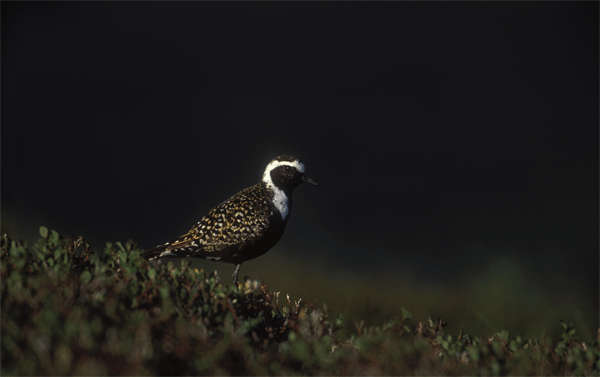
     American Golden Plover – Denali National Park, Alaska:  It was one of the beautiful days I had ever experienced in Alaska.  As I hiked across the tundra of Thoroughfare Pass in Denali National Park wildlife was abundant.  A small group of bull Caribou crossed a ridge in the distances as Lapland longspurs flitted from one bush to another gathering insects, mostly mosquitoes, and Long-tailed Jaegers sailed over the tundra in search for their next meal. As I watched the jaegers one dipped into the low vegetation and plucked a nestling songbird from its nest.   It was quite an amazing site to see, and reminded me that I am the interloper in a wildland that belongs to the wildlife.  
     As the Jaeger flew off with its prey an American Golden Plover appeared on a rise behind me and spoke its “Klee-u” call alerting me to its presence.  Turning to the plover I quickly set my tripod on the ground, aimed and began shooting.  A few moments later the plover flew off and joined a mate, then disappeared over a nearby ridge. 
     This is the only photo I have ever taken of an American Golden Plover in breeding plumage and from the photograph you can see how it gets its name.  With its golden back, black face, white facial ring and bib it is truly one of the most beautiful shorebirds in the Americas. 

Nikon F4, Nikkor 500mm f4, Fujichrome 100

Wednesday, November 17, 2010

Pic of the Day

    Least Tern – Biloxi, Mississippi:  This tern was photographed at a colony located south of Highway US90 between Biloxi and Gulfport, Mississippi.  The colony is one of, if not the largest least tern colony in the world.  Getting close to the terns is easy as they nest right up to the sidewalk used by beach goers to access the waterfront. 
      While I was walking along the edge of the colony looking for a nest I could photograph from the sidewalk one morning, this fellow flew in to drive me away.  The bird used numerous tactics in which the most invasive were swooping upon me and pecking my head, to hovering over me and defecating.  I prefer the head pecking above the latter.  I have learned from experience that a hat is an essential piece of gear, and just plain ole common sense tells me to keep my mouth shut. 
       I used a 300mm lens attached to a gunstock mount to take the image. The Gunstock is my favorite method for shooting birds in flight as it allows for maneuverability, a quick aim and a steady shot.  That maneuvrability thing is important when terns start defecating.  
     The tern spent only a few minutes in its attacks before flying back to the depression in the sand that we call a nest, but as I continued my search other terns took its place.  Eventually I found the right nest in the right place to photograph, absent of the head pecking and, well, the other.


Nikon F5, Nikkor 300mm 2.8, Fuji Provia 100

Friday, November 12, 2010

Pic of the Day

   Additional Ring-necked Pheasant photo from Bear River National Wildlife Refuge.  This is the same bird from the previous post.  The same camera and lens was used as well.
Click on any image on this blog to enlarge.

Wednesday, November 10, 2010

Pic of the Day


     Ring-necked Pheasant – Bear River National Wildlife Refuge, Utah:  For many years I have wanted to visit and shoot at the Bear River National wildlife Refuge but timing was never right until the spring of 2009.  On a trip that took me from the Tallgrass Prairie in Oklahoma to Yosemite National Park in California, I had the opportunity to stop at Bear River. 
     Though it rained most of the time I was there and I shot few photos, I did see a ton of birds.  Avocets, stilts, phalaropes, long-billed curlew, ducks and pheasants were everywhere.  Ring-necked Pheasants were very plentiful, and in full breeding plumage.  Male pheasants seemed to be spaced about every five hundred feet or so, with each one crowing and cackling to attract a female. 
     This male pheasant was in hot pursuit of a female that seemed quite attracted to his displays.  Most of the pheasants were in high grass, and though visible, foreground grasses obscured the birds for photography purposes.  As I photographed this pheasant it moved into an area of shorter grass and began to flap its wings and crow.  It seemed to display just for my camera and I was incredibly fortunate to have been in the right place at the right time.  The bird flapped and crowed a few times and then like the others moved into higher grasses, with the female in hot pursuit this time.
Nikon D300, Nikkor 500mm f4 with 1.4 Converter, Digital Capture ISO 200  -- This image was shot from my van using a window mounted tri-pod head for stability....engine off.

Tuesday, November 2, 2010

Pic of the Day

    Tri-colored Heron – Saint Augustine, Florida:  The Saint Augustine alligator farm is far from the Florida wilds, but it is a great place to photograph wild birds.  Each spring a variety of egrets and herons descend upon the popular tourist attraction to build nest and raise young on natural ponds at the farms periphery.   
     This Tri-colored Heron was photographed nesting only a few feet from the boardwalk that winds through the rookery.  As I walked along the board walk on an early April morning I found these two heron perched atop a freshly built nest.  The two birds seem especially attentive to one another as I watched,  then female stood over the nest, and with out warning an egg popped from the female and plopped into the nest.  The male bird seemed almost prideful as he looked at, and slightly moved the egg around with his bill.  I had never witnessed a bird laying an egg before and was quite surprised to see that the heron stood over the nest letting the egg fall about ten inches instead of setting in the nest to lay the egg.  Nature continues to amaze me, and the boardwalk that traverses the rookery at the Saint Augustine Alligator Farm provides a close-up intimate view of nature at its best.  
     The prime time to visit the rookery is early spring, usually between April 1 and May 31.  For more information on the Alligator Farm, the bird rookery and updates visit: http://www.alligatorfarm.com

Nikon F4, Nikkor 300mm 2.8, Kodachrome 64

Saturday, October 30, 2010

Pic of the Day

    American Coot – Everglades National Park, Florida: Found from the Yukon to Mexico and from California to Labrador, the American Coot is one of the most wide ranging birds of North America. While on one of my shooting forays into the Everglades long ago, I found this bird at Eco Pond near Flamingo. I had little interest in photographing such a common bird as a coot, but this bird, in its prime breeding plumage with white bill and deep red eye set against the dark water was striking. I took just a few shots then continued around the pond stopping often to photograph Roseate Spoonbills, Great Egrets, and Little Blue Herons.
     At one point I took-off cross country hiking through coastal scrub to follow a pair of Bald Eagles that were on wing performing a nuptial flight. The Eagles flapped high into the sky and then clasp talons and began spinning topsy-turvy as they hurdled in freefall toward the earth. Just before striking the ground the birds released their locked talons to soar in a sweeping arc upward into the blue. It was an exciting day and the first time I had witnessed and photographed such an aerial display.
     After returning home, and in anticipation of seeing the eagle photographs I could barley stand the wait that it took to get the film developed and back in my hands. As soon as the yellow boxes arrived I eagerly laid each image on the light table and scrutinized each one. Upon seeing the images of the eagles in flight my heart sank with disappointment. The eagles, while exciting to watch and photograph did not hold the same excitement and command on film, it was a photographic failure.
     As I continued through the boxes of slides I found other images I shot around Eco Pond that same day, and much to my surprise those few shots I had taken of the American Coot jumped out at me. I found the coot images ethereal as the water y background floats in airy wisps disappearing into the darkness. My day around Eco Pond had not been a total photographic failure after all. Looking at those slides that day I quickly realized that there is no such thing as a common bird, only opportunities.
Nikon F3, Nikkor 400mm 2.8, Kodachrome 64

Tuesday, October 26, 2010

Pic of the Day

     Great Egret – Venice Heron Rookery; Venice, Florida:  This Great Egret is caught on the wing as it returns to its nest at the Venice heron rookery.  The rookery is one of the best places to photograph nesting wading birds in Florida.  Along with the Great Egrets other birds that nest in the heronry are, Anhinga, Great Blue and Yellow-crown Night Herons. 
     The best time to visit the rookery is January, February and March.  I have found early morning the best time to shoot as visual access is on the east side of the rookery.  On mornings with a clear eastern sky the sulfurous warmth of the rising sun provides rich, saturated colors. 
     Even before the sun breaks the horizon the rookery is a bustling hub of energy.  Activity in the heronry varies depending on the time of the year.  During the early breeding season birds are busy building and adding to nest.  During the incubation and nest building periods there is the constant nuptial ritual between birds when they arrive and exchange duties at the nest.  After eggs hatch there is constant feeding activity as adults tend to nestlings.  One thing is certain, there is never a dull moment at the Venice Rookery and always uncountable opportunities to shoot great photos.  
     If you are interested in visiting the rookery follow this link for more information and direction: http://www.veniceaudubon.org/rookery.html
Nikon F5, Nikkor 500mm f4, Ektachrome 100VS

Also see post for April 4, & May 21, 2010

Note:  Great Egret, Common Egret and American Egret are the same bird.  Current nomenclature is Great Egret.