Saturday, October 23, 2010

Recently Published Work

   I have written an article on the Pribilof Islands that has been published in the most recent issue of "Creation Illustrated," (Vol 17, No.3).
     The article is a two-page spread with four photos.  I also have a photo of Sandhill Cranes in the same issue on page 48 (below), which accompanies an article by Gayle Irwin entitled, Running the Race.  
    To learn more about, or subscripbe to "Creation Illustrated," follow this link: http://www.creationillustrated.com

Thursday, October 21, 2010

Pic of the Day

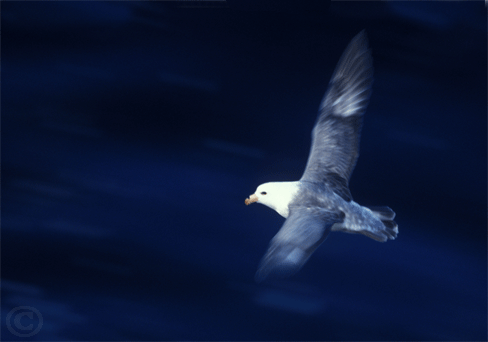
    Northern Fulmar, Fulmarus glacialis  – Saint Paul Island; Pribilof Islands, Alaska:  The Zapadni Cliffs rise out of the Bering Sea, jutting upward for two hundred feet or more.  The height and location of the cliffs provides a splendid view of Saint Paul on a clear day. 
     On a blustery June morning I stood atop the Zapadni Cliffs bundled in a down parka and mittens searching for just the right spot to photograph seabirds.  Walking along the cliffs I found numerous outcrops of rocks that allowed views of birds lined along the narrow ledges.  As I was shooting auklets and murres I noticed a few Northern Fulmars soaring just off the cliff face.  The fulmars soared in long, wide, sweeping figure eight pattern. 
     As I sat and observed, I saw that the fulmars moved in a rhythmic, predictable pattern; a pattern that brought them close to the cliffs edge, which would allow me to get a good shot of these wind masters.  Moving to a position that allowed me to shoot over the cliffs edge I had full command of the scene before me, being able to follow the birds as they road the winds in their long sweeping arcs.    
     The fulmars moved so fast it was hard keeping up with them as I looked through the cameras viewfinder.  If not for the auto focus and tracking feature of the lens and camera a sharp image would have been impossible.  The overcast of the mornings sky required me to shoot using a slow shutter speed and panning technique.  Panning combined with the slow shutter speed causes the background of an image (in this case the moving waves of the Bering Sea) to render as streaks of tone and color.  The technique worked exceedingly well as the slow shutter speed combined with the panning action blurred the background and wing movement to produced an ethereal quality of movement and action that defined the moment and the essence of a fulmar.  
Nikon F5, Nikkor 300mm f4, Ektachorme 100s

Tuesday, October 19, 2010

Pic of the Day

   Baskins Creek – Roaring Forks Auto Trail, Great Smoky Mountains National Park:  This image was taken on the Roaring Forks Auto Trail near the historic Jim Bales cabin.   After walking around the creek I found an angle that maximized the volume of rushing water flowing over the rocks.  I shot the falls from a low angle, only a few inches above the foreground rocks and water.  Using an exposure of two and a half seconds smoothed the water into a wash of movement animating a still image into motion.  A 24mm lens set to an aperture of f22 was used to provide an extended depth-of-field which provided maximum sharpness from foreground to background.     
Nikon D3, Nikkor 24-85mm @ 24mm focal length, f/22 @ 2.5 seconds, Digital Capture ISO 200

Sunday, October 17, 2010

Add Your Input To Important Research

Dr. William Hayes, a biology professor at Loma Linda University is conducting research on attitudes toward the environment and conservation. Taking the survey below will add valuable data needed for the research. Follow the link below to take a short survey. -- Bobby

IMPORTANT SURVEY ON ATTITUDES TOWARD THE ENVIRONMENT AND CONSERVATION
Your help is needed! The Loma Linda University Center for Biodiversity and Conservation Studies is conducting a groundbreaking survey on "attitudes toward the environment and conservation," particularly of those who love plants and animals. The results from this study, to be published in a professional journal, will contribute to our understanding of the role of plants and animals in society. Participants are urgently needed to complete the survey, which should take about 5-10 minutes of your time. Please click on the following link: http://www.facebook.com/l/f806ckPWwgNgSYtv6MlnkgkAeaA;www.surveymonkey.com/s/R9PFYRN

Saturday, October 16, 2010

Pic of the Day


   Appalachia Mountains from Clingman’s Dome – Great Smoky Mountains National Park, TN:  
     My first trip to the Smoky Mountains was around June, 1974.  I was 19 years old and had never before seen such an incredibly beautiful wilderness.  On arriving at Clingman’s Dome I met a few backpackers who were hiking the trails, and after talking with just a few of them I decided that I had to become a backpacker and explore the mountains that I saw before me. 
     By the fall of the same year I was on the Appalachia Trail hiking from Fontana Dam on the south end of the park to Newfound Gap.  Over a five-day period two friends and I hiked the 40 plus miles of undulating trails through deciduous and evergreen forest, rocky balds, meadows and mountain ridges.  There were days that I did not think I would make it through the hike, but I did, and truly enjoyed every mile. 
    Over the next five years I backpacked most of the trails in the southern half of the Great Smoky Mountains National Park.  After that first trip my dad joined me on most of my other backpacking adventures.  We made many trips to the Smokies over the next few years, three of which were during winter. 
     Both of us enjoyed winter camping, even when the mercury dropped to 20 below zero, as it did on a winter bivouac in January1976.  January of “76” was cold, and the day my dad and I started our hiked to Spence Field the temperature was frigid.  The climb took a day and half and the night we spent on the north side of the mountains was freezing.  As I layed in my sleeping bag I was quite comfortable except for my feet, they were glacially cold and never did warm-up.  The next day my cold feet made walking difficult, and as we neared the spine of the mountain the snow depth reached more than two feet making the last three quarters mile to the shelter even a greater struggle. 
Upon reaching the shelter we were both incredibly cold with feet that felt like ice cubes.  Tired and hungry we quickly built a fire then propped our feet near the flames to warm them up. 
     As we sit close to the fire all bundled-up in our goose down parkas, hoods and balaclavas bulled over our head, and feet enveloped in two layers of wool socks I began to smell something unusual burning.  Opening my eyes I saw that my dads right foot was on fire.   I excitedly yelled---“Your foot's on fire!”  My dad quickly jumped up, yanked the sock from his foot, and smoothers the flames.  Half of his outer sock had burned off, but his feet were so cold he could not feel the heat; fortunately his foot was unscathed.  On that same trip I returned with a slight case of frostbite, toes turned purple with loss of surface skin that healed, but nerver damage that never did.  Of all our trips, we told stories and laughed about this particular one the most.
     As I stood on Clingman’s Dome a couple of days ago shooting this image, the air was cold and brisk.   The distant ridges in my viewfinder that faded from black to purple lay in the direction of Spence Field, where my dad and I had climbed during a frigid, snowy winter almost thirty-five years ago.  The cold air and view before me reminded me of those long ago days when my dad and I hiked these rugged mountains, having some of our best times together, and making some of the best memories of our lives.
Nikon D3, Nikkor 24-85 zoom @ 85mm focal length, Digital Capture ISO 200

Tuesday, October 12, 2010

Pic of the Day

   Acorn Woodpecker – Santa Rita Lodge; Madera Canyon, Arizona:  The Acorn Woodpecker is a striking woodpecker with an interesting propensity for storing acorns.  The Acorn woodpecker not only gathers acorns for immediate use, but also gathers acorns to store in a larder for future consumption.  Too store the acorns the woodpeckers drill holes in to a tree and insert the acorn into the hole.  The holes can not be to big or the acorn would fall out or would be easily removed by another bird or small animal.  If the hole is too small the acorn would break apart when the woodpecker hammers the acorn in to the hole.  Acorn Woodpeckers are very precise!  The trees used for the larders are usually called “acorn trees” or granaries.
     This  image was shot at the Santa Rita Lodge near a feeder that the woodpeckers continually returned to feed on suit.  To learn more about Acorn Woodpeckers go to:
Nikon D300, 500mm f/4, Digital Capture ISO 200

See previous post on Madera Canyon or Santa Rita Lodge dated: September 15, 2010; September 12, 2010; May 19, 2010; and May 17, 2010.

Sunday, October 10, 2010

Pic of the Day


    Fall Color – Ceil Ashburn Drive; Huntsville, Alabama:  North Alabama is a wonderful place in which to live.  Though summer temperatures can reach 100 Degrees (Fahrenheit); everything including: cars, homes, business and restaurants are air conditioned to a comfortable temperature.  Winters can reach temperatures below zero, though most days are mild with the average winter temperature being 32 Degrees.  The only thing missing in our seasons is a consistent display of autumn color.   I say consistent, because on occasion we luck out and catch a fall when every tree displays brilliant colors.
    Last year was terrible for color, the lack of summer rains caused the tree leaves to simply turn brown and fall with no hint of color.  The same thing is happening this fall as well.  The leaves are already turning brown.  There will be no color this year, again.  However, 2008 was a different story, summer rains were plentiful and the fall colors of that year were the best I had seen in more than a decade. 
     As I drove across Ceil Ashburn Drive on my way home in late October of 2008 the color was outstanding.  A scene that I had noticed few days earlier had reached peak color and was beckoning to be photographed.  What made it so interesting to me were two dead trees whose repetitive sway weaved through patches of rich color.  

    As I composed the image I framed the scene so the swaying trees became the focal point.  The trees give the eye a path to travel through the image.  Also, the overall colors of the photograph are warm while the colors of the trees are cool, making them standout against the warmer fall colors.  Photo opportunities like this do not come along often in North Alabama, but hopefully it will not be another decade before I get a break  like this again.
Nikon D3, Nikkor 80-200mm f.2.8, Digital Capture ISO 200

Saturday, October 9, 2010

Pic of the Day

    Arctic Fox – Saint Paul Island; Pribilof Islands, Alaska:  The Pribilof Islands are one of my favorite shooting locations.   The four islands that make-up the Pribilof  Archipelago are remote and wild and harbor millions of breeding fur seals and seabirds during the Arctic summer.  I have made five trips to the Pribs, and each one has garnered a lifetime of memories and wonderful shooting opportunities. 
    On one occasion while photographing a least auklet colony near the city of Saint Paul I found myself in the mist of abandoned utility pipes.  The pipes provided excellent cover as I shot the colony.  This particular colony was one of many on Saint Paul and from the numbers I saw must have held many thousands of birds.  The small stretch of rocky seawall where I was shooting was inundated with auklets while flocks of a hundred or more birds were constantly winging in from the sea.
     As I shot frame after frame of the auklets I noticed flashes of movement in my peripheral vision.  Aware that the Arctic Fox on the island love to steal, or worse, urinate on unattended  items  I quickly gathered all my equipment close to my side.  Paying closer attention to the phantom movement I soon saw that the fleeting shadows were indeed a family of Artctic Fox.  The fox were living among the jumble of abandoned utility pipes and I must have been close to the den.
     As I continued to shoot the auklets, the fox kits ran back and forth, over and under, and through the long pipes as they chased and tackled each other.  They were most rambunctious , barley allowing me to get  a shot of their play.  With the kits so close I knew the vixen must me nearby; so I began looking for her.  Sure enough,  I spotted her about thirty feet away peeking out of one of the utility pipes as she kept a watchful eye on me.  With little though I swung the camera around, shot a few frames and then went back to shooting the auklet colony.
    When I arrived home I had a ton of green boxes awaiting my perusal.  Coming home from a long trip and having the film waiting for inspection was like coming home to Christmas, reliving the trip all over again.  I quickly began to sort through the slides, recounting to myself where I had shot each one.  When I opened the box with the fox slides I was happily surprised when I saw the vixen in the utility pipe.  I had remembered shooting the image, but had not thought much about it.  I immediately recognized the image as somewhat special - cute in its on way as the fox was looking directly into the lens.  She was making sure I was no threat to her kits.  
     The next year I entered the image in the Nature’s Best / Cemex International Nature Photography Contest, where it was selected as the winner in the backyard habitat category .  This image was my third win in the Nature’s Best contest, which just goes to prove that good images can just pop-up out of nowhere.  It certainly did for me, while shooting auklets amists a jumble of old abandonded utility pipes.
Nikon F5, Nikkor 500mm  f/4, Fuji Provia
Note:  Also see the “Pic of the Day” post for April 14, 2010

Thursday, October 7, 2010

Pic of the Day

   Bridal Veil Falls -- Valdez, Alaska:  I have made the trip from Glennallen to Valdez numerous times since my first trip to Alaska in 1981, and have found it to be one of the most scenic drives in the state.  The distant Wrangell Mountains to the east provide a stunning backdrop as the Richardson Highway traverses glacial rivers and hilly taiga.  One of my favorite stops along the highway is about fifteen miles out of Valdez where the Richardson Highway passes through Keystone Canyon; a deep cut that passes between mountain walls that reach skyward to four hundred feet.  Along this stretch of highway is Bridal Veil Falls, a waterfall fed by the melt waters of the massive Workman’s Glacier.
     This image of the falls was taken a little after the noon hour when light from a cloudless day flooded into the canyon.   The lighting was bright and contrasty, the worst light imaginable for photography. A full-length shot of the falls was out of the question due to the poor light quality.   However, as I looked at the falls I noticed that the base of the falls were in the shadows.  The light was soft and cool, creating a wide range of blue tones as the water cascaded over the boulders at the base of the waterfall.   Using a medium telephoto lens I composed the image and shot a series of exposures from an eighth of a second, too more than a second long. 
     This image is one of my favorites from the shoot.  The dark blules to whitish blues create a monotone that is usually only found in black and white photography, rarely in color; while the dancing water seems to make the rocks glow.  All the elements came together to give the image an ethereal quality.  A quality that is not always easy to achieve. 
Nikon F3, Nikkor 300mm f/2.8 (?), Kodachrome 64

Sunday, October 3, 2010

"Ghost Birds", New Book on James Tanner

    Over the last two months I have read four books,  and each one was absoloutly wonderful.  Ghost Birds by Stephen Lyn Bales was my favorite, as it would be to those of us with an interest in birds and specifically Ivorybills.  The book is about James Tanner, the one and only person to do a scientific study on Ivory-billed Woodpeckers; thus my interest and excitment over the book.  Below is a short review I wrote on my Ivorybill blog   .  Hope you enjoy the book as much as I did. 


     A new book about James T. Tanner has been published by the University of Tennessee Press.  It is a fantastic book about the life of Tanner, the man who did the first scientific study of Ivory-billed Woodpecker.
     The author, Stephens Lyn Bales did a superb job of telling the fascinating story of this remarkable man.  If you have an interest in the ivorybill or not, this is a must read book.  Once I started reading I could not put it down.  Bales words have a flow that keeps you mesmerized about the young James Tanner and his exploits throughout the south as he searches for the “Grail Bird”.

Book Description on Amazon.com
“Everyone who is interested in the ivory-billed woodpecker will want to read this book—from scientists who wish to examine the data from all the places Tanner explored to the average person who just wants to read a compelling story.”
—Tim Gallagher, author of The Grail Bird: The Rediscovery of the Ivory-billed Woodpecker
In 1935 naturalist James T. Tanner was a twenty-one-year-old graduate student when he saw his first ivory-billed woodpecker, one of America’s rarest birds, in a remote swamp in northern Louisiana. At the time, he was part of an ambitious expedition traveling across the country to record and photograph as many avian species as possible, a trip organized by Dr. Arthur Allen, founder of the famed Cornell Lab of Ornithology. Two years later, Tanner hit the road again, this time by himself and in search of only one species—that ever-elusive ivory-bill. Sponsored by Cornell and the Audubon Society, Jim Tanner’s work would result in some of the most extensive field research ever conducted on the magnificent woodpecker.
Drawing on Tanner’s personal journals and written with the cooperation of his widow, Nancy, Ghost Birds recounts, in fascinating detail, the scientist’s
dogged quest for the ivory-bill as he chased down leads in eight southern states. With Stephen Lyn Bales as our guide, we experience the same awe and excitement that Tanner felt when he returned to the Louisiana wetland he had visited earlier and was able to observe and document several of the “ghost birds”—including a nestling that he handled, banded, and photographed at close range. Investigating the ivory-bill was particularly urgent because it was a fast-vanishing species, the victim of indiscriminant specimen hunting and widespread logging that was destroying its habitat. As sightings became rarer and rarer in the decades following Tanner’s remarkable research, the bird was feared to have become extinct. Since 2005, reports of sightings in Arkansas and Florida made headlines and have given new hope to ornithologists and bird lovers, although extensive subsequent investigations have yet to produce definitive confirmation.
Before he died in 1991, Jim Tanner himself had come to believe that the majestic woodpeckers were probably gone forever, but he remained hopeful
that someone would prove him wrong. This book fully captures Tanner’s determined spirit as he tracked down what was then, as now, one of ornithology’s true Holy Grails.
STEPHEN LYN BALES is a naturalist at the Ijams Nature Center in Knoxville,
Tennessee. He is the author of Natural Histories, published by UT Press in 2007.

Saturday, October 2, 2010

Pic of the Day

     American Egret – Fort Myers Beach, Florida:  It was a rainy March morning in southern Florida as the alarm blared its clanging wakeup call.  Four o’clock A. M., shown in bright red number and it seemed as if I had just gone to sleep.  It was raining outside and I did not want to get out of bed; just a few more winks I told myself.  But I was in Florida to shoot, rain or shine I should be in the field.
I dragged myself out of bed and was soon on the road to Fort Myers Beach.  A beautiful stretch of sand on the mainland that looked west toward Sanibel Island.  By the time I arrived the rain had stopped, but a dense impenetrable fog thickened the landscape.  Why did I get up, I kept asking myself, knowing full well that there were no images to be taken this morning.
     Still, I got my gear together and headed toward the beach.  I could barley tell which direction to walk as the fog obstructed all landmarks.   As I listened in the quietness of the early morning I could hear the waves lapping against the shoreline giving me directions to follow.  After a short walk I was standing at the waters edge.  
     The sun had not broken the horizon nor had the beachcomber yet raised to scourer the beach for shells; for now it was just me and the birds. As I stood on the beach the only sounds audible were the lapping waves ,  and peeps of sanderlings and Ruddy Turnstones as they scurried to and fro along the edge of the incoming tide.  As the eastern sky began to glow I could tell that the clouds that had brought the nights rain were breaking, and perhaps my earlier haste to remain in bed was truly unfounded.
     As the day grew brighter and the fog began to thin a group of American Egrets foraging in the shallows began to materialize out of the vapors.  Occasionally one of the birds would stretch out its huge wings and with a few effortless flaps leap ten or twenty feet to a new fishing spot. The white birds set within the foggy veil were faint ghost, barely visible to the eye. The scene became a perfect blend of pastel blue and white plums; an ethereal quality that only nature can produce.
     I was drawn to the simplicity of the scene; its forms, pastels and motion.  The view before my eyes made me very happy that I had not lingered in my earlier slumber.  For what I thought was to be a dull ordinary morning was quite different than what I had expected.  In fact, as nature often provides, the ordinary had become the extraordinary. 
Nikon F4, Nikkor 500mm f4, Kodachorme 64

Monday, September 27, 2010

Pic of the Day

     Least Tern – Biloxi, Mississippi: The largest least tern colony in the world is on the gulf beaches from Biloxi to Gulfport, Mississippi.  This year more than 2000 thousand pairs  of least terns began nesting in the colony.  The terns expect to raised their young on the resources of the gulf waters.  As you all know this area is experienced the worst man made disaster in history.  During the clean-up not only the oil spill, but the clean-up itself is had a very negative effect on the terns and skimmers as workers and dune buggies traversing the colonies destroying young and disturbing birds.  I have not yet heard results on how successful or unsuccessful the tern colony was this year, put will let you know once I find some stats.  The following link will take you to an article that gives some states on animals killed as of July 27.  Only time will tell how and to what extent the gulf and its wildlife will recover.
additional source: 

Nikon D300, Nikkor 500mm f/4, Digital Capture ISO200

Saturday, September 25, 2010

Pic of the Day


     White-winged Dove – Tucson Desert Museum; Tucson Arizona: The Tucson Desert Museum is an amazing place to see wild birds in the desert southwest. The museum is a “Living Museum” with animals and birds of the southwest desert. Though there are living representatives of most animals and birds in the environmental habitat enclosures and the aviaries, Wild birds live and migrate among the desert flora of the museums exhibits.
This White-winged Dove was photographed as I walked along one of the museums trails. White-winged Doves are common in southeast Arizona, and very approachable within the museum.
Nikon D200, Nikkor 500mm f.4, Digital Capture ISO 200

Wednesday, September 22, 2010

Update:

     Check out the following link. This is a blog on the National Geographic Traveler website written by Rachel Dickinson. Rachel mentions seeing me on Bonaventure Island when I was there to photograph the Gannets this past summer. Rachel is the wife of my good friend and colleague Tim Gallagher. Tim had told me that Rachel was on the Gaspe’ Peninsula, but I never thought our paths would cross, but they did on Bonaventure Island. I was on the way out to photograph the Gannets and she was on the way back across the island. She had no idea that I was on the Gaspe' and was quite shocked to see me. I was surprised as well. You can read her article at the following address.
Go to: blogs.nationalgeographic.com/blogs/intelligenttravel/2010/09/for-the-birds-canadas-gaspe-pe-1.html#more

Sunday, September 19, 2010

Pic of the Day


   Osprey – Sanibel Island, Florida: By the late 50’s and early 60’s the Osprey or Fish Eagle was a threatened species in grave danger of extinction. DDT, dichlorodiphenyl trichloroethane is a pesticide synthesized in 1874 that was used extensively during the mid 20th century. The use of the potent pesticide had a detrimental effect on birds of prey and other animal life. The pesticide worked its way through the food chain to the top avian predators such as eagles, falcons and ospreys. The pesticides ingestion resulted in the thinning of the birds eggs causing the eggs to crush under the weight of the incubating adult.
     It was Rachel Carson’s book, Silent Spring that cataloged the environmental impact of DDT in the United States and its threat to humans and wildlife. The book created a gigantic outcry that let to a ban of DDT in 1972. As a result birds of prey began to recover. Now, the Osprey along with many other birds of prey that were affected have made a remarkable recovery.
     This Osprey was photographed on Sanibel Island at a natural nest in an old snag as it was adding nest material. Osprey use the same nest year after year adding new material to the nest each year. Nest can become extremely large, resulting with the weight of nest eventually toppling the tree, which did happen to this nest a few years after this image was taken.
Nikon F4, Nikkor 500mm f4 with 1.4 teleconverter, Kodakchrome 64

Friday, September 17, 2010

Pic of the Day


Joshua Tree National Park, CA: The day was late. We had driven from San Luis Obispo to Loma Linda, California where my wife met-up with some of her former students who are now doctors. The reunion was lots of fun for Norma and her former students as they reminisced of day gone by. With many miles ahead of us we left Loma Linda and headed east. We were on our way to Madera Canyon south of Tucson, Arizona where I would photograph hummingbirds. It would take a couple of days to get there because we had a few stops to make on the way.
The first was Joshua Tree National Park. We had driven through mile after mile on wind generators as the sun fell toward the horizon. Finally, we came to the park entrance, and I hurriedly drove through the park looking for a spot to take an evening photo. Boulders of mammoth proportions surrounded by Joshua Trees were strewn throughout the desert, yet I could not find the right spot that screamed Joshua Tree.
The sky was cloudless and I knew all was for naught; there would be no clouds for the setting sun to illuminate. No dramatic image of the setting sun with golden rays of light striking Joshua Trees set against a colorful desert sky.
A bit disheartened I shot a few images as the sun set, with some success, and then lingered as darkness fell upon the desert knowing I had not taken a shot I was really happy with.
As the sun dropped further beyond the horizon and the sky began to turn various shades of blue, I saw how the Joshua Trees silhouetted against the modulating blue sky. Immediately I began searching for a single tree with braches that would make a good silhouette, a tree that did not look like a black blob against the darkening sky. Finally, and just in the nick-of-time, I stumbled upon this almost perfect silhouette. I shot the image with a wide-angle lens from a low angle to give the tree greater impact.
Often when taking photographs, things just don't always seem to move in the right direction. And then, as if by providence, my eyes are opened and an image appears to save the day. I like when that happens!
Nikon D3, Nikkor 24, Digital Capture ISO200

Wednesday, September 15, 2010

Pic of the Day


House Finch – Santa Rita Lodge; Madera Canyon, Arizona: The House Finch is a common bird found at feeders across most of North America. Originally the House Finch was a bird endemic to the western United States. In the early part of the twentieth century House Finches were capture in western states and sent to New York city where they were sold in the illegal pet trade as Hollywood Finches. In 1940 pet store owners in New York City got word that wildlife officials were going to raid their stores for illegal trafficking of native species. To avoid prosecution the owners released the birds.
The small number of House Finches that were released began breeding and spread across the eastern half of the country in less than fifty years. Now, east meets west and House Finches are inhabitant of most towns across the United States except for those in the prairie states. It is likely that the bird will eventually inhabit all cities in the country.
As always this is not a happy story of introduced species. House Finches are aggressive birds and have now replaced the eastern endemic Purple Finch whose numbers have been drasticly reduced in much of its range.
Nikon D300, Nikkor 500 f4, Digital Capture, ISO 200

Sunday, September 12, 2010

Pic of the Day


Wild Turkey – Santa Rita Lodge; Madera Canyon,
Arizona
: In a previous post I extolled the abundance of birds at the Santa Rita Lodge (see post for May 17-19). The new owners have built an elaborate bird feeding and watering station that attract all the local wildlife. They also provide grain for ground feeding birds and deer. Wild Turkey in the area take advantage of the abundant food at the feeding station in the early morning and afternoon hours. I saw almost two-dozen turkeys at one time, while I was photographing Arizona and Acorn Woodpeckers, goldfinch, grosbeak and finches.
While I was photographing a Black-headed Grosbeak one afternoon a dozen turkeys wandered into the feeding area and began eating. After spending a few minutes picking grain from the ground a few of the males began to strut to establishing their place in the pecking order.
I was using a 500mm lens to photograph a grosbeak; a lens too long to photograph the fanned tail display of the nearby turkeys. However, the long lens was perfect to isolate a single bird for a head shot. As I shot the birds it continued to strut turning left then right; never in a position to isolate the head against a clean background. Finally, the turkey began to walk toward me with its tail fanned wide. The turkeys body and fanned tail became the perfect background to place emphasis on the turkeys brilliantly colored head.
Nikon D300, Nikkor 500mm f4, Digital Capture ISO200

Saturday, September 11, 2010

Pic of the Day


Sandhill Crane – Bosque del Apache NWR; San Antonio, New Mexico: Just south of San Antonio, New Mexico lay the “Woods of the Apache,” a refuge that borders the Rio Grand a few hundred miles north of where it turns east and eventually forms the boarder of the United States and Mexico.
Along this section of the river, shallow water impoundments have been built to form a wildlife refuge that host more than fifty-thousand snow geese and thirty-thousand sandhill cranes. Both the geese and sandhill cranes nest in Northern Canada then fly south to warmer climes for winter. The refuge also is home to thousands of ducks, Canada and Ross Geese as well as numerous species of passerines.
This photo was taken along the wildlife drive at Bosque as a crane took its respite from feeding on the corn that had been planted and left in the fields for the birds. The U.S. wildlife refuge system has a cooperative program for renting refuge land to local farmers who in tern leave a portion of the crop in the field for the wildlife. A system, which has worked quite well, for the farmer, wildlife system, and birds.
Nikon F5, Nikkor 500mm f4, Ektachrome 100

Thursday, September 9, 2010

Pic of the Day

For those of you who look at the blog often --- my apologies for not posting since September 4. I have been a bit under the weather with a cold with flu like symptoms, and just no energy to think of anything, much less blogging. I have been home in bed since Tuesday and am just now beginning to feel better. Hope you enjoy the following post.
Bobby


White Pelican – J. N. Ding Darling National Wildlife Refuge; Sanibel Island, Florida: White Pelicans are winter migrants to southern Florida. When the birds arrive in the fall the pelicans have molted into their winter plumage, but come late winter and early spring, when this photo was taken, the pelicans begin to attain their breeding plumage. Note the horns that are beginning to grow on the pelican’s beak.
This image was shot at high tide when the birds had gathered on a submerged sandbar to preen and rest after a morning of fishing. Unlike Brown Pelicans that fly high and dive into the water to catch their prey, White Pelicans gather in groups to form long lines, then swim toward shore to corral fish in the shallows so they can be easily scooped up in their pouched bills.
Nikon F5, Nikkor 500mm f4, Ektachorme 100

Saturday, September 4, 2010

Pic of the Day


     Roseate Spoonbill – Ding Darling NWR; Sanibel Island, Florida: The Roseate Spoonbill is a wading bird found along the cost from South Carolina to Texas. J. N. Ding Darling National Wildlife refuge on Sanibel Island is one of the best places to see these graceful waders. This adult spoonbill was photographed in July as it paused during a feeding foray in one of Ding Darlings many brackish water impoundments.
    Spoonbills stand near three feet tall and have a wingspan of almost five feet. With their beautiful pink plumage non-bird watchers often mistake them for flamingos. Flamingos are sometimes seen in Florida Bay between the Florida mainland and the keys, but are very rarely seen as far north as Sanibel Island.
The spoonbill is a tactile feeder. Dipping its spatula shaped bill into the water, the spoonbill swishes its open beak left and right, then snaps shut when it comes in contact with its prey of small fish, amphibians and aquatic invertebrates. The spoonbill gets its beautiful pink plumage from crustaceans that form a major portion of its diet.
Nikon D300, Nikkor 500mm f4, Digital Capture, ISO 200

Tuesday, August 31, 2010

Pic of the Day


Lightning – Fellsmere, Florida: Summertime in Florida means lighting. Rising heat from the day typically forms thunderheads by late evening and rain is usually eminent. I was driving the back roads near Fellsmere, Florida when I notice, in my rear view mirror, a storm approaching from the south. The distant storm seemed violent, clouds rolling forward, sheet lighting flashing, streak lighting arcing from cloud to cloud and bolt lightning blasting to the earth. How could I be so lucky!
I pulled off the road, set the camera on a tripod and watched the storm as it moved toward me. Lightning, lightning everywhere, the sky was ablaze as the clouds were illuminated by the sheet lightning and the streak lightning that electrified the ground.
I began to shoot using exposures that were about five seconds in duration. As I continued to make exposure after exposure in succession the storm moved ever closer and soon the lighting was striking all around me. Not satisfied with the shots I had taken I continued to take photos, being ever mindful that I was in an electrical storm and I was holding onto a metal tripod. I did feel a bit uneasy about the situation. It wasn’t long before I had a shot I liked and it was non-to soon. No sooner had I got the shot lighting stuck a tree less than fifteen hundred feet from were I stood and the bottom dropped out of the sky. I grabbed camera and tripod, ran for the van and jumped in the side door (which was open) and pulled the camera in behind me. Rain fell so hard I could barely see the road in front of me, and the lightning increased tremendously.
Violent rainstorms are common in central Florida and many residents take them with stride. This one got just a little to close for comfort. However, it is such storms that feed the many lakes and marshes that make central Florida a wetland paradise. The home to so many Florida birds that I love to photograph.
Nikon D3, Nikkor 24-85 zoom, Digital Capture, ISO 200

Friday, August 27, 2010

Pic of the Day


Storm over Pyramid Mountains, New Mexico: Thirty miles east of the Arizona, New Mexico border on Interstate 10 lay the Pyramid Mountains, the spine of the continental divide in southern New Mexico. The highest point of the Pyramids is Pyramid Peak which stands at 6,008 feet. The range itself is thirty-eight miles long and stretches from Hildalgo to the south and Lordsburg to the north. Sky islands like the Pyramid Mountains are isolated by a sea of desert and are home to a number of species that are common further south in the Sierra Madre Occidentals of Mexico.
As I crossed into New Mexico from Arizona a storm was forming to the southeast. I pulled my van off the side of the interstate and set-up my camera with a wide-angle lens. The dichotomy of blue sky in the direction the storm was moving and the dark ominous sky of the forming storm set against the golden grasses on the desert created an amazing display of color.
I shot a series of four side by side overlapping photographs to be patched together. After returning home I imported the four images into photoshop, overlapped the images, adjusted color so that each image matched, adjusted contrast, and erased various parts of overlapping images to form proper perspective. The combination of the four images creates a photograph that spans approximately 150 degrees from left to right.
The merged images form a grand panorama of a forming storm over the Pyramid Mountains. The image shows falling rain, cast shadows, blue sky , the impending storm, and a small portion of a rainbow in the lover right corner.
This was a most enjoyable image to shoot, but a bear of an image to create!

Nikon D3, Nikkor 24-85mm Zoom, Digital Zoom, ISO 100

Note: Clicking on the image will open a slightly larger image for closer inspection.

Thursday, August 26, 2010

Pic of the Day


      Double-crested Cormorant - Anhinga Trail, Everglades National Park:  The Double-crested Cormorant is a bird of worldwide distribution.  In most parts of the world it and other cormorants are called shags.  Cormorants are a controversial species for there is the constant conflict between the birds and fishermen.  Cormorants eat fish, and fishermen believe that the cormorants take too large of the a percentage of fish.  Cormorants do number in the millions worldwide.  There have been incidents in other countries where massive killings have been undertaken to reduce the number of birds where populations have exploded.
      The Double-crested Cormorant is often overlooked by the ardent birder as common and unimportant, just a check mark on a list to say it was seen. But the bird is quite beautiful; its aqua green eyes are more stunning than any emerald, and its stout hooked bill more efficient than any manmade fishing hook. The bird is a superb swimmer, and when in breeding plumage its double crest are easily seen and its feathers a combination of blue, red and green iridescence.
This cormorant and his kin in Everglades National Park do not have to worry about angry fishermen. They live a life of leisure, feeding on exotic fish in the everglades waters. Its only worry is being eaten by introduced exotics such as the Burmese or African Rock Pythons that now number in the hundreds of thousands in the South Florida everglades.
Nikon D300, Nikkor 500mm f4, Digital Capture ISO 200

Sunday, August 22, 2010

Pic of the Day

     Bald Eagle, Haliaeetus leucocephalus: Homer, Alaska – Bald Eagles are one of my favorite birds to photograph (see March 20, 2010 post). This bird was one of many eagles I photographed over a ten day stay on Homer Spit. I shot more than 5000 images during my stay and most of them were keepers. The great concentration of eagles on the Spit occurred for one reason, and that reason was the late Jean Keene. Jean, an ex rodeo star, fed more than 500 pounds of fish a day to at least 300 eagles during the winter months for over 20 years. Feeding eagles at Homer became a controversial topic and the city of Homer band the feeding of eagles and other scavengers in 2006; but Jean was given special permission to continue feeding the birds until 2010. Jean passed away in 2009, and now all feeding of eagles has ceased. Jeans love for eagles provided many photographers a great opportunity to photograph these magnificent birds up close, and I am fortunate to have been one of the photographers to do so. All my trips to Alaska hold great memories, and the times I have spent on Homer Spit photographing eagles ranks among the best.

Nikon F5, Nikkor 500mm f/4, Ilford film @100 ISO

Tuesday, August 17, 2010

Pic of the Day


     Common Nighthawk: Tallgrass Prairie Preserve; Pawhuska, Okalahoma – The prairie is an astonishing place in the spring. Fresh bluestem grasses sprout, wildflowers burst upon the rolling hills, and birds invade the grasslands to breed. Nighthawks are among the myriad of birds that move upon the prairie in spring to establish territories and court.
They are most active in the early morning and late evening hours, but on the day I shot this image, the birds were still. A heavy fog had settled over the prairie keeping the birds from hawking insects.
As I drove along the loop road through the preserve I noticed this nighthawk lazily perched on a fence post. I pulled off the road, got out of the van, and with my camera on a tripod slowly moved toward the bird. As I stalked the nighthawk it would occasionally open its sleepy eye and check my approach. When the nighthawk closed its eye, I moved a little closer. My slow stalk allowed me to move within sixteen feet or so of the bird, yet remain outside its fright radius. I wanted to get close enough to show detail, especially the fog that had condensed on the bird’s breast feathers. Getting close also compressed the fog into a clean, out-of-focus background that places emphasis on the subject.
After shooing dozens upon dozens of images, I slowly backed away, leaving the Nighthawk to its slumber. It was undaunted by the experience and I was exuberant over the images.
Nikon D200, Nikkor 500mm f/4, Digital Capture, ISO 200

Sunday, August 15, 2010

Recently Published Work

My Great Birding Escape column for the spring 2010 issue of Living Bird magazine is now online on the Living Bird website. The GBE is about Sarett Natue Center in Benton Harbor, Michigan. This is the fifth GBE I have written. Another GBE should appear in the winter issue. To read this and other GBEs, join the Cornell Lab of Ornithology or see Living Bird online.
Go to: www.allaboutbirds.org/NetCommunity/Page.aspx?pid=1889


Also in the spring issue is an article by Thomas A. Watson on Kayak Birding at Kodiak Island. It is a wonderful article and I was fortunate to be able to supply the bird photos to illustrate the article.
Go to: www.allaboutbirds.org/NetCommunity/Page.aspx?pid=1897


Join the Cornell Lab of Ornithology and support bird study. You’ll also receive 4 issues of Living Bird Magazine each year.
To Join, go to: www.allaboutbirds.org/NetCommunity/Page.aspx?pid=1241

Saturday, August 14, 2010

Pic of the Day

     Burrowing Owl, Athene cunicularia – Cape Coral, Florida:  The Burrowing Owl is the only diurnal owl in North America. While other owls can be seen, and do some hunting during the day, they do their primary hunting at night. The Burrowing Owl hunts day and night, being most active during the morning and evening. Typical food of Burrowing Owls include, insects, skinks lizards, small birds and small mammals.
     In Cape Coral, Burrowing Owls occupy empty lots adjacent to human dwellings. Nest are easily located as most are marked with wood stakes and posted as a protected species. The stakes also serve as a perch owls use to guard burrow entrances, and to hunt from. In Florida, Burrowing Owls typically nest in abandoned gopher tortoise burrows, though the burrows of other animals may be used.
     The prairie grasslands, or what was once the prairie grassland of Florida is the only place Burrowing Owls still exist east of the Mississippi. Of course, these once prairie grasslands now include golf courses, airports, and school campuses.
     This Burrowing Owl was photographed in a group of vacant lots during the fall season. Instead of trying to stalk the bird, I used my van as a blind. The owlsin Cape Coral are used to automobiles, and this bird allowed me to drive to within 25 feet of where it was sitting. Using a window mounted tripod head to steady my camera, I was able to shoot a couple of rolls of film before driving off. The tried grasses provided the perfect backdrop for the owls tawny plumage and yellow eyes, providing me with one of my most memorable and favorite images.

Nikon F5, Nikkor 500mm f/4, Kodachrome 64

Friday, August 13, 2010

Pic of the Day

Brown Creeper: Horsecove, Alabama

Brown Headed Nuthatch: Guntersville State Park, Guntersville, Alabama
     Creepers and Nuthatches:  Birds of a Feather? Not quite, but similar. Creepers and nuthatches are interesting birds. Though they are of different families, they live similar life styles. Both creepers and nuthatches feed on insects that live and hide in cracks and crevices of tree bark. Both species climb tree trunks and search crevices within the bark, and pry back loose bark to gather insects. But how they do it, is what’s interesting.
Creepers start at the bottom of a tree and circle the tree as it climbs upward. It slender curved beak probes into cracks, crevices and under loose bark searching for its prey. It can even use its beak to pry back loose bark like that of a pine or scaly bark hickory. After the creeper has reached the top of the tree, it flies down to the base of the next tree and repeats the process. The creeper climbs from the bottom to the top of the tree.
Nuthatches have a short stout bill. While they too probe cracks and crevices, their stronger bill is more suited for prying back loose bark to reach hidden insects. However, the nuthatch starts at the top of the tree and winds around the tree downward and head first. Upside-down from our perspective. Once the nuthatch has reached the bottom of the tree, it flies to the top of the next tree and begins the process all over.
So, when you are out birding and you see a small bird winding around a tree moving from bottom to top it is most likely a creeper. An in North America it would be the Brown Creeper. When you see a small bird winding around a tree, upside down and moving down the tree from top to bottom, you know it is a nuthatch. In North America it could be one or a combination of possible nuthatches that include the: White-breasted, Red-breasted, Brown-headed and Pygmy nuthatch.
The Brown Creeper shown here was photographed at my home in North Alabama and the Brown-headed Nuthatch was photographed at Guntersville State Park, just east of Guntersville, Alabama.
Brown Creeper photographed with a: Nikon F4, Nikkor 500mm f/4, Kodachrome 64
Brown Headed Nuthatch photographed with a: Nikon F4, Nikkor 500mm f/4, Kodachrome 64

Tuesday, August 10, 2010

Pic of the Day


Vermillion Flycatcher – Catalina State Park: Tucson, Arizona: The desert southwest is an amazing place. The area around Tucson is the home of Sauraro National Park, Catalina State Park and the Tucson Desert Museum. All three of these sanctuaries preserve the deserts flora and fauna. All are excellent places to see specialties such as the Roadrunner, Phainopepla and the Vermillion Flycatcher.
The Vermillion Flycatcher is easily identified. Its vermillion red and black plumage cannot be mistaken with any other bird in the area. My first encounter with a Vermillion Flycatcher was on the wet plains of Venezuela’s Llanos. I worked hard to photograph that bird, but it didn’t happen. The bird was always a step ahead of me and never let me close enough to get the image. It would be a decade before I encountered this species again.
The second encounter was in the beautiful hill country of Concan, Texas. I was in Texas to speak on the Ivory-billed Woodpecker at the Concan Bird Festival. So, I did not have camera equipment with me, just my bino’s. The bird was in a beautiful setting and I spent a quarter of an hour or more watching the Vermillion hawk insects, preen and stretch. How I wish I could have photographed that bird.
My third encounter with the Vermillion Flycatcher was at Catalina State Park in Tucson, Arizona. I had gone to Catalina to photograph Greater Roadrunner. While following roadrunners around the park and shooting from my van I saw this bird perched on a willow branch. As I watched I noticed the flycatcher was retuning to the same perch after it snatched insects from the air. Slowly I drove my van toward the birds perch. As I crept toward the bird I rolled my window down, pointed the camera out the window resting the lens on the window base. Once I was close enough to the bird I turned the engine off and began shooting, and shooting, and shooting. Finally, I had captured the Vermillion Flycatcher.
Nikon D300, Nikkor 500mm f/4, Digital Capture, ISO 200

Friday, August 6, 2010

Pic of the Day


     American Robin – Point Pelee; Ontario, Canada: The American Robin, Turdus migratorius, a member of the thrush family is perhaps the most well know of all birds. After a long arduous winter the sight of robins is one of the first indications that spring is on its way. Robins may very well be the most numerous passerine in North America. I am constantly amazed when I travel, for the first bird I usually see is the Robin. This has occurred in the desert, prairie, mountains, the great north woods and tundra. The Robin really gets around, a very wide spread species.
     The first nest I ever found was that of a robin. I don’t remember how old I was but I was quite young, somewhere between eight and ten. The nest was only about eight feet off the ground, but it seemed much higher as I climbed the tree to see if it had eggs. It did, four bluish eggs about an inch long. The nest was made of mud and sticks. This discovery had me building bird nest for a couple of weeks, trying to recreate the robin’s nest, but the robin’s nest was much better. I watched the nest throughout incubation and rearing of the young until they fledged. I remember thinking how much the baby robins ate, the parents were constantly bringing worms and the babies constantly begging for food.
     As I discovered bird photography it was robins that I chased with my camera and lens. I never did get a shot I liked. Decades later, on a trip to Point Pelee, Canada, I was photographing a Chestnut-sided Warbler when I spied a group of robins feeding on the lawn of a picnic ground. I wasn’t about to give up the warbler for a robin, but as the warbler climbed into the heights of the tree and out of range of the lens, my eyes drifted back to them.
After about ten minutes of watching and stalking I found myself in the right spot to photograph a robin. The bird was far enough from the background grasses so that the shallow depth-of-field caused the grass to blur into a monotone green. This shallow depth isolates the robin from any competing elements. The posture of the bird, its perch and placement provided a coherent composition. Finally, I had taken a robin photo with which I was happy. As always, I love it when all the elements come together.

Nikon D200, Nikkor 500mm f/4, Digital Capture, ISO 200

Wednesday, August 4, 2010

Pic of the Day


     Cornus canadensis (Bunchberry) -- Bonaventure Island, Quebec: While hiking to the gannetry on Bonaventure Island (see post for July 12, 2010) this past June, I found this patch of Bunchberry along the trail. As soon as I saw the patch of flowers I thought of Eliot Porter, the master of 4x5 format color nature photography. Porter, in my opinion was the best bird photographer that has ever lived. In fact, if you are a nature photographer you are following in the footsteps of Eliot Porter. He pioneered the use of color nature photography. He is also well known for his exquisite detailed nature close-ups and landscapes. His book, In Wilderness is the Preservation of the World, was the first oversized coffee table book. Porter’s work inspired a new genre of photography, and future generations of nature photographers.
     As I looked at the scene it beckoned to be photographed. Though I was in a hurry to get to the gannetry I could not pass this exquisite Lilliputian landscape. I use a tripod for almost all my shots. This image required a tripod because I was shooting for an extended depth-of-field to keep the entire scene in focus. Using the depth-of-field preview button I determined an aperture of f/18 would give sufficient depth to the image. The shutter speed dropped to 1/13 of a second, thus the need for the tripod. I shot a few images, and was very pleased with the results. In no time I was back on tract to the gannetry.

For more information on Eliot Porter go to:
http://www.cartermuseum.org/collections/porter
http://www.utata.org/salon/19594.php

Nikon D3, Nikkor 24-85 zoom set to 48mm, Digital Capture, ISO 200