Saturday, September 11, 2010

Pic of the Day


Sandhill Crane – Bosque del Apache NWR; San Antonio, New Mexico: Just south of San Antonio, New Mexico lay the “Woods of the Apache,” a refuge that borders the Rio Grand a few hundred miles north of where it turns east and eventually forms the boarder of the United States and Mexico.
Along this section of the river, shallow water impoundments have been built to form a wildlife refuge that host more than fifty-thousand snow geese and thirty-thousand sandhill cranes. Both the geese and sandhill cranes nest in Northern Canada then fly south to warmer climes for winter. The refuge also is home to thousands of ducks, Canada and Ross Geese as well as numerous species of passerines.
This photo was taken along the wildlife drive at Bosque as a crane took its respite from feeding on the corn that had been planted and left in the fields for the birds. The U.S. wildlife refuge system has a cooperative program for renting refuge land to local farmers who in tern leave a portion of the crop in the field for the wildlife. A system, which has worked quite well, for the farmer, wildlife system, and birds.
Nikon F5, Nikkor 500mm f4, Ektachrome 100

Thursday, September 9, 2010

Pic of the Day

For those of you who look at the blog often --- my apologies for not posting since September 4. I have been a bit under the weather with a cold with flu like symptoms, and just no energy to think of anything, much less blogging. I have been home in bed since Tuesday and am just now beginning to feel better. Hope you enjoy the following post.
Bobby


White Pelican – J. N. Ding Darling National Wildlife Refuge; Sanibel Island, Florida: White Pelicans are winter migrants to southern Florida. When the birds arrive in the fall the pelicans have molted into their winter plumage, but come late winter and early spring, when this photo was taken, the pelicans begin to attain their breeding plumage. Note the horns that are beginning to grow on the pelican’s beak.
This image was shot at high tide when the birds had gathered on a submerged sandbar to preen and rest after a morning of fishing. Unlike Brown Pelicans that fly high and dive into the water to catch their prey, White Pelicans gather in groups to form long lines, then swim toward shore to corral fish in the shallows so they can be easily scooped up in their pouched bills.
Nikon F5, Nikkor 500mm f4, Ektachorme 100

Saturday, September 4, 2010

Pic of the Day


     Roseate Spoonbill – Ding Darling NWR; Sanibel Island, Florida: The Roseate Spoonbill is a wading bird found along the cost from South Carolina to Texas. J. N. Ding Darling National Wildlife refuge on Sanibel Island is one of the best places to see these graceful waders. This adult spoonbill was photographed in July as it paused during a feeding foray in one of Ding Darlings many brackish water impoundments.
    Spoonbills stand near three feet tall and have a wingspan of almost five feet. With their beautiful pink plumage non-bird watchers often mistake them for flamingos. Flamingos are sometimes seen in Florida Bay between the Florida mainland and the keys, but are very rarely seen as far north as Sanibel Island.
The spoonbill is a tactile feeder. Dipping its spatula shaped bill into the water, the spoonbill swishes its open beak left and right, then snaps shut when it comes in contact with its prey of small fish, amphibians and aquatic invertebrates. The spoonbill gets its beautiful pink plumage from crustaceans that form a major portion of its diet.
Nikon D300, Nikkor 500mm f4, Digital Capture, ISO 200

Tuesday, August 31, 2010

Pic of the Day


Lightning – Fellsmere, Florida: Summertime in Florida means lighting. Rising heat from the day typically forms thunderheads by late evening and rain is usually eminent. I was driving the back roads near Fellsmere, Florida when I notice, in my rear view mirror, a storm approaching from the south. The distant storm seemed violent, clouds rolling forward, sheet lighting flashing, streak lighting arcing from cloud to cloud and bolt lightning blasting to the earth. How could I be so lucky!
I pulled off the road, set the camera on a tripod and watched the storm as it moved toward me. Lightning, lightning everywhere, the sky was ablaze as the clouds were illuminated by the sheet lightning and the streak lightning that electrified the ground.
I began to shoot using exposures that were about five seconds in duration. As I continued to make exposure after exposure in succession the storm moved ever closer and soon the lighting was striking all around me. Not satisfied with the shots I had taken I continued to take photos, being ever mindful that I was in an electrical storm and I was holding onto a metal tripod. I did feel a bit uneasy about the situation. It wasn’t long before I had a shot I liked and it was non-to soon. No sooner had I got the shot lighting stuck a tree less than fifteen hundred feet from were I stood and the bottom dropped out of the sky. I grabbed camera and tripod, ran for the van and jumped in the side door (which was open) and pulled the camera in behind me. Rain fell so hard I could barely see the road in front of me, and the lightning increased tremendously.
Violent rainstorms are common in central Florida and many residents take them with stride. This one got just a little to close for comfort. However, it is such storms that feed the many lakes and marshes that make central Florida a wetland paradise. The home to so many Florida birds that I love to photograph.
Nikon D3, Nikkor 24-85 zoom, Digital Capture, ISO 200

Friday, August 27, 2010

Pic of the Day


Storm over Pyramid Mountains, New Mexico: Thirty miles east of the Arizona, New Mexico border on Interstate 10 lay the Pyramid Mountains, the spine of the continental divide in southern New Mexico. The highest point of the Pyramids is Pyramid Peak which stands at 6,008 feet. The range itself is thirty-eight miles long and stretches from Hildalgo to the south and Lordsburg to the north. Sky islands like the Pyramid Mountains are isolated by a sea of desert and are home to a number of species that are common further south in the Sierra Madre Occidentals of Mexico.
As I crossed into New Mexico from Arizona a storm was forming to the southeast. I pulled my van off the side of the interstate and set-up my camera with a wide-angle lens. The dichotomy of blue sky in the direction the storm was moving and the dark ominous sky of the forming storm set against the golden grasses on the desert created an amazing display of color.
I shot a series of four side by side overlapping photographs to be patched together. After returning home I imported the four images into photoshop, overlapped the images, adjusted color so that each image matched, adjusted contrast, and erased various parts of overlapping images to form proper perspective. The combination of the four images creates a photograph that spans approximately 150 degrees from left to right.
The merged images form a grand panorama of a forming storm over the Pyramid Mountains. The image shows falling rain, cast shadows, blue sky , the impending storm, and a small portion of a rainbow in the lover right corner.
This was a most enjoyable image to shoot, but a bear of an image to create!

Nikon D3, Nikkor 24-85mm Zoom, Digital Zoom, ISO 100

Note: Clicking on the image will open a slightly larger image for closer inspection.

Thursday, August 26, 2010

Pic of the Day


      Double-crested Cormorant - Anhinga Trail, Everglades National Park:  The Double-crested Cormorant is a bird of worldwide distribution.  In most parts of the world it and other cormorants are called shags.  Cormorants are a controversial species for there is the constant conflict between the birds and fishermen.  Cormorants eat fish, and fishermen believe that the cormorants take too large of the a percentage of fish.  Cormorants do number in the millions worldwide.  There have been incidents in other countries where massive killings have been undertaken to reduce the number of birds where populations have exploded.
      The Double-crested Cormorant is often overlooked by the ardent birder as common and unimportant, just a check mark on a list to say it was seen. But the bird is quite beautiful; its aqua green eyes are more stunning than any emerald, and its stout hooked bill more efficient than any manmade fishing hook. The bird is a superb swimmer, and when in breeding plumage its double crest are easily seen and its feathers a combination of blue, red and green iridescence.
This cormorant and his kin in Everglades National Park do not have to worry about angry fishermen. They live a life of leisure, feeding on exotic fish in the everglades waters. Its only worry is being eaten by introduced exotics such as the Burmese or African Rock Pythons that now number in the hundreds of thousands in the South Florida everglades.
Nikon D300, Nikkor 500mm f4, Digital Capture ISO 200

Sunday, August 22, 2010

Pic of the Day

     Bald Eagle, Haliaeetus leucocephalus: Homer, Alaska – Bald Eagles are one of my favorite birds to photograph (see March 20, 2010 post). This bird was one of many eagles I photographed over a ten day stay on Homer Spit. I shot more than 5000 images during my stay and most of them were keepers. The great concentration of eagles on the Spit occurred for one reason, and that reason was the late Jean Keene. Jean, an ex rodeo star, fed more than 500 pounds of fish a day to at least 300 eagles during the winter months for over 20 years. Feeding eagles at Homer became a controversial topic and the city of Homer band the feeding of eagles and other scavengers in 2006; but Jean was given special permission to continue feeding the birds until 2010. Jean passed away in 2009, and now all feeding of eagles has ceased. Jeans love for eagles provided many photographers a great opportunity to photograph these magnificent birds up close, and I am fortunate to have been one of the photographers to do so. All my trips to Alaska hold great memories, and the times I have spent on Homer Spit photographing eagles ranks among the best.

Nikon F5, Nikkor 500mm f/4, Ilford film @100 ISO

Tuesday, August 17, 2010

Pic of the Day


     Common Nighthawk: Tallgrass Prairie Preserve; Pawhuska, Okalahoma – The prairie is an astonishing place in the spring. Fresh bluestem grasses sprout, wildflowers burst upon the rolling hills, and birds invade the grasslands to breed. Nighthawks are among the myriad of birds that move upon the prairie in spring to establish territories and court.
They are most active in the early morning and late evening hours, but on the day I shot this image, the birds were still. A heavy fog had settled over the prairie keeping the birds from hawking insects.
As I drove along the loop road through the preserve I noticed this nighthawk lazily perched on a fence post. I pulled off the road, got out of the van, and with my camera on a tripod slowly moved toward the bird. As I stalked the nighthawk it would occasionally open its sleepy eye and check my approach. When the nighthawk closed its eye, I moved a little closer. My slow stalk allowed me to move within sixteen feet or so of the bird, yet remain outside its fright radius. I wanted to get close enough to show detail, especially the fog that had condensed on the bird’s breast feathers. Getting close also compressed the fog into a clean, out-of-focus background that places emphasis on the subject.
After shooing dozens upon dozens of images, I slowly backed away, leaving the Nighthawk to its slumber. It was undaunted by the experience and I was exuberant over the images.
Nikon D200, Nikkor 500mm f/4, Digital Capture, ISO 200

Sunday, August 15, 2010

Recently Published Work

My Great Birding Escape column for the spring 2010 issue of Living Bird magazine is now online on the Living Bird website. The GBE is about Sarett Natue Center in Benton Harbor, Michigan. This is the fifth GBE I have written. Another GBE should appear in the winter issue. To read this and other GBEs, join the Cornell Lab of Ornithology or see Living Bird online.
Go to: www.allaboutbirds.org/NetCommunity/Page.aspx?pid=1889


Also in the spring issue is an article by Thomas A. Watson on Kayak Birding at Kodiak Island. It is a wonderful article and I was fortunate to be able to supply the bird photos to illustrate the article.
Go to: www.allaboutbirds.org/NetCommunity/Page.aspx?pid=1897


Join the Cornell Lab of Ornithology and support bird study. You’ll also receive 4 issues of Living Bird Magazine each year.
To Join, go to: www.allaboutbirds.org/NetCommunity/Page.aspx?pid=1241

Saturday, August 14, 2010

Pic of the Day

     Burrowing Owl, Athene cunicularia – Cape Coral, Florida:  The Burrowing Owl is the only diurnal owl in North America. While other owls can be seen, and do some hunting during the day, they do their primary hunting at night. The Burrowing Owl hunts day and night, being most active during the morning and evening. Typical food of Burrowing Owls include, insects, skinks lizards, small birds and small mammals.
     In Cape Coral, Burrowing Owls occupy empty lots adjacent to human dwellings. Nest are easily located as most are marked with wood stakes and posted as a protected species. The stakes also serve as a perch owls use to guard burrow entrances, and to hunt from. In Florida, Burrowing Owls typically nest in abandoned gopher tortoise burrows, though the burrows of other animals may be used.
     The prairie grasslands, or what was once the prairie grassland of Florida is the only place Burrowing Owls still exist east of the Mississippi. Of course, these once prairie grasslands now include golf courses, airports, and school campuses.
     This Burrowing Owl was photographed in a group of vacant lots during the fall season. Instead of trying to stalk the bird, I used my van as a blind. The owlsin Cape Coral are used to automobiles, and this bird allowed me to drive to within 25 feet of where it was sitting. Using a window mounted tripod head to steady my camera, I was able to shoot a couple of rolls of film before driving off. The tried grasses provided the perfect backdrop for the owls tawny plumage and yellow eyes, providing me with one of my most memorable and favorite images.

Nikon F5, Nikkor 500mm f/4, Kodachrome 64

Friday, August 13, 2010

Pic of the Day

Brown Creeper: Horsecove, Alabama

Brown Headed Nuthatch: Guntersville State Park, Guntersville, Alabama
     Creepers and Nuthatches:  Birds of a Feather? Not quite, but similar. Creepers and nuthatches are interesting birds. Though they are of different families, they live similar life styles. Both creepers and nuthatches feed on insects that live and hide in cracks and crevices of tree bark. Both species climb tree trunks and search crevices within the bark, and pry back loose bark to gather insects. But how they do it, is what’s interesting.
Creepers start at the bottom of a tree and circle the tree as it climbs upward. It slender curved beak probes into cracks, crevices and under loose bark searching for its prey. It can even use its beak to pry back loose bark like that of a pine or scaly bark hickory. After the creeper has reached the top of the tree, it flies down to the base of the next tree and repeats the process. The creeper climbs from the bottom to the top of the tree.
Nuthatches have a short stout bill. While they too probe cracks and crevices, their stronger bill is more suited for prying back loose bark to reach hidden insects. However, the nuthatch starts at the top of the tree and winds around the tree downward and head first. Upside-down from our perspective. Once the nuthatch has reached the bottom of the tree, it flies to the top of the next tree and begins the process all over.
So, when you are out birding and you see a small bird winding around a tree moving from bottom to top it is most likely a creeper. An in North America it would be the Brown Creeper. When you see a small bird winding around a tree, upside down and moving down the tree from top to bottom, you know it is a nuthatch. In North America it could be one or a combination of possible nuthatches that include the: White-breasted, Red-breasted, Brown-headed and Pygmy nuthatch.
The Brown Creeper shown here was photographed at my home in North Alabama and the Brown-headed Nuthatch was photographed at Guntersville State Park, just east of Guntersville, Alabama.
Brown Creeper photographed with a: Nikon F4, Nikkor 500mm f/4, Kodachrome 64
Brown Headed Nuthatch photographed with a: Nikon F4, Nikkor 500mm f/4, Kodachrome 64

Tuesday, August 10, 2010

Pic of the Day


Vermillion Flycatcher – Catalina State Park: Tucson, Arizona: The desert southwest is an amazing place. The area around Tucson is the home of Sauraro National Park, Catalina State Park and the Tucson Desert Museum. All three of these sanctuaries preserve the deserts flora and fauna. All are excellent places to see specialties such as the Roadrunner, Phainopepla and the Vermillion Flycatcher.
The Vermillion Flycatcher is easily identified. Its vermillion red and black plumage cannot be mistaken with any other bird in the area. My first encounter with a Vermillion Flycatcher was on the wet plains of Venezuela’s Llanos. I worked hard to photograph that bird, but it didn’t happen. The bird was always a step ahead of me and never let me close enough to get the image. It would be a decade before I encountered this species again.
The second encounter was in the beautiful hill country of Concan, Texas. I was in Texas to speak on the Ivory-billed Woodpecker at the Concan Bird Festival. So, I did not have camera equipment with me, just my bino’s. The bird was in a beautiful setting and I spent a quarter of an hour or more watching the Vermillion hawk insects, preen and stretch. How I wish I could have photographed that bird.
My third encounter with the Vermillion Flycatcher was at Catalina State Park in Tucson, Arizona. I had gone to Catalina to photograph Greater Roadrunner. While following roadrunners around the park and shooting from my van I saw this bird perched on a willow branch. As I watched I noticed the flycatcher was retuning to the same perch after it snatched insects from the air. Slowly I drove my van toward the birds perch. As I crept toward the bird I rolled my window down, pointed the camera out the window resting the lens on the window base. Once I was close enough to the bird I turned the engine off and began shooting, and shooting, and shooting. Finally, I had captured the Vermillion Flycatcher.
Nikon D300, Nikkor 500mm f/4, Digital Capture, ISO 200

Friday, August 6, 2010

Pic of the Day


     American Robin – Point Pelee; Ontario, Canada: The American Robin, Turdus migratorius, a member of the thrush family is perhaps the most well know of all birds. After a long arduous winter the sight of robins is one of the first indications that spring is on its way. Robins may very well be the most numerous passerine in North America. I am constantly amazed when I travel, for the first bird I usually see is the Robin. This has occurred in the desert, prairie, mountains, the great north woods and tundra. The Robin really gets around, a very wide spread species.
     The first nest I ever found was that of a robin. I don’t remember how old I was but I was quite young, somewhere between eight and ten. The nest was only about eight feet off the ground, but it seemed much higher as I climbed the tree to see if it had eggs. It did, four bluish eggs about an inch long. The nest was made of mud and sticks. This discovery had me building bird nest for a couple of weeks, trying to recreate the robin’s nest, but the robin’s nest was much better. I watched the nest throughout incubation and rearing of the young until they fledged. I remember thinking how much the baby robins ate, the parents were constantly bringing worms and the babies constantly begging for food.
     As I discovered bird photography it was robins that I chased with my camera and lens. I never did get a shot I liked. Decades later, on a trip to Point Pelee, Canada, I was photographing a Chestnut-sided Warbler when I spied a group of robins feeding on the lawn of a picnic ground. I wasn’t about to give up the warbler for a robin, but as the warbler climbed into the heights of the tree and out of range of the lens, my eyes drifted back to them.
After about ten minutes of watching and stalking I found myself in the right spot to photograph a robin. The bird was far enough from the background grasses so that the shallow depth-of-field caused the grass to blur into a monotone green. This shallow depth isolates the robin from any competing elements. The posture of the bird, its perch and placement provided a coherent composition. Finally, I had taken a robin photo with which I was happy. As always, I love it when all the elements come together.

Nikon D200, Nikkor 500mm f/4, Digital Capture, ISO 200

Wednesday, August 4, 2010

Pic of the Day


     Cornus canadensis (Bunchberry) -- Bonaventure Island, Quebec: While hiking to the gannetry on Bonaventure Island (see post for July 12, 2010) this past June, I found this patch of Bunchberry along the trail. As soon as I saw the patch of flowers I thought of Eliot Porter, the master of 4x5 format color nature photography. Porter, in my opinion was the best bird photographer that has ever lived. In fact, if you are a nature photographer you are following in the footsteps of Eliot Porter. He pioneered the use of color nature photography. He is also well known for his exquisite detailed nature close-ups and landscapes. His book, In Wilderness is the Preservation of the World, was the first oversized coffee table book. Porter’s work inspired a new genre of photography, and future generations of nature photographers.
     As I looked at the scene it beckoned to be photographed. Though I was in a hurry to get to the gannetry I could not pass this exquisite Lilliputian landscape. I use a tripod for almost all my shots. This image required a tripod because I was shooting for an extended depth-of-field to keep the entire scene in focus. Using the depth-of-field preview button I determined an aperture of f/18 would give sufficient depth to the image. The shutter speed dropped to 1/13 of a second, thus the need for the tripod. I shot a few images, and was very pleased with the results. In no time I was back on tract to the gannetry.

For more information on Eliot Porter go to:
http://www.cartermuseum.org/collections/porter
http://www.utata.org/salon/19594.php

Nikon D3, Nikkor 24-85 zoom set to 48mm, Digital Capture, ISO 200

Thursday, July 29, 2010

Pic of the Day


     Western Meadowlark, Strunella neglecta – Badlands National Park, South Dakota: A beautiful bird with yellow breast and black bib the Meadowlark is a member of the blackbird family. Though the eastern and western meadowlarks look similar, their songs are quite different. The eastern meadowlarks song is somewhat flat, while the western meadowlarks song is very melodious and lyrical.
     When I was a young man, a friend (Charles), and I were maintaining a bird banding station at my parent’s home (my home at the time as well). Eastern Meadowlarks were common in the pastures around the house and was a bird we had set our sites on banding. So, we strung our nets and waited. It is important to note, “A watched net catches no birds.” Not knowing this axiom, Charles and I watched the nets. It seemed to take forever, but finally two Meadowlarks flew into the nets. We both ran to the nets and were eager to retrieve the birds and band them. Each of us thinking, “next year we might retrieve these very birds, or even better, another birder would retrieve them on their wintering grounds.” How cool would that be!
     We were both new at bird banding and still learning how to extract birds from the nets. This is an easy process once you get the hang of it. Even if the net is rapped around the bird numerous times or even rapped around the tongue, which happens frequently, it usually takes only a few minutes to remove a bird. At this encounter there were no such problems, just inexperience.
     As we both attempted to remove the meadowlarks, Charles lifted the net and reached for the birds feet. Suddenly the meadowlark burst from the net and flew away. He stood there in amazement and I stood there laughing. As I lifted the net holding the second bird I reached for its feet, and before I new what happen the second bird burst from the net flying off into the pasture. We both stood there laughing and pointing fingers at each other and ourselves. And we were both sure the two Meadowlarks were in some secluded part of their territories laughing at us as well. Ever since that time, both Charles and I laugh when we see meadowlarks, knowing that two meadowlarks outsmarted us so long ago.
     This boisterous Meadowlark, the western race, was photographed in the Badlands of South Dakota. It had obviously not heard of my former travails with his eastern kindred; perhaps he was too busy defending his territory with song to notice me. Whatever the reason, this Meadowlark allowed me to drive right up to the post from which he sang his territorial song, and allowed me to shoot frame after frame of robust activity using my car as a blind. By the way, Meadowlarks had made a point to avoid my lens until I found this bird. Now………who had the last laugh!

Nikon D300, Nikkor 500mm f4, Digital Capture, ISO 200

Monday, July 26, 2010

Pic of the Day


     Lark Bunting – Thunder Basin National Grasslands, Wyoming: It seemed like a good idea at the time. Leave Yellowstone National Park and drive east to the Wyoming/South Dakota boarder. There, on the Wyoming side of the boarder is Thunder Basin National Grasslands, more than a hundred thousand acres of open grasslands filled with breeding birds for me to photograph. My wife and I arrived on the grasslands and began traveling down a gravel road. Using my iPad I could see that dozens of county and state roads crisscrossed the grasslands. So, without trepidation I (my wife is not always on board with my decisions) headed down the gravel road with a plan to cross the grasslands into the badlands of South Dakota.
     After about seven miles down the solidly packed gravel road things began to change. The gravel on the road became loose, and deep ruts began to appear in the road. At this point I should have turned around. But for sure, I thought the road would improve. However, the further I progressed the worse the road became. The gravel became dirt, and the ruts got deeper. It was time to turn around. Checking the map, I saw that if I made a right turn at the next intersection I could get back to our starting point, only 9 miles away.
     I made the right turn, drove a mile and came to an intersection with a road leading to the east. I wanted to go east to South Dakota, and this new road would take me in the direction I really wanted to go. A sign at the intersection read, “Bill”, 8 miles. Bill is where I started this little adventure. Within 8 miles I could be back on a nice paved road and could continue my trip on to the Badlands. The sign at the intersection also gave the name of another town 13 miles away, though I do not remember its name, and it was not on my map, which should have been my first clue that things would go awry. Thirteen miles, according to the sign would put us in a town, and to my reasoning, on one of the state highway I saw on my map.
     So, it was off toward the state highway. A state highway would be paved, right? I made the turn and the wet rutted road improved within a 1000 feet. Well, “this is better,” I exclaimed to my wife! And it was, for a while. My wife gave the look that only a husband understands. The look that says, "ARE YOU CRAZY." But, the words went unspoken. It was not long until the road began to become rutted. Streams crossed the road creating mud holes, and the loose gravel was giving way to dirt. The road was rapidly worsening, again. Still, the words were unspoken.
     As we continued down the road it became narrower and narrower, then turned into a one-lane path with tire ruts. Still along the side of the road was a county road marker. It was the same road my map indicated. After 18 miles, I realized the town mentioned on the road marker back at the intersection was either a cross-road or a myth. It never materialized.
     We were traveling in the right direction, but signs of civilization were scarce. Pronghorn antelope abounded, but I was so busy staying out of ruts it was hard to enjoy the view. At one point I looked up, and a Golden Eagle was soaring just in front of the van. It glided to a promontory that overlooked a valley and landed. Trees are non-existent on this grassland and the Golden Eagle and Ferruginous Hawk nest on the ground and valley cliffs. They also use the high points on the rolling grasslands and valley overlooks as perches to spy their prey.
     It was actually quite beautiful, a gorgeous day with blue sky and cumulus clouds floating in the sky. Green grasses carpeted the rolling hills that were spotted with pronghorn antelope. But, it was difficult to enjoy as I struggled to avoid the hazards of the road.
     Soon the two-tracked rut called a county road came to another of many cattle gates I had crossed. This one however had a backhoe lifting and dropping the gate, readjusting and lifting and dropping it all over again. A young man walked to the van and told me they would not be much longer and sure enough, we were on our way within fifteen minutes.
     As soon as we crossed the cattle gate there was a sign that read, “END OF COUNTY ROAD.” Yet, the two ruts continued on and my map indicated that a state road was ahead. I did not believe it possible, but the road got worse. The ruts got deeper, and were crossed by cuts from rain runoff that were 4 to 6 inches across and a foot deep. After about fifteen miles of following a trail across a pasture, the road (trail) turned into a poorly kept gravel road. The road continued to improve and finally after 35 miles we finally came to a state road. A very poor, graveled, washboard state road that we had to travel on for another 25 miles.
     Seven hours and sixty miles from where we started, we made it to a US highway, a paved US highway. There were lots of birds, and the scenery was beautiful within the grasslands. But concentrating on the road took all the time from wildlife watching and enjoying the trip. Would I recommend a trip to Thunder Basin National Grassland? Yes, but only if you have a four-wheel drive vehicle and lots of time. The roads are definitely not made for a Chevy Express Van!
By the way, the only bird I photographed on this escapade was the Lark Bunting, and I shot the image about 4 miles from where I started.
Nikon D300, Nikkor 500mm f4, Digital Capture, ISO 200

Sunday, July 25, 2010

Pic of the Day


Razorbill Auk


Atlantic Puffin

Nikon D300, Nikkor 300 f2.8, Digital Capture, ISO 200

Saturday, July 24, 2010

Pic of the Day


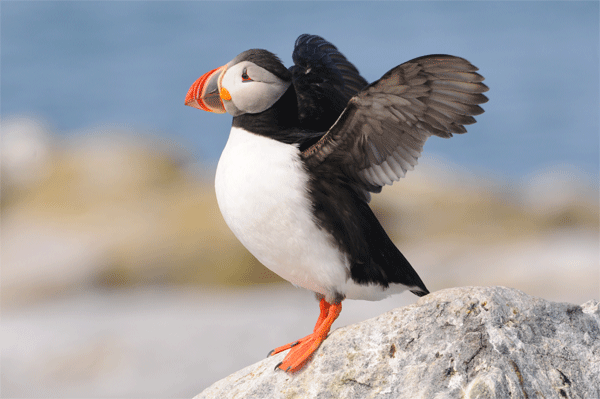
Atlantic Puffin:  Perhaps my favorite image from the shoot. 

Atlantic Puffin


Atlantic Puffin


Atlantic Puffins – Machias Seal Island, ME: In the previous post I have written a little about Machias Seal Island, but the most fascinating thing about the island is its birds. The Puffin is the star of the Island. With its colorful bill it is often called the clown bird. One of the things I find so fascinating is its call. It sounds like a distant chainsaw to me. My first trip to the island back in the early 80’s was my first encounter with this species. As I stood in the blind shooting roll of film after roll of film I suddenly realized I was hearing a chainsaw off in the distance. I stop the rally of shooting for a moment and listen more intently to discover the soft rev of a two cycle engine was not from a chainsaw on the treeless island, but the puffins themselves. Others have told me that the birds voice sounds like a low growl, and others say a raspy purr. We all relate sounds to something familiar to what we have experienced.
Posted here are a few more of my favorite puffins from the shoot. I especially like the top image. The blurred wings and ruffled feathers give an idea of the constant activity that goes on in a puffin colony.
Nikon D3, Nikkor 500mm f4, Digital Capture, ISO 200


Tuesday, July 20, 2010

Me, Buzz, and the Moon


Waxing Gibbous Moon photographed July 31, 2009
Nikon D300, Nikkor 500mm f4, Digital Capture, ISO 200; 
Photographed from Horse Cove, Alabama

   July 20th, 1969, a day I will never forget as long as I live. It was one of the most exciting days of my life and perhaps yours as well. It was the day that man landed on the moon. Wow, that was 41 years ago!
     Long before I was a hard-core birder and bird photographer, I was a space junky. During my junior high and high school years I lived and breathed astronomy and space travel. How could I not? I lived just 20 miles from Huntsville, Alabama at the time. Wernher Von Braun was director of the Marshall Space Flight Center. He and his team designed the Saturn V rocket that carried man to the moon. For me it was an exciting time to live! I spent nights in the backyard with my telescope observing the moon and the planets. I mapped the rotation of the Galilean moons of Jupiter in their orbits, observered comets and cut my teeth on astrophotography. Now that I think of it; It was a miracle that I ever found someone to marry me!


Buzz Aldrin on the moon. Photo by Neil Armstrong.....
                .... I wasn't able to get there to photograph the event.

     Later in life I got to meet some of those heroes of the early space program. Buzz Aldrin was one of them. I first met Buzz in 1992 when he was visiting bookstores to promote his book, “Encounter with Tiber.” I was asked to photograph the event, and of-course, I jumped at the opportunity. The first hour-and-a-half was very busy with a constant flow of autograph seekers (me being one), then there was no one there but Buzz and me. The two of us sat and talked for over an hour. I asked questions and he happily told stories to answer them. It was fascinating to have Buzz Aldrin to myself, telling stories of flying, his favorite aircraft and his time at NASA. This was another moment in time that I will never forget.


Left to Right, Kathy Sullivan, Bobby Harrison, Sylvia Earle,
 Buzz Aldrin: Photo by Whitney Harrison Robison

In 2006 I had another opportunity to meet Buzz. In 2005, Tim Gallagher (editor of Living Bird Magazine) and I had been elected to the Explorers Club in New York City. In 2006 we were among the honorees at the clubs annual dinner to receive the Explorers Club Conservationist of the Year Award. When I arrived at the pre-dinner events there was Buzz and a number of other Great Americans such as astronaut Kathy Sullivan, oceanographer Sylvia Earle, entomologist E. O. Wilson (a fellow Alabamian), and others. I must say, it was pretty cool ...........another day I will never forget!

Notes on moon Photography: Photographing the moon is easy. For a full moon set the shutter speed at the inverse of the ISO setting at f8. Example, if your camera ISO is set at 200. Set the shutter speed at 1/200 of a second at f8 or any equivalent. The faster the shutter speed the better. So convert the 1/200 @ f8, to 1/800 @ f4. If the moon is at a first quarter open the aperture 1 stop. With your digital camera you can check the exposure and make adjustments if needed.

Sunday, July 18, 2010

Pic of the Day


Atlantic Puffin – Machais Seal Island, Maine: A two and a half hour trip into the Gulf of Maine and I find myself on Machais Seal Island. The treeless island is little more than a few acres in size and the only thing found there is a lighthouse and seabirds. Puffins are the star of the island. The bird that brings most birders from the mainland.
The Atlantic Puffins spent nine months of the year at sea, coming ashore only to breed. They can dive to 200 feet, and will fly more than thirty miles from the nest site to catch prey. With their short stubby wings puffins are not the best fliers in the air, but when it comes to flying underwater, puffins are at the top of the list.
The pigeon sized bird feed on herring, sprats and sand eels. Puffins swim (flies through the water) from behind a school of fish and grab fish on the left then right of the school, which lines-up the fishes heads facing alternate directions. Puffins can hold up to a dozen fish in its beak. Rows of spines in the upper beak (close-up photo) holds each fish in place as the puffin catches another fish.
Nikon D300, Nikkor 500 f4, Digital Capture, ISO 200;
Note: The top photo of this post, puffin with fish, was shot with a Nikon D3, Nikkor 300 f2.8, Digital Capture, ISO 200


Pic of the Day


Razorbill Auk -- Machais Seal Island, Maine: Perhaps I should say Machais Seal Island, Canada. Machais Seal is claimed by both Canada and the United States. The claim by both countries was established over a hundred years ago. By claimming the island, fishing rights of the respective nations were extended further out to sea.
The Canadians have turned the island into a wildlife refuge and maintains the only manned lighthouse in the Canadian system on the island. Canadian biologist work on the island as well. Fortunaly neither the United States nor Canada have started a war on who really owns Machais Seal Island. When I see the island it is obvious that it is owned by the seabirds. I hope that it will always be so!
There is never a lack of subject or action on the island. Birds are constantly coming and going, squabbling between birds is never ending, and preening and wing flapping is a favorite pastime. This Razorbill Auk, one of many milling around the blind hopped on a rock in front of me and began to stretch and flap its wings.
Razorbills are not easy to photograph. The razorbill is a white brested, brown-black bird with dark eyes. If the light does not fall on the bird just right, the eyes disappears into the dark feathers. On my recent trip I had the opportunity to shoot numerous razorbills and was fortunate to capture the birds as they turned their heads at just the right angle to the light to illuminate and show detail in the eyes.
I love it when all the elements come together to create a harmonious image!
Nikon D300, Nikkor 500mm f4, Digital Capture, ISO 200

Pic of the Day


       Bridled Murre – Machais Seal Island, Maine: Twenty-seven years ago when I first visited Machais Seal Island, Razorbills and Murres were only seen around the periphery of the island. Murres were uncommon around the blinds, and razorbills stayed a safe distance making them small in the camera viewfinder.
     On my recent trip to the Machais Seal Island Common Murres and Razorbills were common around the blind and easy to shoot. What I did not expect close to the blind were Bridled Murres.
In 2003 when I was on the island I counted only three Bridled Murres, and they were seen at the waters edge, far from the photography blinds. When I arrived on the island this summer I told the naturalist which blind I wanted to be stationed. Preverious experiene on the island had shown me that blind four would present the best opportunity to photography puffins, razorbills and murres.
     What I did not expect close to the blind was Bridled Murres. I was surprised when this Bridled Murre suddenly hopped on a rock about thirty-feet in front of the blind. I quickly shot a series of images as the bird skipped and hop across the rocks. While this is not the first Bridled Mrurre I have seen it is the first Bridled Murre that I have gotten a decent photo. I could have shot this Bridled Murre all day, but did not get the chance. Within ten or fifteen seconds the bird disappeared behind some boulders. As it disappeared my attention was drawn to the Razorbills and Puffins that crowed the rocks around the blind and I began to shoot without missing a beat, knowing I had taken some good shots of the Bridled Murre.
Nikon D300, Nikkor 500 f4, Digital Capture, ISO 200

Monday, July 12, 2010

Pic of the Day, and more

Northern Gannet soaring over ocean
Northern Gannet landing with nesting materia
Northern Gannet flying over gannetry

Northern Gannet 
Gannetry on Bonaventure Island looking South


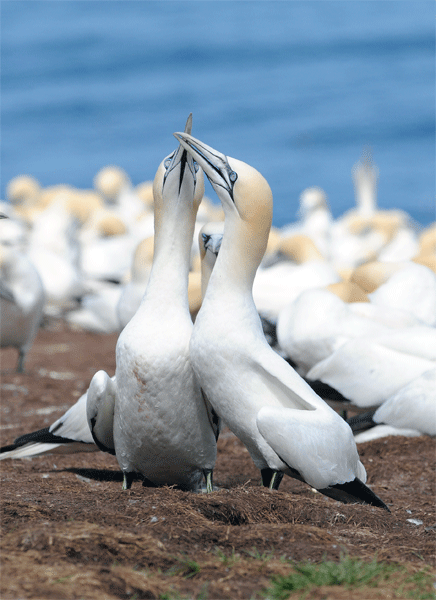
Northern Gannet pair bonding behavior
     Northern Gannet  • Morus bassanus – Bonaventure Island, Quebec, Canada:  My first trip to Bonaventure Island off the Gaspe’ Peninsula of Quebec, Canada was in 1983. My visit was prompted by a book by George Harrison titled Roger Tory Peterson’s Favorite Birding Hotspots. I was stunned by the number of birds I saw, which at the time numbered 35,000 pairs. In 1984 while visiting with RTP in his studio I showed him slides from that trip. When I told him that 35,000 pairs of Gannets nested on the island. He seemed surprised and told me the story of when he had visited the island in the early 60’s. At that time he told me, only 15,000 pair of Gannet nest on the island. Roger was pleased to here that the birds had increased and told me he would like to return and see the colony again. I’m not sure if he made it back, but if he did he would have had a great time shooting photos.
I returned to Bonaventure again in the summer of 2003 and the number had increased to 55,000 pairs of birds. Now, on my recent trip this summer I discovered that the number of Gannets has grown to more than 65,000 pair of birds. It’s hard to imagine the scene and the photos here do not give justice to the number of birds on the island. The Gannets nest on the ocean side of the island, and the rookery stretches at least three-quarters of a mile. The two group photos shown here, stretches only a quarter of a mile or less. The air is constantly filled with Gannets and the noise of the squawking birds is deafening. Yet worse, and depending on the direction of the wind, the smell can be stifling.
The trip to the island takes only about 15 minutes if you take the direct boat from the mainland, but the walk over the island to the rookery takes about 45 minutes (according to the park service personal). It took me an hour and fifteen minutes with a fifty pound camera pack on my back and carrying an eight pound tripod to cross the island. It seems that the entire trip was up hill. The funny thing about this is that, the return trip seemed uphill as well. At one point I thought I was in an Escher drawing!
My first day out was a bust. I landed. Then walked across (1 1/4 hour trip) the island. When I arrived at the rookery the ranger told me I would have to go back to the dock (on the other side of the island) because the island was being closed due to high waves. So it was back across the island to return to the mainland.
The next day I was back on the island. It was a beautiful day and I shot tons of photos. The colony was unbelievable and is a must see for anyone interested in birds. I can truly see why Roger Tory Peterson called it one of his favorite birding hotspots. It is certainly one of mine!

Additonal Pic for July 12


Pronghorn Antelope

Pic of the Day


Pronghorn Antelope – Wyoming: While driving from Yellowstone to New York I drove across Wyoming on US 26. It was one of the most beautiful stretches of highway I have ever driven. Wildflowers were in bloom and the grasslands were covered with blue lupine. Pronghorn Antelope were ever present. As I was driving down the road I found this pronghorn close to the road. Most pronghorn ran away immediately when I stopped the van, but this one lingered giving me the opportunity to shoot a few images. I also saw Golden Eagle, Mule Deer and various species of perching birds on the route.
Nikon D300, Nikkor 500mm f4, Digital Capture, ISO 200

Sunday, July 11, 2010

Pic of the Day


   Teton/Snake River – Teton National Park, WY: I love black-and-white photography. Like most people my age I got my start in photography doing black-and-white. While I love shooting black-and-white film this image was a digital capture. I admit I am no Ansel Adams, but when I travel to a location where he has shot one of his famous images I am compelled to shoot from the same location. On my recent trip to Teton National Park I stopped at the location where Ansel Adams shot his famous Teton image. Not knowing the exact spot where Adams shot his image I positioned myself with a point-of-view similar to that of Adams. My original digital capture was made in color, then converted to black-and-white. From that point I used the curves feature of photoshop to adjust the contrast of the sky and mountains. Wish I had taken my film camera!
Nikon D3, Nikkor 24-50mm zoom set to 32mm, Digital Capture, ISO 200, Converted to Black-and-White